Blog Post
What Is a GMDSS Radio Survey? Requirements, Procedure & Inspection Checklist for Ships
Posted By: Harsh Bamnolia
Posted On : 18-Aug-2026
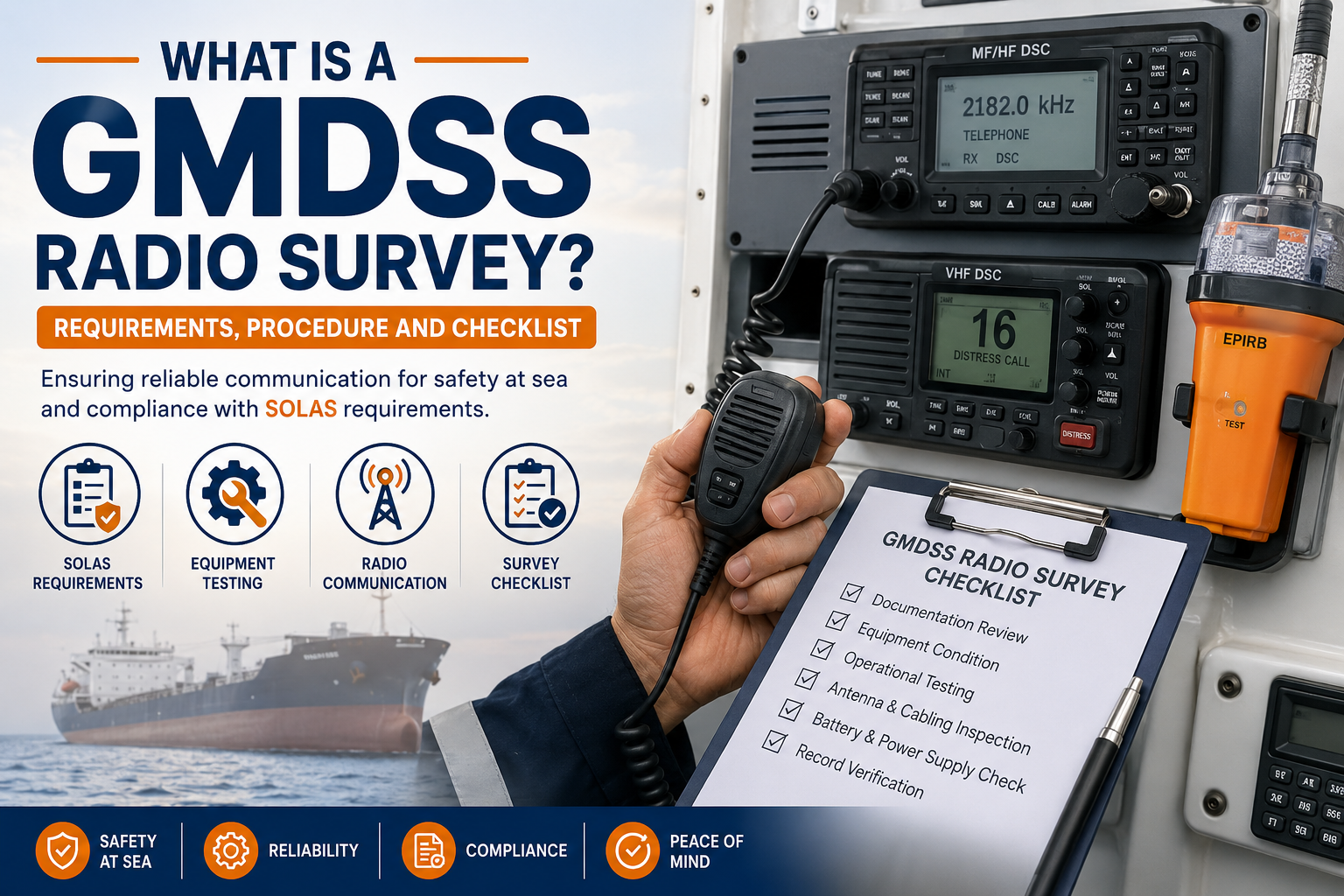
What Is a GMDSS Radio Survey? Requirements, Procedure and Checklist
Introduction
The Global Maritime Distress and Safety System (GMDSS)
is a critical part of a vessel's safety and communication arrangements. It
enables ships to transmit distress alerts, receive maritime safety information
and communicate during emergencies.
A GMDSS Radio Survey is carried out to verify that
the vessel's required radio communication equipment and associated systems are
properly installed, operational, maintained and supported by appropriate
documentation.
For shipowners, ship managers, Masters, Chief Engineers and
technical superintendents, understanding the GMDSS survey process is important
for maintaining vessel readiness and meeting applicable statutory requirements.
This guide explains what a GMDSS Radio Survey is, the
applicable requirements, equipment normally checked, survey procedure,
documentation and a practical GMDSS inspection checklist.
What Is a GMDSS Radio Survey?
A GMDSS Radio Survey is an inspection and testing
process used to verify the condition and operational performance of a vessel's
GMDSS radio communication and associated safety equipment.
Depending on the vessel's installation and applicable
requirements, the survey can include checks of:
- VHF
radio and DSC
- MF/HF
radio and DSC
- Inmarsat-C
- EPIRB
- SART
or AIS-SART
- NAVTEX
- Portable
GMDSS VHF radios
- GMDSS
reserve batteries
- Antennas
and cables
- Power
supplies
- Equipment
installation
- Operational
performance
- Maintenance
records
- Certificates
and documentation
A GMDSS survey should not be considered only a visual
inspection. Applicable equipment needs to be tested using appropriate
procedures and suitable test equipment, with the results documented as
required.
The exact scope depends on the vessel's type, size, voyage
area, GMDSS installation, statutory certificates, flag administration
requirements and recognized organization or class requirements.
Why Is a GMDSS Radio Survey Important?
Reliable communication is essential when a vessel faces an
emergency at sea.
A properly maintained GMDSS installation helps ensure that
the vessel can communicate effectively and use its distress and safety systems
when required.
1. Distress Alerting
GMDSS equipment provides designated means for transmitting
distress alerts to maritime search and rescue authorities and other vessels.
2. Maritime Safety Information
Ships need reliable access to navigational and maritime
safety information relevant to their voyage.
3. Emergency Communication
GMDSS equipment provides different communication methods
that can be used according to the vessel's operational area and emergency
situation.
4. Regulatory Compliance
GMDSS installations are subject to international, flag-state
and applicable statutory requirements. Regular surveys help verify that the
equipment remains in the required condition.
5. Early Detection of Deficiencies
Regular inspection and testing can identify problems such
as:
- Expired
batteries
- Defective
radio equipment
- Damaged
antennas
- Faulty
cables
- Power
supply problems
- DSC
faults
- Incomplete
maintenance records
Identifying these issues before an emergency or statutory
inspection can significantly improve vessel readiness.
GMDSS Requirements Under SOLAS Chapter IV
The principal international requirements for GMDSS are
contained in SOLAS Chapter IV – Radiocommunications.
The requirements address areas including:
- Radio
installations
- Availability
of radio equipment
- Sources
of electrical power
- Reserve
power arrangements
- Equipment
performance
- Maintenance
arrangements
- Radio
personnel
- Operational
procedures
- Radio
records
The specific GMDSS equipment required depends on the vessel
and its applicable sea area and regulatory requirements.
Therefore, shipowners and managers should always verify the
vessel-specific requirements against the applicable SOLAS provisions,
flag-state requirements, statutory certificates and recognized
organization/class requirements.
What Equipment Is Checked During a GMDSS Radio Survey?
The exact equipment covered depends on the vessel's GMDSS
installation. Common equipment includes the following.
1. VHF Radio and DSC
VHF is one of the most important short-range communication
systems onboard.
Checks may include:
- Transmit
operation
- Receive
operation
- Audio
quality
- DSC
functionality
- Channel
operation
- Controls
and displays
- Antenna
condition
- Power
supply
- General
physical condition
2. MF/HF Radio and DSC
Where fitted and applicable, MF/HF equipment may be checked
for:
- Transmitting
performance
- Receiving
performance
- DSC
operation
- Distress
communication functions
- Antenna
system
- Controls
and displays
- Power
supply
- Equipment
condition
3. Inmarsat-C
The Inmarsat-C terminal may be checked for its applicable
operational and communication functions.
Inspection can include:
- Terminal
condition
- Antenna
- Power
supply
- Communication
functions
- Safety-related
functions
- Printer
or associated equipment where applicable
4. EPIRB
The Emergency Position-Indicating Radio Beacon (EPIRB)
is an important distress-alerting device.
Checks may include:
- Physical
condition
- Self-test
function
- Battery
validity
- Hydrostatic
release arrangement where applicable
- Mounting
arrangement
- Identification
information
- Registration
information
The EPIRB should remain accessible and properly maintained
according to the applicable requirements and manufacturer's instructions.
5. SART / AIS-SART
Search and Rescue Transponder equipment may be checked for:
- Physical
condition
- Battery
validity
- Self-test
function
- Indicators
- Controls
- Mounting
arrangement
- Accessibility
- General
operational condition
6. NAVTEX
Where fitted and applicable, NAVTEX equipment may be
inspected for:
- Reception
- Display
- Printer
operation where fitted
- Antenna
- Power
supply
- General
condition
NAVTEX plays an important role in receiving relevant
maritime safety information.
7. Portable GMDSS VHF
Portable two-way VHF equipment may be checked for:
- Required
quantity
- Physical
condition
- Transmit
and receive functions
- Battery
condition
- Battery
expiry
- Charger
condition
- Accessories
- Proper
stowage
8. GMDSS Reserve Power and Batteries
Reserve power is an important component of the GMDSS
installation.
The survey may include checks of:
- Battery
condition
- Battery
capacity
- Battery
expiry
- Charging
arrangements
- Electrical
connections
- Emergency
power availability
- Maintenance
and test records
The specific testing method should follow the applicable
requirements and manufacturer's instructions.
GMDSS Radio Survey Procedure
The exact procedure may vary depending on the vessel, survey
authority, flag administration, recognized organization and equipment
installed.
A typical GMDSS Radio Survey can involve the following
stages.
Step 1: Review Vessel Documentation
The surveyor reviews relevant documentation and identifies
the vessel's GMDSS installation and applicable requirements.
Documents may include:
- Statutory
certificates
- Radio
licence
- Previous
survey reports
- Equipment
certificates
- Maintenance
records
- Battery
records
- Service
reports
- Equipment
manuals
Step 2: Verify GMDSS Equipment Inventory
The surveyor identifies the GMDSS equipment installed
onboard and verifies that the equipment corresponds with the vessel's required
arrangements.
This can include checking equipment model, serial number,
location and general condition.
Step 3: Visual Inspection
The equipment and installation are visually examined for:
- Physical
damage
- Corrosion
- Loose
connections
- Damaged
cables
- Poor
mounting
- Water
ingress
- Incorrect
installation
- Missing
labels
- Accessibility
problems
Step 4: Operational Testing
Applicable GMDSS equipment is operated and tested to verify
its functions.
Depending on the equipment, checks may include:
- Transmit
functions
- Receive
functions
- DSC
functions
- Distress-related
functions
- Communication
functions
- Self-test
functions
- Displays
and alarms
Step 5: Antenna and Cable Inspection
Antennas, feeders, cables and associated connections are
examined for obvious deterioration, damage, corrosion or installation problems.
Poor antenna or cable condition can affect communication
performance even when the radio unit itself appears operational.
Step 6: Battery and Power Supply Checks
Reserve batteries and associated power supplies are
inspected and tested as applicable.
Particular attention should be given to:
- Battery
condition
- Expiry
dates
- Charging
arrangements
- Connections
- Test
records
Step 7: Review GMDSS Records
Relevant maintenance and operational records are checked to
confirm that required testing and maintenance have been carried out.
Proper documentation also helps demonstrate that the
vessel's GMDSS equipment is being maintained systematically.
Step 8: Record Deficiencies
Any deficiencies identified during the inspection should be
documented and addressed according to the applicable requirements.
Examples may include equipment faults, expired batteries,
damaged cables or missing documentation.
Step 9: Completion of Survey Documentation
Once the applicable survey requirements have been
satisfactorily completed, the relevant survey documentation is completed by the
authorized surveyor or organization.
GMDSS Radio Survey Checklist
The following checklist can be used by ship operators as a pre-survey
preparation checklist.
Documentation Checklist
- GMDSS
equipment inventory available
- Relevant
statutory certificates available
- Radio
licence available
- Previous
survey reports available
- Equipment
manuals available
- Maintenance
records updated
- Battery
records available
- Service
reports/certificates available
VHF / DSC Checklist
- VHF
transmit function checked
- VHF
receive function checked
- DSC
function checked where applicable
- Controls
and displays operational
- Antenna
condition checked
- Cabling
checked
- Power
supply checked
MF/HF Checklist
- Transmit
function checked
- Receive
function checked
- DSC
checked
- Antenna
system inspected
- Power
supply checked
- Controls
and displays checked
Inmarsat-C Checklist
- Terminal
operational
- Antenna
checked
- Power
supply checked
- Relevant
communication functions tested
- Associated
equipment checked
EPIRB Checklist
- Physical
condition satisfactory
- Self-test
completed
- Battery
validity checked
- Hydrostatic
release arrangement checked where applicable
- Identification
details verified
- Registration
information checked
SART / AIS-SART Checklist
- Physical
condition checked
- Battery
expiry checked
- Self-test
completed
- Mounting/stowage
checked
- Operational
condition verified
NAVTEX Checklist
- Receiver
operational
- Display
operational
- Printer
checked where fitted
- Antenna
checked
- Power
supply checked
Portable VHF Checklist
- Required
equipment available
- Batteries
checked
- Battery
expiry verified
- Transmit/receive
operation checked
- Chargers
checked
- Equipment
properly stowed
GMDSS Battery Checklist
- Battery
condition inspected
- Expiry
date checked
- Charging
arrangement checked
- Connections
inspected
- Required
tests completed
- Records
maintained
Common Deficiencies Found During GMDSS Surveys
Several deficiencies can be identified during GMDSS surveys
and inspections.
1. Expired Batteries
EPIRB, SART, portable VHF and reserve power batteries need
proper monitoring and replacement when due.
2. Damaged Antennas
Corroded, damaged or poorly maintained antennas can affect
radio communication performance.
3. Faulty DSC Functions
Deficiencies in DSC functions can affect the vessel's
distress communication capability.
4. Damaged Cables and Connections
Loose, corroded or damaged connections can result in
unreliable equipment performance.
5. Incomplete Maintenance Records
Missing or incomplete records can make it difficult to
demonstrate that required inspections and maintenance have been performed.
6. Equipment Not Properly Maintained
A radio may appear operational during a basic check but
still have technical deficiencies that become evident during detailed testing.
How to Prepare Your Vessel for a GMDSS Radio Survey
Proper preparation can help reduce avoidable delays during
the survey.
Before the survey, the ship's responsible personnel should:
- Review
the previous GMDSS survey report.
- Check
all GMDSS equipment for visible defects.
- Verify
battery expiry dates.
- Confirm
required maintenance has been completed.
- Test
applicable radio equipment.
- Inspect
antennas and cables.
- Review
GMDSS logbooks and records.
- Keep
certificates and service reports available.
- Ensure
equipment is accessible for inspection.
- Rectify
known deficiencies before the survey where possible.
GMDSS Radio Survey and Port State Control
GMDSS equipment and documentation may receive attention
during vessel inspections and Port State Control (PSC) examinations.
A vessel should maintain its GMDSS equipment in the required
operational condition and keep relevant supporting documentation properly
organized.
Problems such as:
- Expired
batteries
- Defective
radio equipment
- Damaged
antennas
- Faulty
communication systems
- Missing
records
can create unnecessary compliance issues.
Regular maintenance and pre-survey inspections can help ship
operators identify deficiencies before statutory surveys or port inspections.
Why Professional GMDSS Inspection Matters
GMDSS equipment is safety-critical equipment. Inspection and
testing should be performed by competent personnel using appropriate procedures
and suitable test equipment.
A professional marine GMDSS service provider can assist
with:
- GMDSS
equipment inspection
- Radio
performance testing
- Functional
testing
- Battery
inspection
- Fault
identification
- Preventive
maintenance
- Equipment
servicing
- Documentation
- Pre-survey
inspection
- GMDSS
survey support
The exact scope of service should always be aligned with the
vessel's applicable statutory, flag-state and recognized organization
requirements.
GMDSS Radio Survey Services in India
Shipowners and managers operating vessels through Indian
ports require reliable access to marine radio inspection and servicing support.
GMDSS service support can be planned around major maritime
locations including:
Mumbai | Mundra | Kandla | Hazira | Surat | Sikka |
Jamnagar | Chennai | Vizag | Paradip
Marinetech Safety Pvt. Ltd. provides marine safety,
communication and navigation equipment servicing support for shipowners, ship
managers and vessel operators.
Our GMDSS-related services can support inspection, testing,
maintenance and pre-survey preparation requirements, depending on the vessel
and scope of work.
Frequently Asked Questions
1. What is a GMDSS Radio Survey?
A GMDSS Radio Survey is an inspection and testing process
used to verify that a vessel's applicable GMDSS equipment, associated systems
and supporting documentation meet the relevant requirements.
2. How often is a GMDSS Radio Survey required?
The applicable survey interval depends on the vessel's
statutory survey regime and the requirements of the relevant flag
administration or recognized organization. Ship operators should follow the
vessel's statutory survey schedule.
3. What equipment is checked during a GMDSS survey?
Depending on the vessel, the survey may cover VHF/DSC,
MF/HF, Inmarsat-C, EPIRB, SART or AIS-SART, NAVTEX, portable VHF equipment,
reserve batteries, antennas and associated systems.
4. Is GMDSS equipment tested during the survey?
Yes. Applicable equipment is generally subject to
operational and/or performance checks appropriate to the equipment and
applicable survey requirements.
5. What documents are required for a GMDSS survey?
Relevant statutory certificates, radio licence, equipment
records, maintenance records, previous survey reports, battery records and
applicable equipment documentation may be required.
6. What are common GMDSS survey deficiencies?
Common issues can include expired batteries, equipment
faults, damaged antennas or cables, DSC problems, poor maintenance and
incomplete records.
7. Can GMDSS inspection be arranged at Indian ports?
GMDSS service and inspection support can be arranged
depending on the vessel's location, scope of work and applicable survey
authority or organization.
Conclusion
A GMDSS Radio Survey is more than a routine
inspection. It is an important part of maintaining the reliability of a
vessel's distress, safety and communication systems.
By regularly checking GMDSS equipment, batteries,
antennas, power supplies, documentation and maintenance records, shipowners
and managers can identify deficiencies early and keep their vessels prepared
for applicable statutory surveys and inspections.
Professional GMDSS inspection and servicing support can help
ship operators maintain their communication systems in reliable operating
condition and prepare their vessels for applicable survey requirements.
Need GMDSS Radio Survey & Inspection Support?
Marinetech Safety Pvt. Ltd.
Phone: +91-8866475732 | +91-72270 38216
Email: info@marinetechss.com
Request a Free QuoteContact our team for GMDSS Radio Survey, inspection,testing, servicing and marine communication equipment support.
Related Blogs
1. IMO MSC.1/Circ.1318/Rev.1 Explained: Complete Guide toFixed CO2 Fire Extinguishing System Inspection (2026)
SEO Keywords: fire fighting equipment, ship fire
fighting system, IMO MSC.1/Circ.1318/Rev.1, Fixed CO2 System, Fixed CO2 Fire
Extinguishing System, CO2 System Inspection, CO2 System Maintenance, CO2 Fire
Suppression System, Marine Fire Safety, Marine Safety, SOLAS Compliance, SOLAS
Chapter II-2
2. Marine Navigation & Communication EquipmentSupplier in India: Complete Guide for Ship Managers
SEO Keywords: AIS transponder supplier India, ECDIS
supplier India, VHF radio ship India, Inmarsat terminal supplier India, navcom
equipment India, marine radar supplier India
3. Life Saving Equipment for Ships: What SOLAS Requires& What Marinetech Supplies
SEO Keywords: life saving equipment ship India, LSE
supplier India, lifejacket supplier India, immersion suit supplier India, EPIRB
supplier India, SART supplier India, SOLAS life saving equipment India
Read More:
https://marinetechss.com/blog/life-saving-equipment-ships-solas-requirements
4. Fire Fighting Equipment on Ships: What SOLAS Requires& What Marinetech Supplies
SEO Keywords: fire fighting equipment ship India,
SOLAS fire fighting equipment requirements, marine fire fighting equipment
supplier India, fireman outfit supplier India, SCBA supplier India, fire
extinguisher ship India
5. Fire Fighting Appliances Service in India 2026:Complete Guide
SEO Keywords: fire fighting appliances service India
2026, LSA FFA inspection India, fire fighting equipment service ship India,
marine fire safety India, SOLAS fire fighting requirements, DG Shipping
approved fire fighting service India
Read More:
https://marinetechss.com/blog/fire-fighting-appliances-service-india-2026
Contact Marinetech Safety Pvt. Ltd.
Marine Safety | GMDSS | NAVCOM | LSA | FFA | Calibration | Marine Equipment Services
Phone: +91-8866475732 | +91-72270 38216
Email: info@marinetechss.com
Request a Free Quote for your vessel's GMDSS RadioSurvey, Inspection or Service.