Blog Post
IMO MSC.1/Circ.1318/Rev.1 Explained: Complete Guide to Fixed CO2 Fire Extinguishing System Inspection (2026)
Posted By: Harsh Bamnolia
Posted On : 31-Jul-2026
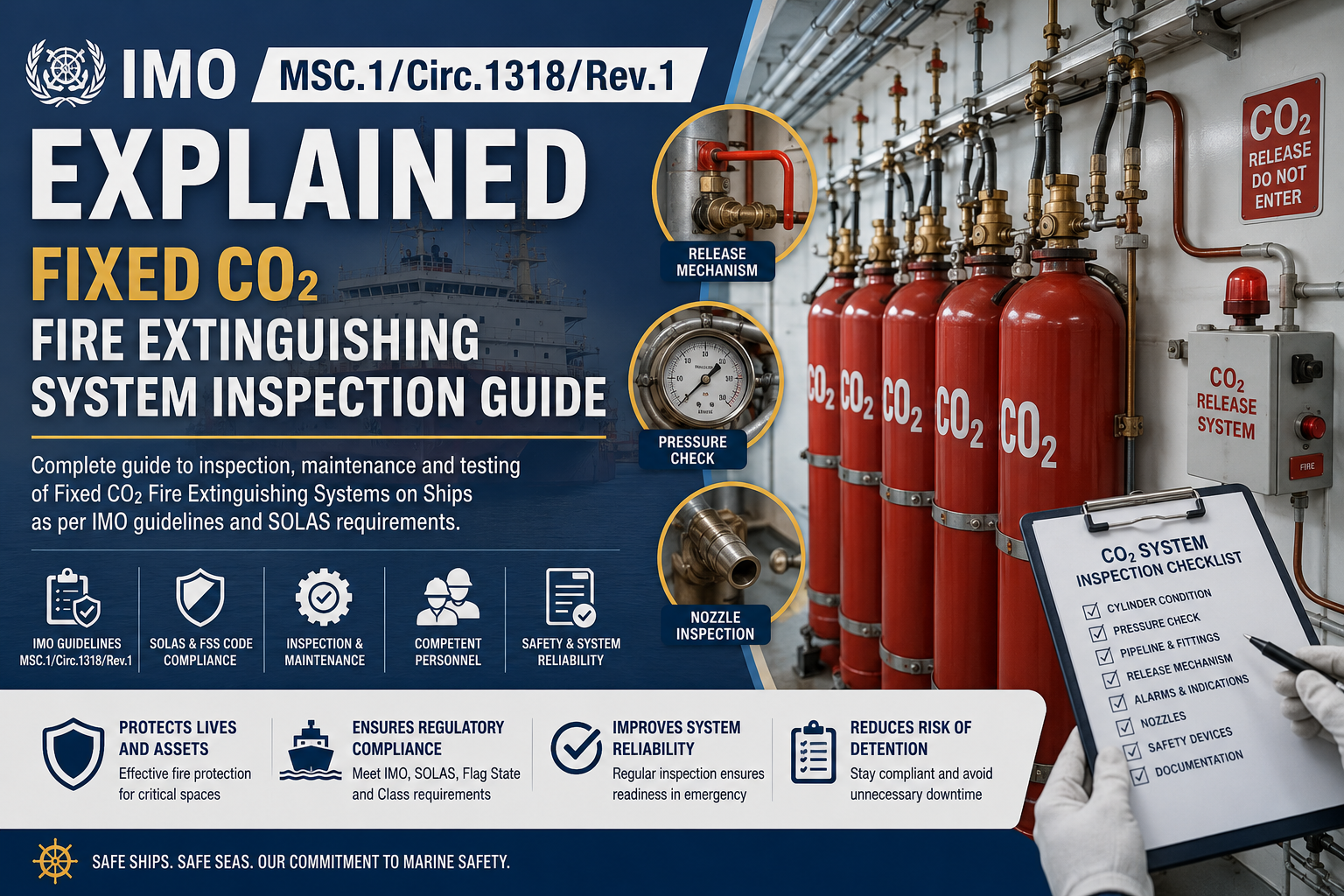
IMO MSC.1/Circ.1318/Rev.1 Explained: Complete Guide to Fixed CO2 Fire Extinguishing System Inspection
Fire remains one of the most
significant hazards on board a ship, especially in machinery spaces, engine
rooms, cargo pump rooms, and enclosed spaces where combustible materials and
high temperatures coexist. A properly maintained Fixed Carbon Dioxide (CO2)
Fire Extinguishing System is one of the most effective methods for suppressing
fires without causing damage to electrical equipment or machinery.
To ensure these systems remain
reliable throughout their operational life, the International Maritime
Organization (IMO) published MSC.1/Circ.1318, later revised
as MSC.1/Circ.1318/Rev.1, providing comprehensive guidelines for
the maintenance, testing, inspection, and servicing of fixed CO2 fire
extinguishing systems installed on ships.
This guide explains everything ship
owners, operators, superintendents, and marine engineers need to know about the
circular, inspection requirements, servicing schedules, and industry best
practices.
What is IMO MSC.1/Circ.1318/Rev.1?
IMO MSC.1/Circ.1318/Rev.1 is an
International Maritime Organization circular that provides detailed
recommendations for the maintenance, inspection, testing, operational
readiness, and servicing of fixed gas fire-extinguishing systems, including
carbon dioxide (CO2) systems installed on ships.
The circular was developed because
many fire suppression systems were found to have hidden defects due to
inadequate maintenance or improper servicing. Since these systems are rarely
activated during normal ship operations, periodic inspections are essential to
verify that they will operate correctly in an emergency.
The guidance complements the
requirements of SOLAS and is widely followed by classification societies, flag
administrations, and recognized organizations during surveys.
Why is a Fixed CO2 System So Important?
A Fixed CO2 Fire Extinguishing
System protects high-risk spaces where conventional firefighting methods may be
ineffective or dangerous.
Typical protected spaces include:
- Engine rooms
- Generator rooms
- Cargo pump rooms
- Paint lockers
- Incinerator spaces
- Machinery spaces
- Fuel treatment rooms
- Cargo compressor rooms
- Large enclosed machinery spaces
When activated, CO2 rapidly reduces
the oxygen concentration in the protected space, extinguishing the fire without
leaving residue or damaging sensitive equipment.
Applicable SOLAS Regulations
The maintenance and inspection of
Fixed CO2 Systems are governed by several IMO instruments, including:
- SOLAS Chapter II-2 – Fire Protection, Fire
Detection and Fire Extinction
- FSS Code (International Code for Fire Safety
Systems)
- IMO MSC.1/Circ.1318/Rev.1
- Manufacturer's maintenance instructions
- Flag State requirements
- Classification Society survey requirements
Compliance with all applicable
requirements helps ensure that the fire suppression system remains fully
operational throughout the vessel's service life.
Components of a Fixed CO2 Fire Extinguishing System
A typical marine Fixed CO2 System
consists of:
- CO2 cylinders
- Cylinder valves
- Pilot cylinders
- Manual release cabinet
- Pneumatic release system
- Time delay unit
- Distribution manifold
- Selector valves
- Main distribution piping
- Nozzles
- Pressure gauges
- Flexible hoses
- Safety pins
- Warning alarms
- Release controls
- Locking arrangements
- Control panel
- Release cables
- Operating instructions
- Safety signage
Every component must be inspected
periodically to verify its readiness.
Inspection Schedule Under IMO MSC.1/Circ.1318/Rev.1
Annual Inspection
Annual inspections should be
carried out by qualified personnel familiar with the system in
accordance with the manufacturer's instructions and applicable regulatory
requirements.
Typical activities include:
- Visual inspection of all cylinders
- Verification of cylinder pressure or weight
- Inspection for corrosion
- Inspection of flexible hoses
- Inspection of release mechanisms
- Functional testing of alarms
- Inspection of valves
- Inspection of manifolds
- Inspection of distribution piping
- Verification of selector valves
- Inspection of nozzles
- Inspection of operating cables
- Verification of warning systems
- Examination of safety devices
- Operational checks (without releasing CO2)
Two-Year Inspection
Depending on system design and
manufacturer recommendations:
- Flexible hose inspection
- Control equipment inspection
- Pneumatic line testing
- Pilot cylinder examination
Operating mechanism verification
Five-Year Inspection
A more detailed inspection
generally includes:
- Internal inspection of selected cylinders (where
applicable)
- Hydrostatic testing of flexible hoses, if required
by the manufacturer or regulations
- Inspection of valve assemblies
- Comprehensive examination of release mechanisms
Distribution piping inspection
Ten-Year Inspection
At intervals specified by
regulations and the manufacturer:
- Hydrostatic testing of CO2 cylinders (where
required)
- Cylinder valve overhaul
- Replacement of aging components
- Flexible hose replacement (if applicable)
- System integrity verification
Always follow the manufacturer's
maintenance manual and the requirements of the flag administration or
classification society.
What Does a Competent Inspection Include?
A thorough inspection should
verify:
Cylinder quantity
Cylinder identification
Filling ratio
Cylinder weight
Pressure condition
Valve operation
Flexible hose condition
Pipe integrity
Corrosion
Leakage
Warning alarms
Control system
Release cabinet
Safety locking devices
Time delay operation
Selector valves
Manual release mechanism
Pneumatic release mechanism
Safety notices
Room ventilation
Operating instructions
Benefits of Regular Fixed CO2 System Inspection
Routine inspection provides several
benefits:
- Improved crew safety
- Reliable fire protection
- Regulatory compliance
- Reduced equipment failure
- Increased vessel availability
- Lower risk of detention
- Better insurance confidence
- Enhanced operational readiness
- Protection of critical machinery
- Reduced repair costs following fire incidents
Frequently Asked Questions (FAQ)
1) Is a Fixed CO2 System inspection mandatory?
Yes. Fixed CO2 systems must be
maintained and inspected in accordance with SOLAS requirements, the FSS Code,
the manufacturer's instructions, and applicable flag or class requirements.
2) What is IMO MSC.1/Circ.1318/Rev.1?
It is an IMO circular that provides
detailed guidance for the maintenance, inspection, testing, operational
readiness, and servicing of fixed gas fire-extinguishing systems installed on
ships.
3) How often should a Fixed CO2 System be inspected?
The guidance includes monthly
checks, annual inspections, and periodic detailed examinations at longer
intervals, depending on the component, manufacturer recommendations, and
regulatory requirements.
4) Why is cylinder weighing important?
Cylinder weight helps verify that
the correct amount of CO2 is available. Significant loss of contents can reduce
the effectiveness of the system.
5) Can ship crew perform annual servicing?
Routine visual checks may be
performed by trained crew, but annual servicing and more detailed inspections
should be carried out by qualified personnel in accordance with applicable
requirements and manufacturer instructions.
Conclusion
A Fixed CO2 Fire Extinguishing
System is one of the most critical life-saving systems on board a vessel.
However, its effectiveness depends entirely on proper inspection, maintenance,
and testing.
By following the guidance in IMO
MSC.1/Circ.1318/Rev.1, together with SOLAS, the FSS Code, manufacturer
instructions, and applicable flag and class requirements, ship owners and
operators can help ensure their systems remain reliable when they are needed
most.
Regular inspections not only
support compliance but also enhance crew safety, protect valuable assets, and
reduce the risk of costly operational disruptions.
Ensure Your Fixed CO2 Fire Extinguishing System Is Ready When It Matters Most
A Fixed CO2 Fire Extinguishing
System is one of the most critical fire protection systems on board any vessel.
Regular inspections, testing, and maintenance in accordance with IMO
MSC.1/Circ.1318/Rev.1, SOLAS, and the FSS Code help
ensure compliance while protecting your crew, vessel, and cargo.
At Marinetech Safety PVT. LTD. our
experienced marine safety engineers provide professional inspection, servicing,
testing, and certification of Fixed CO2 Fire Extinguishing Systems for vessels
worldwide.
Contact our team today to
schedule your annual inspection, request a service quotation, or discuss your
vessel's compliance requirements.
Phone : +91-8866475732 |
+91-72270 38216
Email : info@marinetechss.com
Request a
Free Quote
Related Blogs
1. Marine Navigation & Communication Equipment Supplier in
India: Complete Guide for Ship Managers
AIS transponder supplier India,
ECDIS supplier India, VHF radio ship India, Inmarsat terminal supplier India,
navcom equipment India, marine radar supplier India
2.Life Saving Equipment for Ships: What SOLAS Requires & What
Marinetech Supplies
life saving equipment ship India,
LSE supplier India, lifejacket supplier India, immersion suit supplier India,
EPIRB supplier India, SART supplier India, SOLAS life saving equipment India
3. Fire Fighting Equipment on Ships: What SOLAS Requires &
What Marinetech Supplies
fire fighting equipment ship India,
SOLAS fire fighting equipment requirements, marine fire fighting equipment
supplier India, fireman outfit supplier India, SCBA supplier India, fire
extinguisher ship India
4.Fire Fighting Appliances Service in India 2026: Complete Guide
fire fighting appliances service
India 2026, LSA FFA inspection India, fire fighting equipment service ship
India, marine fire safety India, SOLAS fire fighting requirements, DG Shipping
approved fire fighting service India