Blog Post
Life Saving Equipment for Ships: What SOLAS Requires & What Marinetech Supplies
Posted By: Harsh Bamnolia
Posted On : 20-May-2026
Life Saving Equipment for Ships: What SOLAS Requires & What Marinetech Supplies
Life saving equipment on a ship is not a single item — it is an entire system of individual components, each with a specific SOLAS requirement, a specific carriage quantity, a specific maintenance interval, and a specific consequence if it is missing, expired, or non-compliant when a PSC officer steps on board.
For procurement managers, ship managers, and superintendents, translating SOLAS Chapter III and the LSA Code into a practical purchasing list requires clarity on what each item is, what quantity is required, what standard it must meet, and where to source it from a supplier whose products will pass a class society survey and a PSC inspection without question. Getting this wrong — sourcing non-type-approved equipment, carrying insufficient quantities, or allowing items to expire without replacement — generates LSA deficiency findings that are entirely avoidable.
This guide sets out what SOLAS requires for each category of life saving equipment on ships, and what Marinetech Safety & Shipping Corporation supplies to vessels across India's major ports to meet those requirements.
Lifejackets: Carriage Requirements and Specification
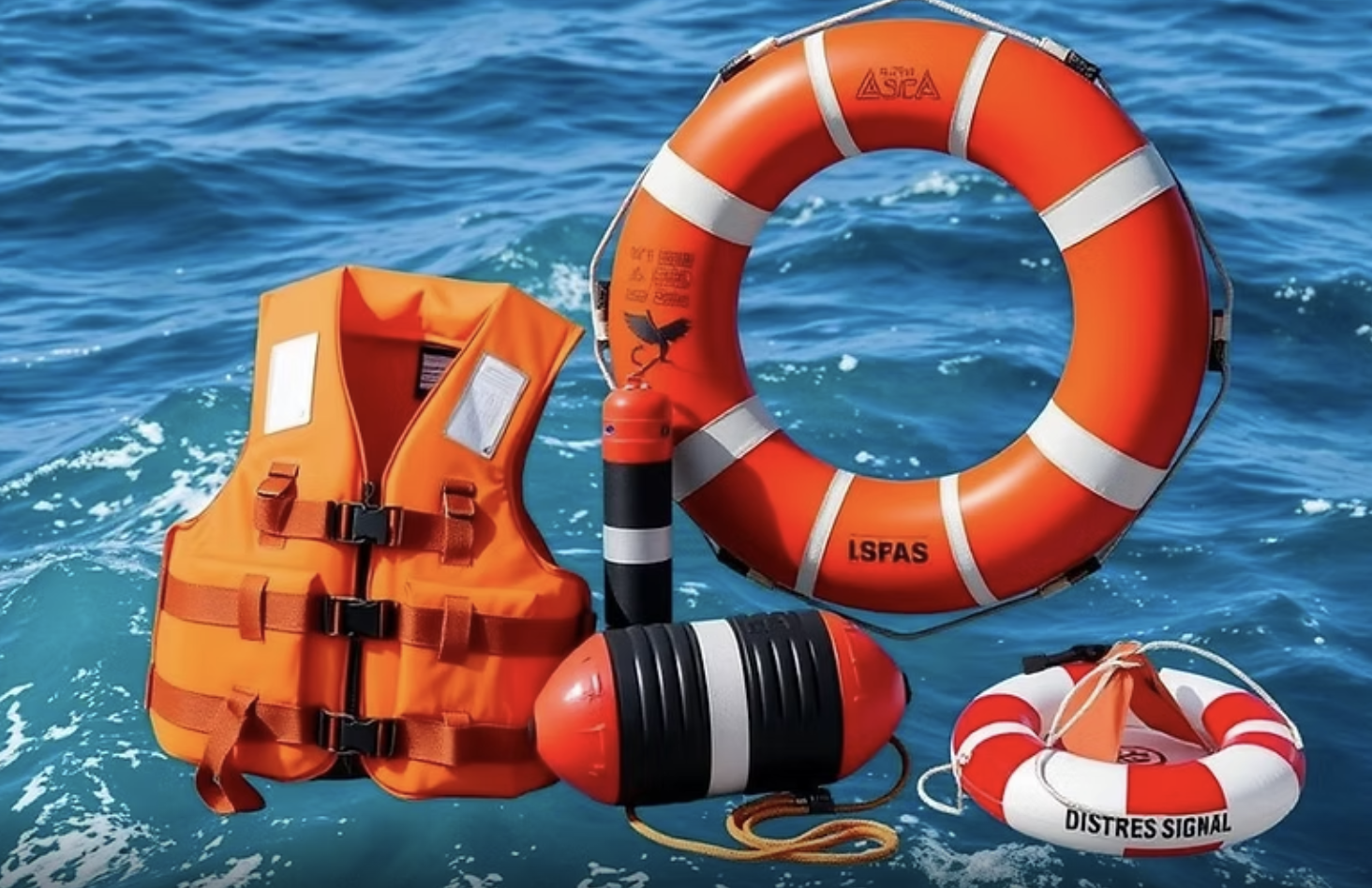
Lifejackets are the most fundamental piece of personal life saving equipment on any SOLAS vessel. SOLAS Regulation III/7 requires a lifejacket for every person on board, stowed in an easily accessible location. In addition, a number of lifejackets — typically not less than 5% of the total number on board — must be stowed in conspicuously marked locations on deck for persons who may be working away from the accommodation.
SOLAS distinguishes between lifejackets for adults and children. Where children are carried on board — on passenger ships and some offshore vessels — lifejackets sized for children must be provided in proportion to the number of children carried.
The lifejacket must be designed and approved to provide a minimum buoyancy of 150 newtons for adult lifejackets, capable of turning an unconscious person face-up in the water within 5 seconds, and maintaining that position with the wearer's face clear of the water at an angle of not more than 50 degrees from vertical. The lifejacket must carry retro-reflective tape, a whistle, and a light meeting SOLAS specifications.
Inflatable lifejackets must be serviced annually. Foam-type lifejackets do not require annual inflation testing but must be inspected at each safety equipment survey for condition, buoyancy integrity, and completeness of accessories.
Marinetech supplies SOLAS-approved adult and child lifejackets from type-approved manufacturers, accepted by all major classification societies. We supply both foam-type and inflatable-type lifejackets depending on vessel requirements and trading area. View our life saving equipment supply range.
Immersion Suits: Carriage Requirements and Specification
SOLAS Regulation III/7 requires an immersion suit for every person on board vessels operating in cold water areas. The specific carriage requirement depends on the vessel type and trading area — cargo ships operating outside tropical zones must carry immersion suits for every person on board, while the requirement for vessels in tropical areas is modified based on water temperature data for the trading area.
An immersion suit must cover the entire body except the face, be capable of being donned without assistance in less than 2 minutes, and provide sufficient thermal insulation to limit the core body temperature drop of a person wearing it to not more than 1.5°C per hour in calm water at a water temperature of 5°C. The suit must be inherently buoyant — or capable of providing buoyancy with a separately attached lifejacket — and must allow the wearer to swim a short distance and climb a vertical ladder.
Immersion suits must be tested annually for air retention by inflating the suit through the mouthpiece and checking for leakage. Where the suit includes an inflatable chamber, the inflation and valve system must be tested. The suit must be inspected for deterioration of the neoprene or other outer material, condition of all zips and seals, and completeness of accessories including retro-reflective tape and hood.
Marinetech supplies immersion suits from type-approved manufacturers in a range of sizes and configurations for both cargo ship and offshore use, along with the annual pressure test service required to maintain compliance.
EPIRBs: Carriage Requirements and Specification
An Emergency Position Indicating Radio Beacon is a critical distress alerting device that — when activated manually or automatically on immersion — transmits a distress signal and the vessel's position to the COSPAS-SARSAT satellite network, triggering a search and rescue response. SOLAS Regulation IV/7 requires every SOLAS vessel to carry at least one float-free EPIRB capable of operating on 406 MHz.
The EPIRB must be stowed in a float-free bracket fitted with a hydrostatic release unit so that it floats free and activates automatically if the vessel sinks. The HRU must be replaced every 2 years. The EPIRB battery must be replaced before the expiry date printed on the battery — typically every 5 years for standard batteries. The EPIRB must be registered in the COSPAS-SARSAT international database with the current vessel name, flag state, and owner details. EPIRB registration must be updated every time these details change.
Every EPIRB must carry a current annual test record confirming its self-test function is operational and its battery and HRU are within their replacement dates. This record is checked by PSC officers at every LSA inspection — an EPIRB with an out-of-date registration, an expired battery, or an expired HRU is one of the most consistently cited LSA deficiency findings at Indian ports.
Marinetech supplies type-approved 406 MHz float-free EPIRBs from recognised manufacturers including ACR, McMurdo, Ocean Signal, and others. We also supply replacement batteries and HRUs, and can assist with COSPAS-SARSAT registration updates. View our navcom and GMDSS equipment supply range.
SARTs and AIS-SARTs: Carriage Requirements and Specification
A Search and Rescue Transponder responds to a vessel's 9 GHz radar signal by transmitting a pattern of 12 blips on the radar screen, enabling search and rescue aircraft and vessels to home in on a survival craft's position. SOLAS requires at least one SART on vessels of 500 GT and above, and at least two SARTs on passenger ships. The SART must be stored in an accessible location near the survival craft embarkation station and must be capable of being carried and operated in a liferaft.
An AIS-SART achieves the same purpose using a different technology — instead of responding to a radar signal, it transmits an AIS distress signal with the craft's GPS position, appearing as a target on AIS displays on all vessels and aircraft in range. AIS-SARTs are accepted as an alternative to radar SARTs subject to flag state approval and vessel type requirements.
SART and AIS-SART batteries must be replaced before the expiry date printed on the battery, typically every 5 years. The device must be tested annually and the test record retained on board.
Marinetech supplies type-approved radar SARTs and AIS-SARTs from recognised manufacturers and carries replacement batteries for all major brands in our stock at Indian ports.
Lifebuoys: Carriage Requirements and Specification
SOLAS Regulation III/7 requires a specific number of lifebuoys distributed around the deck perimeter of the vessel based on vessel length. A lifebuoy is a ring-shaped buoyancy aid that can be thrown to a person in the water to support them while they are recovered. The required number ranges from 8 lifebuoys for vessels under 60 metres in length to 30 or more for vessels over 300 metres.
Several of the required lifebuoys must be fitted with self-igniting lights that activate automatically on contact with water, and some must be fitted with self-activating smoke signals. A specific number must be fitted with buoyant lifelines of at least 30 metres in length. All lifebuoys must be stowed in brackets that allow immediate release by a single person, and must be positioned for ready deployment on both sides of the vessel.
The lights, smoke signals, and lifelines attached to lifebuoys must be within their SOLAS expiry dates — PSC officers check these individually. Lifebuoys themselves must be in good physical condition, clearly marked with the vessel name and port of registry, and retro-reflective tape must be intact and undamaged.
Marinetech supplies SOLAS-approved lifebuoys with self-igniting lights, smoke signals, and lifelines. We carry stock at all major Indian ports for immediate supply to vessels with expiry or condition deficiencies.
Thermal Protective Aids: Carriage Requirements
SOLAS requires thermal protective aids — insulating bags that cover the entire body except the face — to be provided in every survival craft for a proportion of the persons the craft is approved to carry. In lifeboats, the requirement is thermal protective aids for 10% of the persons or a minimum of 2, whichever is greater. In liferafts, the same proportional requirement applies.
Thermal protective aids are primarily intended for use in cold water where immersion suits are not carried — they provide a degree of thermal protection for persons in a survival craft who have already been exposed to cold water. They are single-use items that must be replaced after use or when they reach the end of their indicated service life.
PSC officers check that the required number of thermal protective aids is present in every survival craft during LSA inspections. Missing or insufficient quantities are a deficiency finding. Marinetech supplies SOLAS-approved thermal protective aids for immediate delivery at all major Indian ports.
Line Throwing Apparatus: Carriage Requirements
SOLAS Regulation III/18 requires every cargo ship of 500 GT and upward and every passenger ship to carry a line throwing apparatus capable of accurately throwing a line to a distance of at least 230 metres. The line throwing apparatus is used to establish a connection between the vessel and a shore installation, another vessel, or a rescue helicopter when direct contact is not possible.
The line throwing apparatus must meet SOLAS performance standards and carry a type approval certificate. Rocket-type line throwing apparatus must be checked for the expiry of the rockets — like all pyrotechnic devices, they have a mandatory SOLAS expiry date. The line itself must be inspected for condition and correct stowage.
Marinetech supplies SOLAS-approved rocket-type line throwing apparatus and replacement rockets for all major brands. View our pyrotechnics and distress signals supply range.
Muster Lists, Placards, and Safety Signs
Beyond the physical equipment, SOLAS requires every vessel to post a muster list in crew accommodation, the engine room, and on the bridge. The muster list must be current — reflecting the current crew complement and their individual emergency assignments. Out-of-date muster lists are a consistent PSC deficiency finding, particularly after crew changes.
Safety signs — including IMO safety symbols for lifejacket stowage locations, muster station locations, survival craft embarkation ladder positions, and fire extinguisher locations — must be posted at the correct positions throughout the vessel, be of the correct specification, and be in good condition. Faded, damaged, or missing IMO safety signs are a deficiency finding. Marinetech supplies the full range of IMO safety symbols and maritime signage to vessels across India.
Ordering Life Saving Equipment from Marinetech
Marinetech Safety & Shipping Corporation supplies the complete range of SOLAS-compliant life saving equipment to vessels at all major Indian ports — Mumbai, JNPT, Kandla, Mundra, Hazira, Dahej, Cochin, Goa, Chennai, Vizag, Kolkata, Haldia, and Paradip. Every item we supply carries type-approval documentation accepted by all major classification societies, ensuring no discrepancy between supplied equipment and the vessel's Safety Equipment Certificate.
To order, provide your vessel's name, IMO number, and Safety Equipment Certificate with its Record of Equipment. We will confirm which items are in stock for immediate supply at your port of call, provide pricing, and coordinate delivery to the berth with your vessel's agent. For urgent orders — vessels identified with a deficiency during a PSC inspection or pre-arrival check — contact us by phone for fastest response.
Supplies email: supply@marinetechss.com
Phone: +91-8866475732 | +91-72270 38216
View Our Life Saving Equipment Supply Range
Related reading: Certified Lifeboat Servicing in India 2026 | Liferaft Servicing in India 2026 | Fire Fighting Equipment on Ships: SOLAS Requirements | Top 10 PSC Deficiencies That Lead to Ship Detention