Blog Post
Liferaft Servicing in India 2026: Complete Guide for Ship Owners
Posted By: Harsh Bamnolia
Posted On : 18-Mar-2026
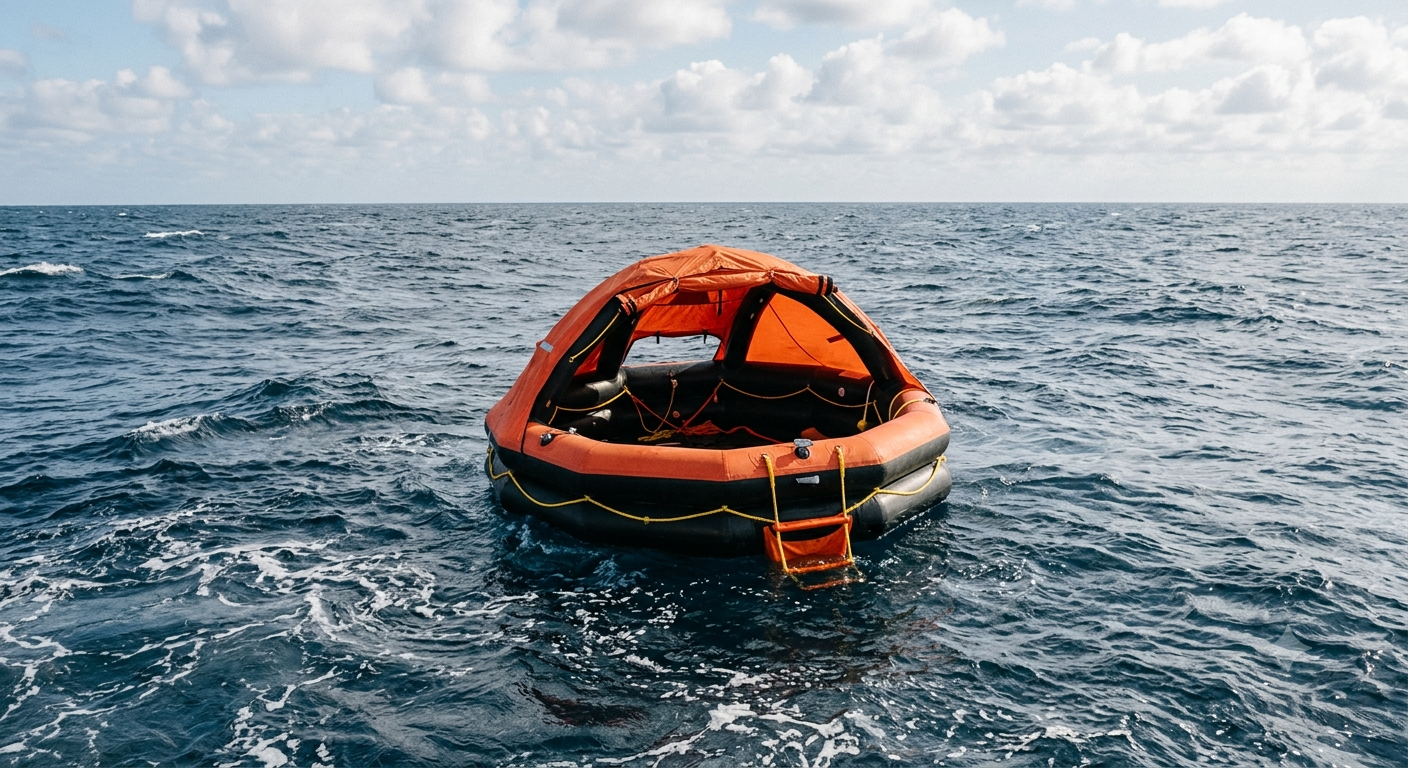
Liferaft Servicing in India 2026: The Complete Guide for Ship Owners
Every inflatable liferaft on a SOLAS vessel must be serviced every year — no exceptions, no extensions beyond the 17-month rule, and no shortcuts on who is authorised to do it. Yet liferaft-related deficiencies remain among the most common PSC findings on vessels calling at Indian ports. Expired service certificates, HRUs beyond their replacement date, and liferafts serviced at non-approved stations are found on vessels across every flag and every ship type.
This guide covers everything ship owners and superintendents need to know about liferaft servicing in India in 2026 — what SOLAS requires, what the service involves, how to verify an approved service station, and where Marinetech operates across India's major ports.
What SOLAS Requires for Liferaft Servicing
The legal requirement for inflatable liferaft servicing is set out in SOLAS Regulation III/20.8. It states that every inflatable liferaft must be serviced at intervals not exceeding 12 months. In practice, port state control authorities accept a maximum interval of 17 months between services — but this is a one-time extension permitted to account for scheduling practicalities, not a routine interval. Ship managers who treat 17 months as the standard interval are taking a compliance risk.
The service must be conducted at an approved service station. SOLAS defines an approved service station as a facility that has been approved by the liferaft manufacturer and recognised by the relevant flag state administration or an authorised classification society. This is not a general marine workshop or a ship repair yard — it is a purpose-equipped facility staffed by manufacturer-trained technicians using manufacturer-approved equipment, tools, and spare parts.
Beyond the annual service, the Hydrostatic Release Unit (HRU) that automatically deploys the liferaft if the vessel sinks must be replaced every 2 years — regardless of its apparent condition. The HRU has no visible indicator of internal deterioration, which is precisely why SOLAS sets a mandatory calendar-based replacement interval rather than a condition-based one.
The 17-Month Rule: What It Means and When It Applies
The 17-month extension exists to allow vessels that cannot reach an approved service station within 12 months — due to trading patterns, remote port calls, or operational constraints — additional time to schedule the service. It requires the flag state administration or class society to formally approve the extension. It is not an automatic entitlement.
In practice, PSC officers in India and across the Indian Ocean MOU region do not accept an expired service certificate on the basis that the 17-month rule was "intended" to apply. If your liferaft service certificate shows a service date more than 12 months prior and you do not have formal written approval for the extension, you are exposed to a deficiency finding. The safest approach is to service every liferaft within 12 months without exception.
What Happens During a Liferaft Annual Service
A compliant annual service at an approved service station is a thorough process — not a visual check and a new sticker. Here is what takes place at every Marinetech liferaft service:
Receipt and Initial Inspection: On arrival at the service station, the liferaft is logged and the service history is reviewed. The canister or valise is inspected externally for damage, corrosion, or contamination. The service label from the previous inspection is read and recorded.
Inflation and Deployment Test: The liferaft is inflated using a test gas supply to verify that the inflation system operates correctly and that the liferaft achieves its rated inflation pressure. The fully inflated liferaft is examined for leaks, seal integrity, and structural condition across the canopy, floor, buoyancy tubes, and internal fittings.
Internal Equipment Check: Every item of SOLAS equipment inside the liferaft is physically checked against the applicable pack list. For SOLAS A Pack liferafts, this includes water and rations, first aid kit, bailer and sponge, paddles, sea anchor, signalling equipment, repair outfit, and all pyrotechnics — each individual pyrotechnic is checked for expiry. For SOLAS B Pack liferafts, the reduced equipment list is verified against the relevant SOLAS regulation.
Canopy and Structure: The canopy is inspected for tears, abrasion damage, UV degradation, and integrity of all seams and attachment points. The internal lighting system and retro-reflective tape are checked. All grab lines, lifelines, and boarding ladders are inspected.
Gas Inflation System: The CO2 cylinder or equivalent inflation gas supply is weighed to confirm it is within the manufacturer's specified weight tolerance. If the cylinder is underweight, it is recharged or replaced. The automatic inflation head is inspected and serviced. The inflation line and connections are checked.
Repacking: After all inspection and any rectification work, the liferaft is deflated, folded, and repacked to the manufacturer's specification in the original canister or a replacement approved valise. Repacking must follow the manufacturer's procedure exactly — an improperly repacked liferaft may fail to deploy correctly in an emergency.
HRU Replacement: If the HRU is within 6 months of its 2-year replacement date, it is replaced at the service. If it has already passed its replacement date, it is replaced as a mandatory item. The new HRU is fitted, its installation date is recorded, and the weak link connecting the painter line to the vessel is inspected and replaced if necessary.
Documentation: A service certificate is issued identifying the liferaft by manufacturer and serial number, the date of service, the name of the approved service station, the signature of the certified technician, and the next service due date. This certificate must be retained on board and made available to PSC officers on demand.
Davit-Launched Liferaft Servicing: Additional Requirements
Vessels carrying davit-launched liferafts — commonly found on passenger ships, large container vessels, and offshore units — have additional servicing requirements beyond those covering throw-overboard liferafts.
The davit and its launching equipment must be serviced at the same interval as the liferaft itself. The davit structure, winch, wire, and automatic release hook are all inspected. The liferaft container cradle and HRU arrangement specific to the davit-launched configuration are checked. The automatic release hook — which deploys the liferaft if the vessel sinks while the davit is rigged — is tested and certified.
Davit-launched liferaft systems are more complex and take longer to service than throw-overboard configurations. When booking, advise whether your vessel carries davit-launched liferafts so our team can allocate the correct time and equipment for the job.
Common PSC Deficiencies Found on Liferafts at Indian Ports
Understanding where vessels typically fail on liferaft inspections at Indian ports helps you target your pre-arrival checks more effectively.
The most consistently cited liferaft deficiency across both the Indian Ocean MOU and Tokyo MOU is an expired service certificate — either beyond the 12-month standard interval or beyond the 17-month maximum. The second most common is an HRU that has passed its 2-year replacement date, typically because the HRU date was not being tracked separately from the liferaft service date. The third is a service certificate issued by a non-approved service station — a facility that was not recognised by the manufacturer or the relevant classification society at the time of service. PSC officers in 2026 are actively verifying service station approval status, not just accepting certificates at face value.
Less common but serious findings include liferafts stowed with an improperly attached or missing painter line, liferaft containers showing significant physical damage, and liferaft markings that are illegible or do not match the vessel's Safety Equipment Certificate.
Liferaft Brands Marinetech Services in India
Marinetech's approved service stations are equipped and authorised to service all major liferaft brands commonly found on vessels calling at Indian ports. These include Survitec (Zodiac, RFD, Beaufort), Viking, Jiangyin Neptune, Lalizas, Norsafe, and other brands on request. When booking your liferaft service, provide the brand, model, and serial numbers of all liferafts to be serviced so we can confirm authorisation and ensure the correct manufacturer-approved parts are available at the service station before your vessel arrives.
Ports Where Marinetech Provides Liferaft Servicing in India
Marinetech Safety Pvt. Ltd. operates approved liferaft service stations and provides liferaft inspection and servicing across all major Indian ports.
On the west coast, we cover Mumbai and JNPT for vessels calling at India's primary container port, with rapid turnaround times suited to the tight schedules at these terminals. We cover Kandla and Mundra in Gujarat — the highest-volume bulk cargo ports in India — as well as Hazira and Dahej for the petrochemical and LNG sector. Our Cochin team serves vessels on the Kerala coast, and we provide service to vessels calling at Goa's Mormugao port.
On the east coast, we cover Chennai and Ennore for South India's primary container and bulk trade, Visakhapatnam (Vizag) for the eastern bulk sector, Kolkata and Haldia for Bay of Bengal operations, and Paradip for the growing Odisha bulk trade. If your vessel is calling at a port not listed here, contact us — we have the network to arrange service at virtually any Indian port with appropriate advance notice.
Why Choose Marinetech for Liferaft Servicing
Marinetech Safety Pvt. Ltd. holds DG Shipping approval and is recognised as an approved liferaft service station by all major classification societies — ABS, DNV GL, Bureau Veritas, Lloyd's Register, IRS, NKK, RINA, CCS, and Korean Register. Every liferaft serviced at our stations is handled by manufacturer-trained, certified technicians using only original manufacturer-approved spare parts and inflation gas supplies.
Every service we conduct produces a certificate that PSC officers across all major port state control regimes will accept without question — because it comes from a facility that is genuinely approved, not merely presenting itself as one. Our pan-India coverage means we can schedule your liferaft service at the port most convenient for your vessel's trading pattern, avoiding the need to deviation to a single service location. View our full approvals and class society recognition certificates.
We also provide the full range of complementary LSA services at the same port call — lifeboat inspection and servicing, fire fighting appliances inspection, and GMDSS radio surveys — so your vessel can address multiple compliance requirements in a single port stop.
Frequently Asked Questions
How often must an inflatable liferaft be serviced under SOLAS?
Every 12 months. The maximum permissible interval is 17 months, but this requires formal approval from the flag state administration or class society and cannot be applied as a matter of routine. Aim for 12 months as your standard interval.
What is the HRU replacement interval for liferafts?
The Hydrostatic Release Unit must be replaced every 2 years regardless of its apparent condition. The replacement date is printed on the HRU and is checked by PSC officers at every inspection. If the HRU is beyond its replacement date, the liferaft is considered non-compliant.
Can the ship's crew service the liferaft themselves?
No. Inflatable liferaft servicing must be conducted at an approved service station by manufacturer-trained, certified technicians. Crew involvement is limited to the monthly visual inspection of the liferaft's external condition, the HRU replacement date, and the service certificate validity — they may not open, inspect internally, or repack an inflatable liferaft.
What is the difference between a SOLAS A Pack and SOLAS B Pack liferaft?
A SOLAS A Pack liferaft contains the full equipment pack as required under SOLAS, including water, rations, first aid kit, signalling equipment, and pyrotechnics. It is required for vessels on unlimited international voyages. A SOLAS B Pack contains a reduced equipment set and is permitted on vessels on short international voyages or in near-coastal trade under specific flag state conditions. Your vessel's Safety Equipment Certificate will specify which pack standard applies.
How long does liferaft servicing take in India?
A single throw-overboard liferaft service typically takes 2 to 4 hours at an approved service station. Davit-launched liferaft systems take longer due to the additional davit and release gear servicing requirements. Marinetech provides estimated completion times before the service begins so you can plan your vessel's port schedule accordingly.
What should we do if the liferaft service certificate expires while the vessel is at sea?
If the service certificate expires during a voyage with no approved service station available, the master should note this in the logbook and contact the flag state administration or class society to request a formal extension approval. On arrival at the next Indian port, contact Marinetech immediately to schedule the service before the vessel's next departure. Do not attempt to conceal an expired certificate — a proactive approach with documented flag state contact is treated far more favourably by PSC officers than an undisclosed lapse.
Book Liferaft Servicing Across India
Contact Marinetech Safety Pvt. Ltd. to schedule your liferaft annual service or inspection at any major Indian port. Provide the number of liferafts, brand, model, and your vessel's expected arrival date and we will confirm availability and turnaround time within 24 hours.
Services email: info@marinetechss.com
Phone: +91-8866475732 | +91-72270 38216
Get a Free Quote for Liferaft Servicing
Related reading: Certified Lifeboat Servicing in India 2026 | SOLAS Lifeboat Requirements 2026: Complete Guide | Common Lifeboat PSC Deficiencies & How to Fix Them | How to Prepare for a PSC Inspection: Checklist 2026