Blog Post
SOLAS Lifeboat Requirements 2026: The Complete Guide for Ship Owners & Superintendents
Posted By: Harsh Bamnolia
Posted On : 15-Feb-2026
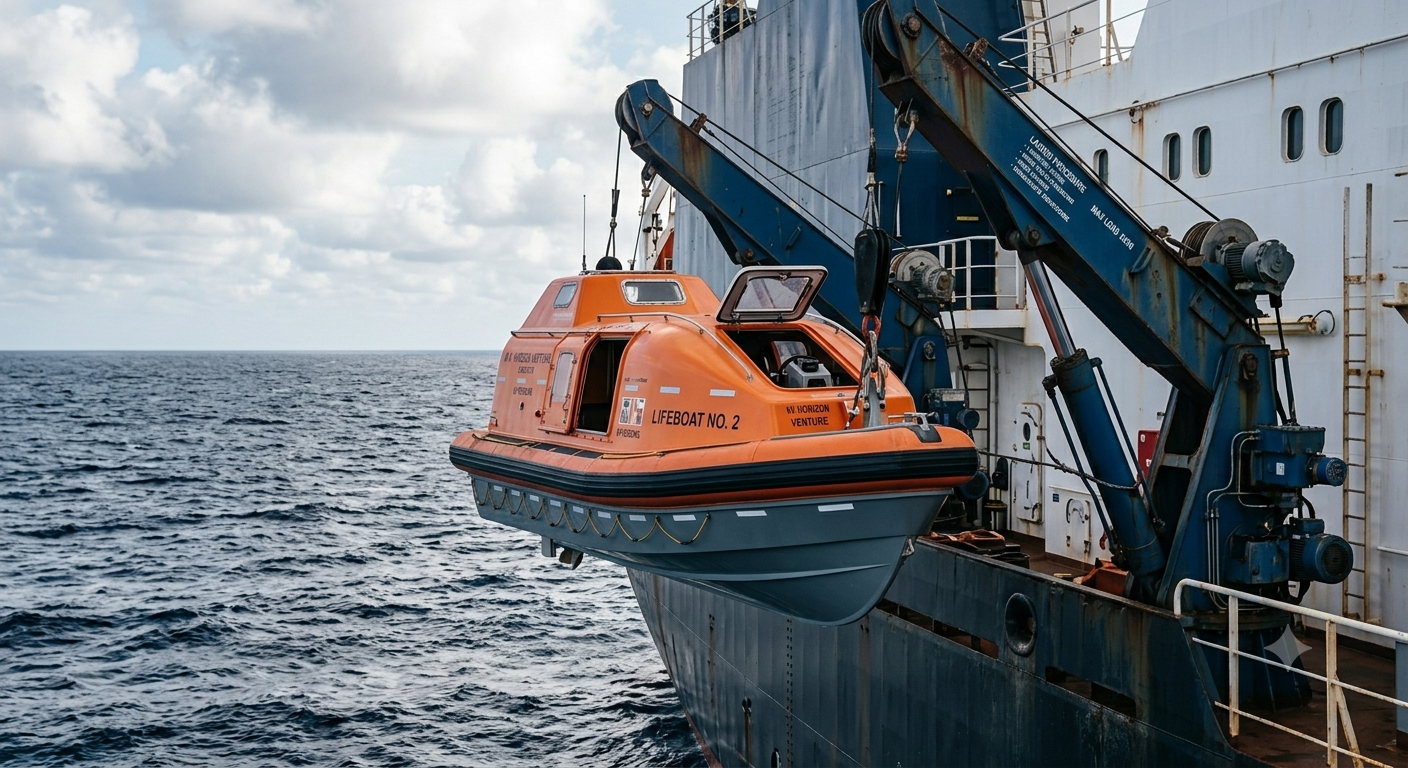
SOLAS Lifeboat Requirements 2026: The Complete Guide for Ship Owners & Superintendents
SOLAS lifeboat requirements in 2026 are more stringent than ever — and non-compliance carries real consequences: PSC detention, class deficiencies, and in the worst case, loss of life at sea. Whether you are a ship owner, fleet superintendent, or master, understanding what SOLAS Chapter III mandates for lifeboats — including the changes brought in by IMO Resolution MSC.559(108) — is not optional. It is your legal and safety obligation.
This guide covers everything: carriage rules by vessel type, design and construction standards, mandatory equipment, inspection intervals, the latest IMO updates, and what PSC officers are actively checking on vessels calling at Indian ports right now.
What Is SOLAS Chapter III and Why Does It Govern Lifeboats?
The Safety of Life at Sea (SOLAS) Convention is the cornerstone of international maritime safety law, developed and maintained by the International Maritime Organization (IMO). Chapter III, combined with the Life-Saving Appliance (LSA) Code, sets out legally binding requirements for lifeboats on every commercial vessel engaged in international voyages.
Compliance is enforced at two levels. First by the flag state — the country where the vessel is registered — through statutory surveys and certification. Second by port state control (PSC) officers who inspect vessels independently on every port call. In India, the Directorate General of Shipping (DGS) and PSC authorities under the Indian Ocean MOU and Tokyo MOU verify lifeboat compliance on every vessel calling at major Indian ports. LSA deficiencies consistently rank among the top three PSC detention categories globally — meaning lifeboat non-compliance is one of the most common reasons ships get detained in port.
SOLAS Lifeboat Carriage Requirements by Vessel Type
Carriage requirements differ by vessel type. Here is a clear breakdown:
Cargo Ships
- Must carry lifeboats on both port and starboard sides, each capable of accommodating 100% of all persons on board
- Vessels under 85 metres in length may carry one lifeboat on one side, provided liferafts cover the remaining 100% on the other side
- At least one rescue boat must be carried — on smaller vessels this may be a dual-purpose rescue/survival craft
- Bulk carriers, tankers, and most large cargo vessels carry free-fall lifeboats at the stern
Passenger Ships
- Must carry totally enclosed, self-righting lifeboats on both sides, sufficient for 100% of persons on board
- All lifeboats must be ready for launching within 30 minutes of the decision to abandon ship
- At least one rescue boat required on each side
- Partially enclosed lifeboats may be permitted on short international voyage passenger ships under specific flag state exemptions
Tankers (Oil, Chemical, Gas)
- Free-fall lifeboats are mandatory for most tanker types — positioned at the aft end for rapid deployment away from any deck fire
- Fire-protected lifeboats are required for tankers carrying flammable cargoes with a flashpoint below 60°C
- All tanker lifeboats must be capable of operating in burning oil on the water surface
SOLAS Lifeboat Design and Construction Standards
Every lifeboat placed on a SOLAS vessel must meet the construction standards set out in LSA Code Chapter 4. These are mandatory minimums, not manufacturer guidelines.
Structural Requirements
- Built of Glass Reinforced Plastic (GRP) or marine-grade aluminium — materials must resist seawater, oil, UV exposure, and biological attack
- Must withstand a free drop of 3 metres without structural failure
- Must survive a lateral impact of 3.5 m/s against the ship's side when fully loaded
- Must maintain structural integrity and operational readiness in temperatures from -20°C to +65°C
- Must remain afloat when completely flooded and fully open to the sea
- Non-skid flooring and anti-slip walkways required throughout
Performance Requirements
- Minimum speed of 6 knots in calm water when fully loaded with all persons and equipment
- Must maintain at least 2 knots while towing a 25-person liferaft
- Fuel supply sufficient for 24 hours of continuous operation at 6 knots
- Must be launchable when the ship is making headway at up to 5 knots
- Must remain launchable with the ship listed up to 20 degrees or trimmed up to 10 degrees
Capacity Standards
- Cargo ships: seating calculated at 82.5 kg per person
- Passenger ships: seating calculated at 75 kg per person
- Maximum capacity of any single lifeboat: 150 persons, regardless of calculation result
- Each seating position must be clearly marked and structurally capable of supporting a 100 kg static load
Mandatory Lifeboat Equipment: What Must Be On Board
SOLAS Regulation III/38 and LSA Code Chapter 4 mandate a specific equipment list inside every compliant lifeboat. PSC officers check this on every inspection — missing or expired items are among the most common deficiency findings.
Survival Equipment
- Floating sea anchor with at least 10 metres of line and a tripping line
- Buoyant rescue quoit with 30 metres of floating line
- One fixed butt-type or folding knife per side of the boat, securely attached
- Two bailers and two sponges
- First aid kit in a waterproof case, contents compliant with the SOLAS Annex
- Thermal protective aids for 10% of the total persons the lifeboat is approved to carry, or a minimum of 2 — whichever is greater
- 3 litres of fresh drinking water per person, or an equivalent approved desalting apparatus
- Sufficient food rations — minimum 10,000 kJ per person
Pyrotechnics
- 6 rocket parachute flares
- 4 red hand flares
- 2 buoyant orange smoke signals
All pyrotechnics must be within their SOLAS expiry date at the time of PSC inspection. Expired pyrotechnics are one of the most frequently cited LSA deficiency findings across all major port state control regimes.
Navigation and Communication Equipment
- Luminous compass and set of paddles or oars
- Radar reflector
- At least 3 two-way portable VHF radiotelephony sets (handheld)
- Search and Rescue Transponder (SART) — required on at least one lifeboat per side
- Searchlight capable of operating for at least 3 continuous hours
Propulsion and Engineering
- Self-contained compression ignition engine with sufficient fuel for 24 hours at 6 knots
- Tools and spare parts for minor engine and equipment repairs
- One fire extinguisher suitable for liquid fuel fires
SOLAS Lifeboat Inspection and Maintenance Requirements
This is where the majority of PSC detentions originate. SOLAS Regulation III/20, as strengthened by MSC.402(96) and now further updated by MSC.559(108), sets out a layered maintenance regime with clear responsibilities for both the ship's crew and authorised shore-based service providers.
Onboard Maintenance by Crew (Ongoing)
The ship's crew is responsible for maintenance between professional inspections:
- Weekly: Engine start test (minimum 2 minutes running time), visual inspection of lifeboat and davit condition, confirmation of fuel level and battery charge
- Monthly: Full visual inspection of all equipment, test of battery-operated lights, check of pyrotechnic expiry dates, inspection of release gear for visible defects
- Every 3 months: The lifeboat must be physically launched and manoeuvred in water — not just swung out on the davit, but lowered into the water and operated under power
All maintenance must be logged in the ship's maintenance record and reported to the master.
Annual Inspection (Thorough Examination)
The annual inspection must be conducted by a person who is certified and trained by the lifeboat manufacturer or their authorised representative, AND recognised by a classification society or the flag state administration. This is not a task the ship's crew can perform independently.
The annual thorough examination covers:
- Full inspection of hull, structural components, and all internal fittings
- Engine test and complete fuel system inspection
- Inspection and operational test of the on-load release gear
- Inspection and operational test of the davit and winch system
- Inspection of the fall wire and fall preventer device (FPD)
- Test of all communication and navigation equipment
- Verification of all pyrotechnics, survival equipment, and provisions against the SOLAS equipment list
- Formal sign-off of all onboard maintenance records
Five-Yearly Overhaul
The five-yearly service is a comprehensive overhaul carried out at an approved service facility. In addition to everything in the annual inspection, it includes:
- Thorough structural examination: hull, bulkheads, thwarts, and buoyancy materials
- Dynamic winch brake test at 1.1 times the maximum working load of the winch
- Complete overhaul of the launching appliance including all sheaves, blocks, and fittings
- Fall wire renewal — SOLAS requires renewal every 5 years or sooner if inspection warrants it
- On-load release gear overhaul or replacement as required
- Full exterior repaint of the lifeboat
- Hydrostatic testing of compressed air systems where fitted
What Changed: IMO Resolution MSC.559(108) — Now in Force
IMO Resolution MSC.559(108) was adopted at IMO MSC 108 in May 2024 and enhances the earlier maintenance regime under MSC.402(96). It introduced two significant requirements that are now fully in force and actively checked by PSC officers in 2026.
New Ventilation Requirements for Totally Enclosed Lifeboats
The revised LSA Code (paragraphs 4.6.6 and 4.6.7) now requires totally enclosed lifeboats to have:
- A minimum ventilation capacity of at least 5 m³ per hour per person
- Ventilation that remains fully functional for a minimum of 24 continuous hours of operation
- Ventilation controls that can be operated from inside the lifeboat
- A watertight ventilation design that maintains integrity even when submerged, without relying on radio or engine battery systems
Ships built before this requirement should have their existing lifeboat ventilation systems assessed against this standard. Where deficiencies exist, retrofits or replacements are required before the next class survey.
Reinforced Requirement for Certified Service Providers
MSC.559(108) explicitly reinforces that annual inspections must be conducted by service providers holding both OEM authorisation AND class society recognition. This closes the loophole of using uncertified local technicians for annual lifeboat service.
In practical terms: if your lifeboat service record does not show certification from both the manufacturer's authorised representative and a recognised classification society, the service does not count as compliant under SOLAS. PSC officers in 2026 are scrutinising service records closely against this standard.
Practical Compliance Checklist for Ship Managers in 2026
Use this checklist before your next port call at any Indian port:
- Verify your service records — confirm that the last annual inspection was performed by an OEM-authorised, class-recognised service provider compliant with MSC.559(108)
- Check all pyrotechnic expiry dates — rocket flares, hand flares, and smoke signals must be within date. Replace anything expiring within 3 months
- Inspect the on-load release gear — test it as per the annual operational test requirement. Faulty release gear is among the most dangerous and most cited lifeboat deficiencies
- Check fall wire age and condition — if wires are approaching 5 years, schedule renewal before the five-yearly service date
- Assess lifeboat ventilation — verify compliance with MSC.559(108) ventilation requirements, especially on lifeboats more than 10 years old
- Audit your onboard maintenance log — gaps in the weekly and monthly maintenance record are an immediate red flag for PSC officers
Frequently Asked Questions
1. How often must lifeboats be professionally serviced under SOLAS in 2026? SOLAS requires an annual thorough examination by an OEM-authorised, class-recognised service provider, plus a comprehensive five-yearly overhaul. Crew maintenance — weekly and monthly — is mandatory between professional inspections and must be logged.
2. Who is authorised to conduct the annual lifeboat inspection in India? The inspection must be carried out by a company holding DG Shipping approval and recognition from the relevant class society (ABS, DNV GL, Lloyd's Register, Bureau Veritas, IRS, etc.) for the specific make and model of lifeboat being serviced.
3. What happens if a lifeboat fails a PSC inspection at an Indian port? The vessel will receive a deficiency code. Depending on severity, the ship may be detained until the deficiency is rectified. LSA deficiencies are treated as serious findings — detention can mean significant delays, port costs, and reputational damage with charterers.
4. What is the difference between the annual inspection and the five-yearly overhaul? The annual inspection is a thorough examination and operational test, conducted on board or at an approved service station. The five-yearly overhaul is a comprehensive strip-down, including dynamic winch brake testing, fall wire renewal, full structural inspection, and complete repainting of the lifeboat.
5. Does IMO MSC.559(108) apply to all existing vessels? Yes, it applies to all SOLAS vessels. For existing lifeboats, new ventilation requirements must be assessed and addressed at the next scheduled survey. Consult your class society for vessel-specific implementation timelines.
6. What is the Fall Preventer Device (FPD) and why does it matter? The FPD is a secondary safety device that prevents the on-load release hook from opening unintentionally during launching or recovery. SOLAS requires FPD renewal every 5 years and a 6-monthly inspection by a senior officer. PSC officers specifically check FPD condition and renewal dates.
Book a DG Shipping Approved Lifeboat Inspection in India
Marinetech Safety Pvt. Ltd. is DG Shipping approved and recognised by ABS, DNV GL, Bureau Veritas, Lloyd's Register, IRS, NKK, RINA, CCS, and Korean Register. Our OEM-authorised engineers conduct annual lifeboat inspections and five-yearly overhauls across all major Indian ports — Mumbai, Kandla, Mundra, Hazira, JNPT, Chennai, Vizag, Cochin, Kolkata, and more.