Blog Post
Lifeboat PSC Deficiencies — Causes & How to Fix Them
Posted By: Harsh Bamnolia
Posted On : 17-Feb-2026
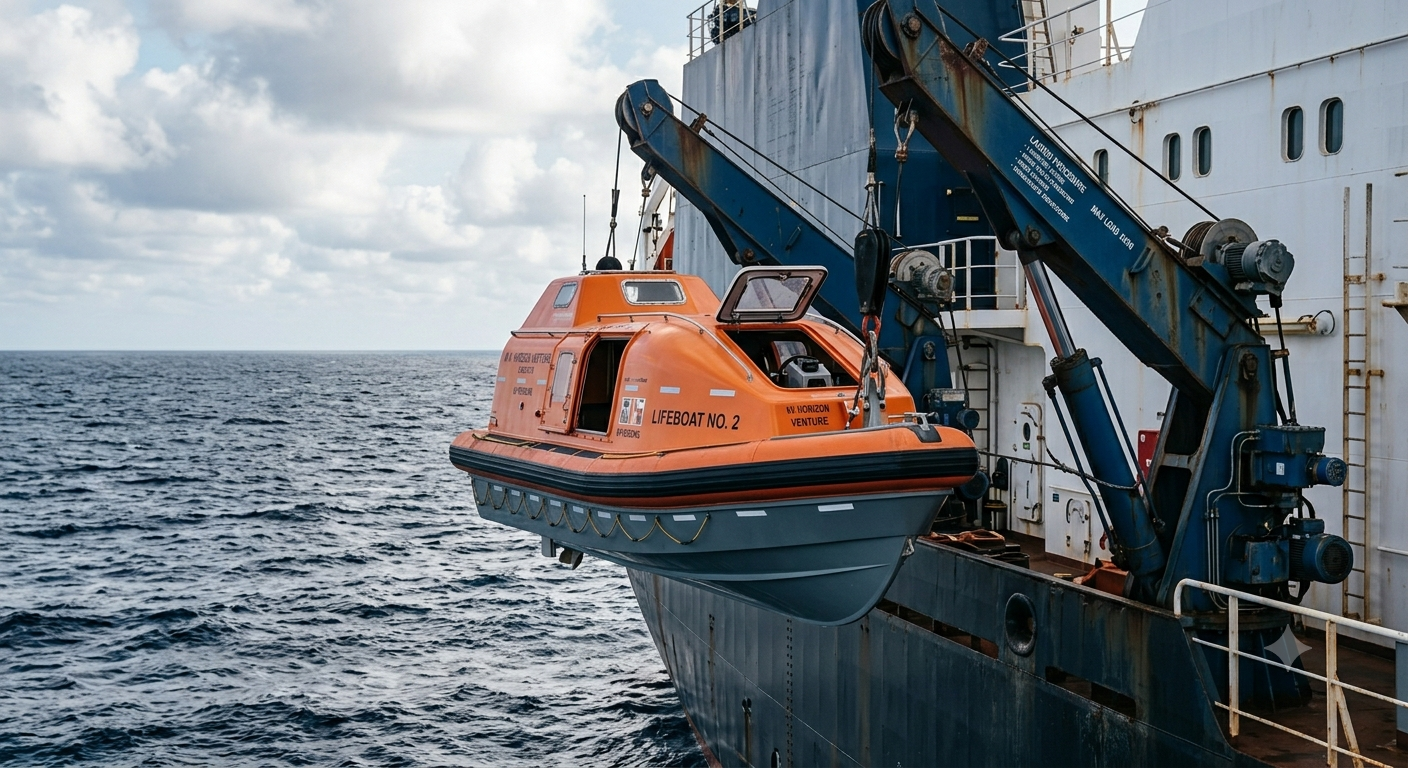
Common Lifeboat Deficiencies Found During PSC Inspections in India — And How to Fix Them
A PSC detention does not begin the moment an officer steps on board. It begins weeks or months earlier — when a lifeboat engine is not test-run, when a service record is not signed off correctly, when a pyrotechnic expires and no one orders a replacement.
By the time a port state control officer arrives at your vessel in Mumbai, Kandla, Chennai, or Vizag, the deficiency already exists. The inspection simply reveals it.
Life-saving appliances — and lifeboats specifically — are among the top three deficiency categories across both the Tokyo MOU and Indian Ocean MOU regions year after year.
Understanding exactly what PSC officers look for, what triggers a deficiency code, and what constitutes a detainable finding is the most practical thing a ship manager or master can do to protect their vessel's schedule and reputation.
This article covers the most common lifeboat-related PSC deficiencies found on ships calling at Indian ports, what causes each one, and the specific steps required to fix them.
How PSC Officers Approach Lifeboat Inspections
Before covering individual deficiencies, it helps to understand how a PSC officer actually approaches a lifeboat inspection — because the pattern reveals where most ships fail.
A PSC officer begins with documents. They will ask to see:
- The lifeboat's maintenance record card
- The ship's planned maintenance system (PMS) records for lifeboats
- The last annual inspection certificate and service report
- The last five-yearly overhaul certificate (if due)
- The service provider's OEM authorisation and class society recognition
If the documentation is incomplete, inconsistent, or missing, the officer has grounds for a more detailed physical inspection. And a more detailed physical inspection almost always finds something.
After reviewing records, the officer will conduct a physical walkthrough of the lifeboat, davit, and all associated equipment. They are looking at the same checklist your authorised service provider should have worked through — which means if your service provider did their job properly, you have very little to worry about. If they did not, you will find out the hard way.
Deficiency #1: Faulty or Non-Compliant On-Load Release Gear
Why it happens: The on-load release hook is the single most safety-critical component on a lifeboat — and it is the most frequently deficient. Hooks wear, corrode, and accumulate paint during routine hull maintenance. The hydrostatic interlock mechanism — designed to prevent accidental release while the boat is in the water — can fail, seize, or be bypassed without anyone noticing during normal operation.
What PSC officers check:
- Physical condition of the hook, operating handle, and connecting lines
- Correct engagement of the hydrostatic interlock
- Correct engagement and condition of the Fall Preventer Device (FPD)
- Operational test of the hook opening and resetting sequence
- Service records showing the hook has been inspected and tested at the annual interval
- Whether the hook has been subject to any unauthorised modification
What triggers a detainable finding: A hook that fails the operational test, a hook with a seized or inoperable hydrostatic interlock, or a hook with no valid inspection record are all considered serious deficiencies. PSC authorities are specifically sensitised to on-load release gear failures following a series of fatal accidents globally caused by accidental hook release during boat drills.
How to fix it: Schedule an annual inspection by a DG Shipping approved, OEM-authorised service provider before your next port call at an Indian port. Do not attempt to free a seized hook with tools or force — this can permanently damage the safety mechanism.
If the hook is found to be non-compliant, the service provider will carry out an overhaul or recommend replacement. A new hook installation must be accompanied by a shore-side pull test and certification before the lifeboat returns to service.
Deficiency #2: Expired or Missing Pyrotechnics
Why it happens: Pyrotechnics — rocket parachute flares, red hand flares, and orange smoke signals — have mandatory SOLAS expiry dates printed on each unit. SOLAS requires replacement before expiry, but because pyrotechnics are stored inside the lifeboat and out of sight during routine operations, their expiry dates are easy to overlook between inspections.
What PSC officers check:
- Physical presence of all required pyrotechnics (6 rocket flares, 4 hand flares, 2 smoke signals per SOLAS)
- Expiry date on every individual unit — officers check each one, not just a sample
- Storage condition — pyrotechnics must be in their original sealed packaging and stored in the approved container
What triggers a detainable finding: Any expired pyrotechnic is a deficiency. Multiple expired units, or missing units, can escalate to a detainable finding depending on the PSC officer's overall assessment of the vessel's maintenance culture.
How to fix it: Conduct a full pyrotechnic inventory at every monthly lifeboat inspection — not just the annual service. Record the expiry date of every unit in the maintenance log. Order replacements at least 3 months before expiry to account for delivery lead times, particularly for vessels operating in Indian ports where supply logistics vary by port. Ensure replacements are sourced from an authorised supplier and are SOLAS-approved for the vessel's flag state. View Marinetech's range of SOLAS approved pyrotechnics and distress signals, supplied to vessels across all major Indian ports.
Deficiency #3: Incomplete or Falsified Maintenance Records
Why it happens: This is the deficiency that catches ships out even when the physical equipment is in reasonable condition. SOLAS Regulation III/20 requires that all weekly and monthly maintenance activities be recorded in the ship's log and signed off. When this is not done consistently — or worse, when records are backdated — PSC officers notice immediately.
What PSC officers check:
- Weekly engine test records — each entry must show the date, duration of run, and signature of the responsible officer
- Monthly inspection records — must cover all items on the SOLAS monthly checklist
- Three-monthly launching records — the lifeboat must have been launched and manoeuvred, not just swung out
- Annual and five-yearly service certificates — must be from an authorised provider, not self-certified
What triggers a detainable finding: Gaps in records of more than a few weeks, records that appear to have been completed in the same handwriting and same ink in a single session, or an absence of three-monthly launching records are all grounds for a deficiency code. If the pattern suggests systematic falsification, this escalates to an ISM-related deficiency — which is always detainable.
How to fix it: Implement a reminder system — digital or physical — that prompts the responsible officer to complete and sign the lifeboat maintenance log at each required interval. The three-monthly launching requirement is the most commonly missed — schedule it in the PMS as a formal work order, not an informal task. Ensure the officer signing off has actually witnessed the maintenance being performed.
Deficiency #4: Davit, Winch, and Fall Wire Deficiencies
Why it happens: The davit and winch system bears the full weight of the loaded lifeboat every time it is launched. Without regular lubrication, inspection, and maintenance, sheaves seize, wire falls corrode, and winch brakes wear — none of which are visible from deck level during routine watchkeeping.
What PSC officers check:
- Condition of the davit structure — visible corrosion, cracks, or distortion
- Free rotation of all sheaves and blocks — seized sheaves are an immediate flag
- Condition of the fall wire — broken wires, kinks, corrosion, and bird-caging are all checked
- Age of the fall wire — must be renewed every 5 years
- Condition and renewal date of the Fall Preventer Device (FPD)
- Condition and operation of the winch brake and clutch
- Evidence that the dynamic winch brake test has been conducted at the five-yearly interval
What triggers a detainable finding: A fall wire with broken wires or significant corrosion is immediately detainable — it is a structural safety risk. A davit with seized sheaves or a winch with a slipping brake are serious deficiencies. A fall wire beyond its 5-year renewal date, or a missing dynamic brake test record, are common detention findings.
How to fix it: Include fall wire condition and age in the monthly lifeboat inspection record. If the wire is approaching 4.5 years, schedule renewal proactively — do not wait for the five-yearly service date. Ensure sheaves are lubricated at the intervals specified by the davit manufacturer, and include sheave condition in the monthly maintenance record. If the five-yearly overhaul is overdue, schedule it immediately with a DG Shipping approved service provider — do not call at a port where you know PSC is active with an overdue overhaul.
Deficiency #5: Lifeboat Engine Fails to Start or Has Not Been Tested
Why it happens: A lifeboat engine that is not run regularly will fail to start when needed — either in an emergency or during a PSC inspection. Fuel deteriorates, injectors block, batteries discharge, and cooling water lines scale up. The SOLAS weekly engine test requirement exists specifically to prevent this, but it is frequently skipped on vessels with heavy operational schedules.
What PSC officers check:
- The engine start record in the maintenance log — weekly entries are required
- Physical test of the engine during the inspection — the officer may ask for the engine to be started and run
- Condition of the fuel tank and fuel system — contaminated or insufficient fuel is a common finding
- Battery charge and condition — both the main and emergency starting batteries are checked
What triggers a detainable finding: An engine that fails to start during a PSC inspection is an immediate detainable deficiency. Missing weekly engine test records over a period of several weeks, combined with physical signs of a poorly maintained engine (seized throttle, corroded battery terminals, empty fuel tank), will lead to a detention.
How to fix it: The weekly engine test takes less than ten minutes. It must be treated as a non-negotiable requirement — not an optional maintenance task. Assign clear responsibility to a named officer. Ensure the fuel tank is kept topped up and that the specified fuel type for the engine is used. If the engine fails during routine testing, contact an authorised service engineer immediately — do not simply record "engine started with difficulty" and move on.
Deficiency #6: Non-Compliant or Uncertified Annual Service
Why it happens: Following MSC.559(108), the requirement that annual lifeboat inspections must be conducted by OEM-authorised, class-recognised service providers is more strictly enforced than ever. Vessels that have been serviced by uncertified local technicians — or that have self-certified their own inspections — are increasingly finding that their service records do not satisfy PSC officers.
What PSC officers check:
- The annual inspection certificate — who issued it, what their authorisation covers, and whether it covers the specific make and model of lifeboat on board
- The OEM authorisation certificate of the service provider
- The class society recognition of the service provider
- Whether the scope of the inspection matches what SOLAS and MSC.402(96) require
What triggers a detainable finding: An annual inspection certificate issued by an entity that cannot demonstrate OEM authorisation and class society recognition is not a valid inspection for SOLAS purposes. PSC officers are increasingly checking the authorisation status of service providers, not just the presence of a certificate. A certificate from an uncertified provider is treated the same as no certificate.
How to fix it: Before scheduling any lifeboat service, verify that your service provider holds:
- Written OEM authorisation for the specific make and model of your lifeboat
- A valid class society approval certificate from the relevant society for your vessel
A reputable DG Shipping approved provider will supply both documents on request without hesitation. If they cannot, do not use them. Marinetech holds OEM authorisation for all major lifeboat brands and is recognised by ABS, DNV, GL, Lloyd's Register, BV, IRS and all major class societies.
Deficiency #7: Missing or Damaged Lifeboat Equipment
Why it happens: Equipment goes missing from lifeboats during port calls, drills, and routine maintenance. A portable VHF set is removed for use on deck and not returned. A first aid kit is raided for supplies and not replaced. A thermal protective aid is taken for a shore-based drill and not restowed. Over time, the lifeboat's equipment inventory drifts away from SOLAS compliance without anyone noticing.
What PSC officers check:
- Physical count of all items against the SOLAS equipment list (Regulation III/38)
- Condition of all items — damaged, wet, or corroded equipment is treated as absent
- Expiry dates of perishable items — food rations, water, first aid kit contents
- Battery charge and operation of VHF sets and SART
What triggers a detainable finding: Missing mandatory equipment items — particularly communication equipment (VHF, SART) — are serious deficiency findings. Multiple missing or deficient items, even if individually minor, can collectively trigger an ISM-related deficiency if they demonstrate a broader failure of the safety management system.
How to fix it: Conduct a complete SOLAS equipment inventory at every monthly lifeboat inspection — not just a visual check, but a physical count and condition check of every item against the full SOLAS list. Maintain a dedicated stowage location for each item inside the lifeboat, and use a physical checklist mounted inside the boat. Any item removed for any reason must be replaced before the boat is returned to its stowed position.
The Cumulative Effect: How Minor Deficiencies Become Detentions
One of the most important things to understand about PSC inspections is the ISM multiplier effect. A single minor deficiency — an expired smoke signal, a missing first aid item, an unsigned maintenance log entry — will typically result in a deficiency code but not a detention. However, when a PSC officer finds multiple individually minor deficiencies across different systems, they treat this as evidence of a systemic failure in the vessel's safety management system.
At that point, an ISM-related deficiency is recorded — and ISM deficiencies are always detainable.
The practical implication is simple: it is not enough to fix the one thing the last PSC officer flagged. A genuine compliance culture requires systematic, documented maintenance across all LSA systems at every required interval.
Frequently Asked Questions
What is the most common lifeboat deficiency in Indian ports? Based on PSC data from the Indian Ocean MOU and Tokyo MOU regions, the most consistently cited lifeboat deficiencies are: incomplete maintenance records, expired pyrotechnics, and non-compliant annual service (either overdue or conducted by an uncertified provider).
Can a ship be detained solely because of lifeboat deficiencies? Yes. Deficiencies related to life-saving appliances — particularly the on-load release gear, fall wire condition, or a non-functional engine — are treated as serious safety hazards and are detainable on their own. Multiple smaller LSA deficiencies can also trigger an ISM detention.
How much notice do we get before a PSC inspection in India? PSC inspections at Indian ports can be announced or unannounced. Vessels with a poor PSC history, vessels flagged under administrations with high detention rates, and vessels that have been selected for a Concentrated Inspection Campaign (CIC) are most likely to receive an unannounced inspection. The safest approach is to assume your vessel could be inspected on any port call.
How long does it take to fix a lifeboat detention deficiency? It depends entirely on the nature of the deficiency. A missing pyrotechnic can be replaced within hours. A non-compliant on-load release hook requiring overhaul or replacement may take 1 to 3 days depending on parts availability. A full annual inspection by an authorised provider typically takes 4 to 8 hours per lifeboat. This is why proactive maintenance is always faster and cheaper than emergency rectification under detention.
Who is responsible for lifeboat maintenance on board? SOLAS places overall responsibility on the master. In practice, the chief officer is typically assigned as the officer responsible for LSA maintenance and records. The shipping company's designated person ashore (DPA) holds responsibility under the ISM Code for ensuring the vessel has the resources and systems in place to maintain compliance.
How do we choose a PSC-ready lifeboat service provider in India? Ask for their DG Shipping approval certificate, their OEM authorisation letters for your specific lifeboat make and model, and their class society recognition certificates. Check that the authorisations are current and cover the ports where you need service. A provider that cannot produce these documents on request is not a safe choice.
Fix Your Lifeboat Deficiencies Before Your Next Port Call
Marinetech Safety Pvt. Ltd. provides DG Shipping approved, OEM-authorised lifeboat inspections, annual servicing, and five-yearly overhauls across all major Indian ports. Our engineers are available at Mumbai, JNPT, Kandla, Mundra, Hazira, Dahej, Chennai, Vizag, Cochin, Kolkata, and more — with rapid response times to minimise your vessel's time in port.
Contact Us for Emergency or Scheduled Lifeboat Servicing