Blog Post
Marine Fire Extinguisher Servicing in Mumbai: Ship Inspection, Refilling & Hydro Testing
Posted By: Harsh Bamnolia
Posted On : 02-Sep-2026
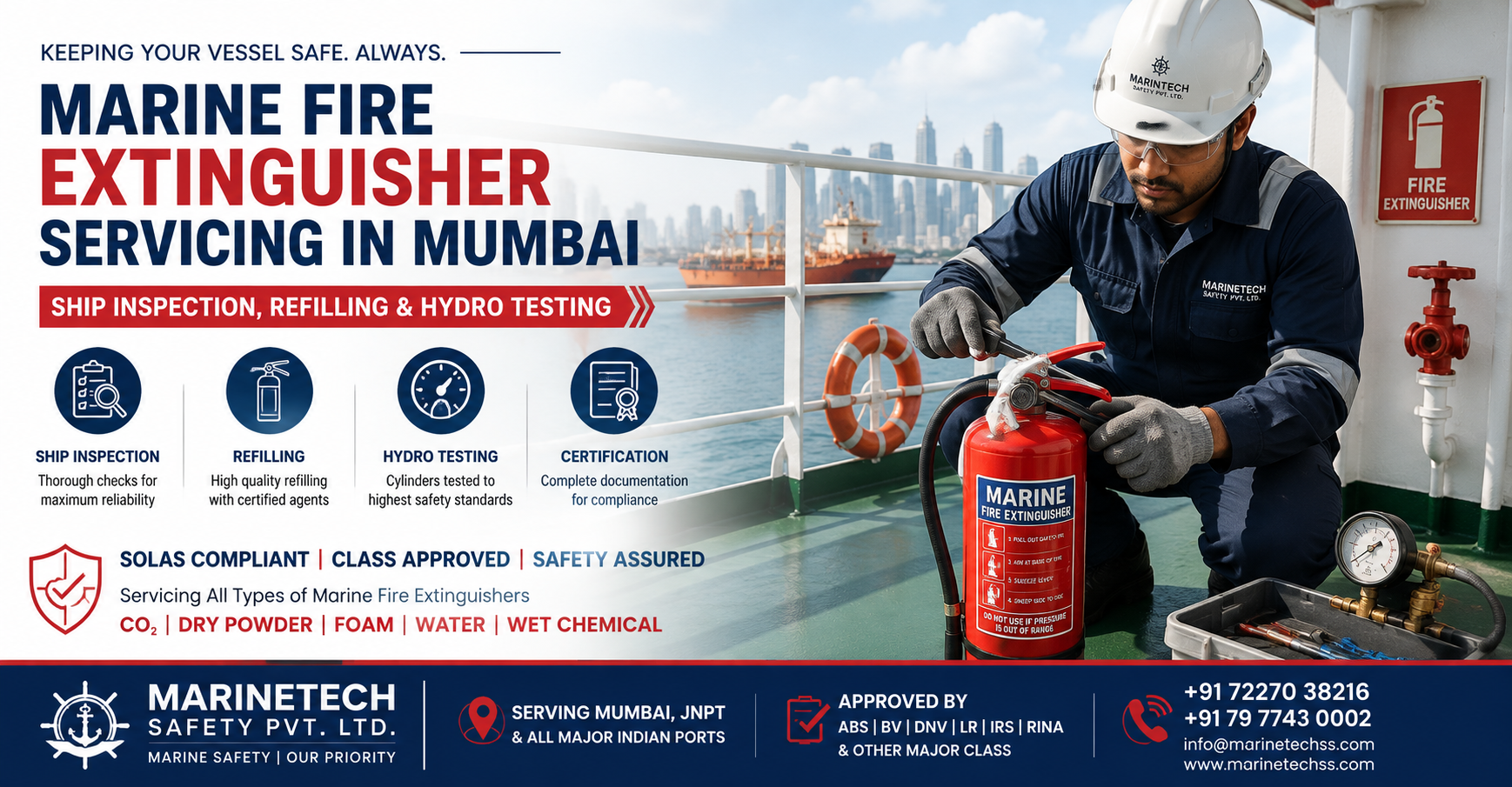
Fire extinguishers are among the
most important portable firefighting appliances carried onboard commercial
vessels. During a fire emergency, an extinguisher must be immediately
available, correctly charged and capable of operating as intended.
For shipowners, ship managers,
technical superintendents and vessel operators calling at Mumbai Port, Nhava
Sheva/JNPT and other nearby maritime locations, regular inspection and
servicing of marine fire extinguishers is an important part of maintaining the
vessel's firefighting readiness.
Marine fire extinguisher servicing
is more than simply refilling an extinguisher. A proper service may involve visual
inspection, pressure verification, cylinder examination, valve servicing,
extinguishing-agent replacement, refilling, leak testing, hydrostatic testing
when due, component replacement and service certification, depending on the
extinguisher type and applicable requirements.
Marinetech Safety Pvt. Ltd.
provides marine safety equipment servicing and supply services for vessels
operating at major Indian ports, including Mumbai. The company provides
comprehensive Lifesaving
and Firefighting Appliances Service covering fire extinguishers and
other marine firefighting and lifesaving equipment. (marinetechss.com)
What Is Included in Marine Fire Extinguisher Servicing?
A professional marine fire
extinguisher service should be adapted to the equipment type, manufacturer and
applicable testing requirements.
Typical service activities include:
1. Visual Inspection
Technicians inspect the
extinguisher for:
- Corrosion
- Dents
- Cracks
- Leakage
- Damaged hoses
- Damaged nozzles
- Missing safety pins
- Broken tamper seals
- Damaged handles
- Illegible operating instructions
- Incorrect mounting
Particular attention should be
given to cylinders exposed to the marine atmosphere.
2. Pressure and Weight Verification
For applicable extinguishers,
pressure gauges are checked to determine whether the extinguisher is within its
acceptable operating range.
CO2 extinguishers are generally
checked by weight, since they do not use the same type of pressure gauge
arrangement as many stored-pressure extinguishers.
3. Valve and Component Inspection
The valve assembly, hose, nozzle,
O-rings and other components are inspected.
Depending on condition, servicing
may include:
- Valve overhaul
- O-ring replacement
- Hose replacement
- Nozzle cleaning
- Safety pin replacement
- Tamper seal replacement
- Pressure gauge replacement
4. Internal Examination
Where required by the equipment's
maintenance schedule, the extinguisher is discharged and opened for internal
inspection.
The technician can check for:
- Internal corrosion
- Contamination
- Deterioration of extinguishing media
- Moisture
- Cylinder condition
- Valve condition
Marine Fire Extinguisher Refilling in Mumbai
Fire extinguisher refilling
is required after discharge or when the extinguishing agent has been replaced
during servicing.
A proper refill procedure should
not simply involve adding extinguishing media.
Depending on the extinguisher type,
the service can involve:
- Discharging the existing contents
- Opening the extinguisher
- Inspecting the cylinder internally
- Cleaning the cylinder where required
- Inspecting and servicing the valve
- Replacing seals or other components
- Filling the correct extinguishing agent
- Pressurizing the extinguisher where applicable
- Leak testing
- Checking the discharge assembly
- Installing safety pin and tamper seal
- Updating service identification
- Issuing service documentation
The correct extinguishing agent and
filling quantity should always be determined from the extinguisher
specification and manufacturer requirements.
Marinetech's existing fire
extinguisher service information covers CO2, dry powder, foam, water and wet
chemical extinguishers, with services including inspection, refilling,
hydrostatic testing, valve servicing, component replacement and certification.
(marinetechss.com)
Marine Fire Extinguisher Hydrostatic Testing in Mumbai
Hydrostatic testing is an important
part of pressure-vessel safety for applicable fire extinguisher cylinders.
The purpose of a hydrostatic test
is to determine whether the cylinder remains structurally suitable to withstand
the required test pressure.
The test process generally
involves:
- Cylinder identification
- External examination
- Removal of unsuitable components where required
- Filling with water
- Controlled pressure application
- Monitoring for leakage or abnormal deformation
- Inspection after testing
- Recording the test result
- Reassembly and recharge where applicable
Important: Hydrostatic-test
intervals are not necessarily identical for every extinguisher. They depend on
the extinguisher type, cylinder construction, applicable regulations,
manufacturer instructions and relevant testing requirements.
For this reason, ship operators
should not use a generic interval for every extinguisher onboard.
If a cylinder does not pass the
required test or is otherwise considered unsafe, it should not be returned to
service.
Which Marine Fire Extinguishers Require Servicing?
Ships may carry different types of
portable extinguishers depending on vessel design, fire hazards, equipment
arrangements and applicable requirements.
CO2 Fire Extinguishers
CO2 extinguishers are commonly used
where a clean extinguishing agent is desirable, including certain electrical
and flammable-liquid fire risks.
Service may include:
- External inspection
- Weight verification
- Valve inspection
- Horn inspection
- Siphon tube inspection
- Leak testing
- Hydrostatic testing when due
- CO2 refilling
- Certification
Dry Powder Fire Extinguishers
DCP extinguishers can be used for
several classes of fire depending on the agent specification.
Servicing can include:
- Powder condition inspection
- Moisture examination
- Cylinder inspection
- Valve servicing
- Pressure verification
- Hose and nozzle inspection
- Refilling
- Certification
Foam Fire Extinguishers
Foam extinguishers are commonly
associated with Class A and Class B fire risks.
Service can include:
- Foam-agent inspection
- Internal cylinder examination
- Foam replacement
- Pressure testing
- Valve overhaul
- Hose inspection
- Leak testing
Water Fire Extinguishers
Water extinguishers are primarily
intended for suitable Class A fire risks.
Maintenance can include:
- Internal cleaning
- Water replacement
- Pressure testing
- Valve servicing
- Hose inspection
- Seal replacement
Wet Chemical Fire Extinguishers
Wet chemical extinguishers are
designed for specific fire risks such as cooking-oil and fat fires.
Service may include:
- Chemical replacement
- Lance inspection
- Hose inspection
- Pressure testing
- Internal cleaning
- Valve servicing
- Certification
The exact maintenance procedure
should always follow the extinguisher's approved specification and manufacturer
instructions. (marinetechss.com)
Marine Fire Extinguisher Inspection Before a Ship Survey
Before an annual, intermediate or
other scheduled vessel survey, shipowners and technical managers should review
the condition and documentation of firefighting equipment.
A basic fire extinguisher
survey-preparation checklist can include:
|
Inspection Point |
What to Check |
|
Location |
Correct and accessible |
|
Mounting |
Securely mounted |
|
Cylinder |
No unacceptable corrosion/damage |
|
Pressure |
Within applicable range |
|
Weight |
Correct for applicable
extinguisher |
|
Safety Pin |
Present |
|
Tamper Seal |
Intact |
|
Hose |
No damage/blockage |
|
Nozzle |
Clean and unobstructed |
|
Label |
Legible |
|
Service Tag |
Current |
|
Hydro Test |
Not overdue |
|
Extinguishing Agent |
Correct and serviceable |
|
Documentation |
Available onboard |
A surveyor or PSC officer may
identify deficiencies where firefighting equipment is inaccessible, damaged,
improperly maintained, overdue for required testing or inadequately documented.
Therefore, fire extinguisher
servicing before a ship inspection in Mumbai should be planned in advance
rather than waiting until the surveyor identifies a deficiency.
Marine Firefighting Equipment Servicing in Mumbai
Fire extinguishers are only one
part of a ship's overall firefighting arrangement.
Depending on vessel requirements, a
broader Lifesaving & Firefighting Appliances Service programme may
include:
- Fire extinguishers
- Fixed CO2 systems
- Foam systems
- Wet chemical systems
- Water mist systems
- Clean-agent systems
- SCBA sets and cylinders
- EEBD
- Breathing air analysis
- Foam analysis
- Immersion and protective suits
- Other firefighting appliances
Marinetech Safety Pvt. Ltd.'s
service portfolio specifically includes these categories of firefighting and
lifesaving equipment. (marinetechss.com)
Internal-link opportunity:
Shipowners looking for a complete marine equipment maintenance programme can
visit the Lifesaving
and Firefighting Appliances Service page for the full scope of service.
Marine Fire Extinguisher Service in Mumbai, JNPT & Navi Mumbai
Mumbai is one of India's major
maritime centres, with vessels and shipping companies operating through Mumbai
and the wider Nhava Sheva/JNPT region.
For ship managers, one advantage of
using a marine service provider with broader port coverage is the ability to
coordinate several compliance services around the vessel's port schedule.
Marinetech provides marine safety
equipment servicing across major Indian maritime locations, including Mumbai,
JNPT/Nhava Sheva, Mundra, Kandla, Hazira, Surat, Sikka, Jamnagar, Chennai,
Visakhapatnam and Paradip. Its existing fire extinguisher service content
also identifies Mumbai and JNPT among its service locations. (marinetechss.com)
This can allow shipowners and
managers to coordinate firefighting equipment servicing with other vessel
services where applicable.
Why Choose Marinetech Safety Pvt. Ltd. for Marine Fire Extinguisher Servicing?
Marinetech Safety Pvt. Ltd.
is an India-based marine servicing and ship-supply company providing marine
safety equipment services to shipowners, ship managers and vessel operators.
The company's website describes its
business as a marine servicing and supplies provider with more than a decade of
industry experience. (marinetechss.com)
For firefighting and lifesaving
appliances, Marinetech provides inspection, maintenance and certification
services covering a broad range of equipment.
Its listed approvals/accreditations
include ABS, BV, DNV-GL, RINA, NKK, DGS, IRS, Lloyd's Register, Korean
Register and CCS for relevant services. (marinetechss.com)
Key advantages for shipowners
and managers include:
- Marine-focused technical service
- Fire extinguisher inspection and servicing
- Fire extinguisher refilling
- Hydrostatic testing where applicable
- Firefighting appliance inspection
- Service documentation
- Support for vessel surveys and inspections
- Pan-India service coverage
- Supply of marine safety equipment
- Ability to coordinate multiple marine compliance
services
For the complete scope, visit the Marinetech
Lifesaving & Firefighting Appliances Service page.
Documents Shipowners Should Keep After Servicing
After marine fire extinguisher
servicing, vessel records should be maintained according to the vessel's SMS,
flag requirements, class requirements and applicable maintenance procedures.
Depending on the work performed,
documentation may include:
- Service report
- Inspection record
- Refill/recharge record
- Hydrostatic test certificate
- Cylinder identification details
- Equipment service tag
- Replacement-parts record
- Test results
- Certification
- Maintenance history
Good documentation is particularly
important when preparing for Flag State, Class or PSC inspections.
How to Prepare Your Vessel for Fire Extinguisher Servicing in Mumbai
Shipowners and managers can make
the service process more efficient by providing the service company with:
- Vessel name
- IMO number
- Port and berth/location
- ETA/ETB
- Number of extinguishers
- Extinguisher types and capacities
- Manufacturer/brand
- Previous service date
- Hydrostatic test status
- Any known defects
- Required certificates
- Vessel survey schedule
Providing this information before
arrival allows the service team to plan manpower, testing equipment,
replacement components and extinguishing agents.
Conclusion
Marine fire extinguishers are
critical emergency equipment and should never be treated as routine
consumables.
Inspection, servicing, refilling
and hydrostatic testing help ensure that extinguishers remain ready for use
and that deficiencies can be identified before a vessel inspection or
emergency.
For vessels calling at Mumbai,
JNPT/Nhava Sheva and other Indian ports, shipowners and managers can plan
fire extinguisher servicing together with other firefighting and lifesaving
appliance requirements.
Marinetech Safety Pvt. Ltd.
provides marine firefighting and lifesaving appliance servicing, including fire
extinguisher inspection, maintenance, refilling and related firefighting
equipment services.
For the complete service scope,
visit the Lifesaving
and Firefighting Appliances Service page.
Frequently Asked Questions
1. How often should marine fire extinguishers be serviced?
Marine fire extinguishers should be
inspected and maintained according to applicable SOLAS, flag-state, class,
manufacturer and vessel SMS requirements. Routine visual inspections and
periodic professional servicing should be scheduled as required, while
hydrostatic testing is performed at the applicable interval for the particular
cylinder.
2. Do marine fire extinguishers need to be refilled after use?
Yes. A fire extinguisher that has
been discharged should normally be recharged before being returned to service,
even if only part of its contents was discharged.
3. What is hydrostatic testing of a marine fire extinguisher?
Hydrostatic testing is a pressure
test used to determine whether an applicable extinguisher cylinder remains
structurally suitable for continued service. The cylinder is tested using an
appropriate controlled procedure and the result is documented.
4. Does every type of fire extinguisher have the same hydro-test interval?
No. Testing intervals can differ
according to extinguisher type, cylinder construction, applicable regulations,
manufacturer instructions and testing requirements. The correct interval should
be confirmed for each extinguisher.
5. Can Marinetech service fire extinguishers for ships in Mumbai?
Yes. Marinetech provides marine
fire extinguisher and broader firefighting-appliance services in Mumbai and
supports vessels at major Indian ports, including the Mumbai/JNPT region. (marinetechss.com)
6. Which types of marine fire extinguishers can be serviced?
Services can cover commonly used
marine extinguisher types including CO2, dry powder, foam, water and wet
chemical extinguishers, subject to the equipment specification and
applicable servicing requirements. (marinetechss.com)
7. Can fire extinguisher servicing be combined with other marine safety services?
Yes. Depending on the vessel's
requirements and port schedule, fire extinguisher servicing can be coordinated
with other lifesaving and firefighting appliance services. Marinetech's service
portfolio includes fire extinguishers, SCBA, EEBD, fixed CO2, foam, wet
chemical, water mist and other marine safety equipment. (marinetechss.com)
8. What should a shipowner provide when requesting fire extinguisher servicing in Mumbai?
The shipowner or manager should
ideally provide the vessel name, IMO number, port/berth, ETA, extinguisher
quantity and types, manufacturer details, previous service information,
hydrostatic test status and any specific survey or certification requirements.
Related Blogs
1. Fire Extinguisher Service | Inspection, Refilling & Maintenance
A detailed guide covering fire
extinguisher inspection, maintenance, refilling, pressure testing, hydrostatic
testing and different extinguisher types. (marinetechss.com)
2. How Often Should a Fire Extinguisher Be Serviced? Complete Inspection & Maintenance Guide
Explains monthly inspections,
annual servicing, internal maintenance, hydrostatic testing and recharge
requirements. (marinetechss.com)
3. IMO MSC.1/Circ.1318/Rev.1 Explained: Fixed CO2 Fire Extinguishing System Inspection
A useful resource for shipowners
and superintendents responsible for fixed CO2 firefighting system inspection
and maintenance. (marinetechss.com)
4. Fire Fighting Appliances Service in India 2026: Complete Guide
Covers the wider scope of fire
fighting appliances inspection and servicing for vessels in India. (marinetechss.com)
5. Liferaft Service in Mumbai: SOLAS Requirements, Inspection & Certification
Useful for shipowners coordinating
lifesaving appliance servicing during a Mumbai port call. (marinetechss.com)
Contact Marinetech Safety Pvt. Ltd.
Marine Fire Extinguisher
Servicing in Mumbai | Inspection | Refilling | Hydro Testing
Phone: +91 72270 38216 | +91
79 7743 0002
Email: info@marinetechss.com
Website: Marinetech
Safety Pvt. Ltd.