Blog Post
Liferaft Service in Mumbai: SOLAS Requirements, Inspection & Certification
Posted By: Harsh Bamnolia
Posted On : 29-Aug-2026
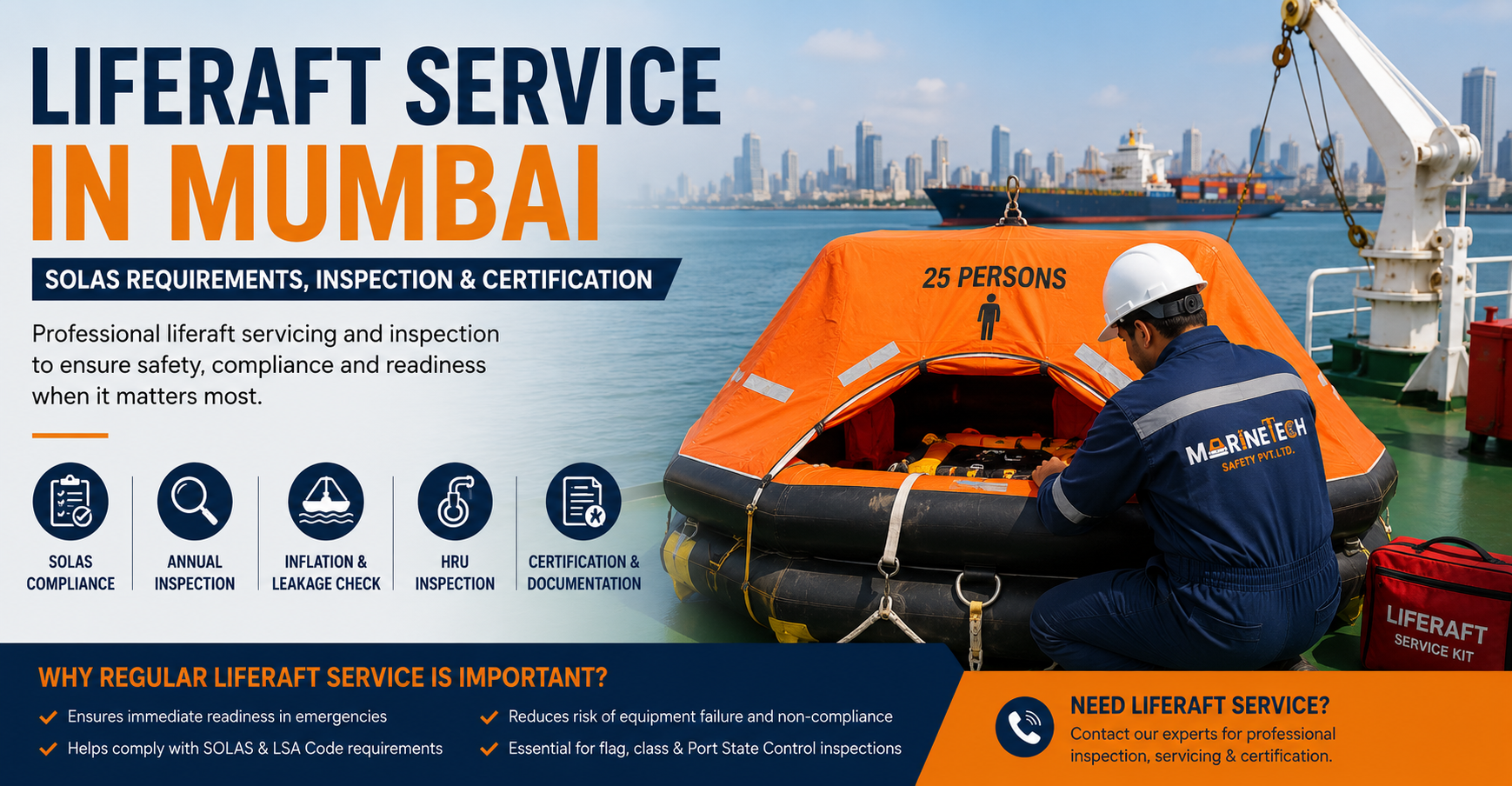
Liferaft Service in Mumbai: SOLAS Requirements, Inspection & Certification
A liferaft is one of the most
important life-saving appliances carried onboard a commercial vessel. In an
emergency such as fire, collision, flooding or abandonment of the vessel, the
liferaft may become the primary means of survival for crew members until rescue
arrives.
Because a liferaft may remain
packed and unused for long periods, regular inspection and professional
servicing are essential. A liferaft that appears to be in good condition from
the outside may still have problems with its inflation system, fabric, seams,
valves, equipment pack, hydrostatic release unit (HRU) or other components.
For vessels operating from or
calling at Mumbai, Navi Mumbai, JNPT/Nhava Sheva and other Indian ports,
selecting a competent and appropriately approved liferaft service provider is
an important part of maintaining statutory compliance and operational readiness.
In this guide, we explain the key
SOLAS requirements, liferaft inspection process, servicing intervals,
certification and what shipowners and ship managers should consider when
arranging liferaft service in Mumbai.
What Is Liferaft Servicing?
Liferaft servicing is a systematic
inspection, testing, maintenance and repacking process carried out to verify
that an inflatable liferaft and its associated equipment remain ready for
deployment.
Depending on the liferaft type,
manufacturer requirements and applicable servicing procedure, the service may
involve examination of:
- Liferaft container or valise
- Inflatable tubes and chambers
- Seams and fabric condition
- Inflation valves
- Gas inflation system
- CO2 cylinder and associated components
- Pressure and leakage condition
- Canopy and supporting structure
- Boarding arrangements
- Liferaft floor
- Painter system
- Sea anchor
- Survival equipment
- Emergency equipment pack
- Pyrotechnics and expiry dates
- Water and food rations where applicable
- First-aid equipment
- Paddles and other accessories
- Hydrostatic Release Unit (HRU), where fitted
- Identification markings and service information
The exact servicing procedure
should follow the applicable manufacturer instructions and the requirements of
the relevant administration and approval framework.
Why Is Liferaft Servicing Important?
Unlike equipment that is regularly
operated, an inflatable liferaft is normally stored in a packed condition.
Deterioration can therefore occur without being immediately visible.
Exposure to:
- Saltwater
- Humidity
- Heat
- UV radiation
- Temperature variations
- Oil and chemical contamination
- Ageing of rubber and fabric
- Mechanical damage
- Improper storage
can affect the readiness of the
equipment.
Regular servicing helps identify
defects before the liferaft is required in an actual emergency.
For shipowners and managers,
professional servicing also provides documented evidence that the equipment has
been inspected and maintained according to the applicable requirements.
What Does SOLAS Say About Liferaft Servicing?
Liferafts form part of the
life-saving appliances required under SOLAS Chapter III – Life-Saving
Appliances and Arrangements, together with the International Life-Saving
Appliance (LSA) Code.
For inflatable liferafts on
Indian-flag vessels, the Directorate General of Maritime Administration
(DGMA/DGS) states that inflatable liferafts are to be serviced at intervals of
not more than 12 months at a DGS-approved LSA service station. DGS also states
that hydrostatic release units are subject to annual servicing.
This means annual liferaft
servicing should not simply be treated as routine maintenance. It is an
important part of maintaining the vessel's life-saving appliance compliance.
Ship operators should always verify
the current requirements applicable to the vessel's flag, liferaft manufacturer
and approval status before arranging service.
How Often Should a Liferaft Be Serviced?
For Indian-flag vessels, DGS
currently specifies servicing intervals of not more than 12 months for
inflatable liferafts at an approved LSA service station.
Ship managers should maintain a
clear record of:
- Last service date
- Next service due date
- Liferaft serial number
- Manufacturer
- Capacity
- Container number
- HRU details
- Service certificate
- Service station details
- Relevant approval information
It is good practice to schedule
servicing before the due date rather than waiting until the vessel is
approaching a port or survey.
Liferaft Inspection in Mumbai: What Is Checked?
A professional liferaft inspection
normally involves a systematic examination of the complete appliance.
1. External Inspection
Technicians inspect the liferaft
container or valise for:
- Cracks
- Damage
- Corrosion
- Deformation
- Missing markings
- Damaged securing arrangements
- Evidence of water ingress
The condition of the container is
important because it protects the packed liferaft from the marine environment.
2. Liferaft Inflation and Pressure Checks
The liferaft is opened and inflated
according to the applicable servicing procedure.
Technicians check the inflation
system and examine the inflated chambers for signs of leakage, damage or
abnormal pressure loss.
3. Fabric and Seam Examination
The inflatable fabric and seams are
carefully examined for deterioration, cuts, abrasion, delamination, damage or
other defects.
Particular attention may be given
to areas exposed to mechanical stress and environmental conditions.
4. Valve and Inflation System Inspection
Inflation valves and associated
components are inspected to ensure that they are in appropriate condition and
function according to the manufacturer's servicing procedure.
5. Equipment Pack Inspection
The contents of the liferaft
emergency equipment pack are checked against the applicable requirements.
Items may include survival
equipment, first-aid equipment, signalling equipment, water, food, sea anchor,
paddles and other prescribed equipment depending on the pack and vessel
operation.
Expired, damaged or missing items
must be identified and dealt with according to the applicable requirements.
6. HRU Inspection
Where a hydrostatic release unit is
fitted, its condition and validity should be checked.
The HRU is particularly important
because it is designed to help release the liferaft automatically when the
vessel sinks below the specified water depth.
DGS currently identifies annual
servicing of hydrostatic release units as part of its life-saving appliance
maintenance requirements.
7. Repacking
After completion of the applicable
inspection and servicing procedure, the liferaft is repacked correctly into its
container or valise.
Correct packing is essential
because the liferaft must be capable of being deployed when required.
Liferaft Certification After Servicing
One of the most important documents
associated with liferaft servicing is the service certificate or servicing
documentation issued by the authorised service station.
The documentation should provide
traceability for the serviced equipment and should correspond with the actual
liferaft identification details.
Ship managers should check
information such as:
- Liferaft manufacturer
- Liferaft serial number
- Capacity
- Service date
- Next due date
- Service station
- Relevant approval number
- Competent person/service personnel details where
applicable
- HRU details
- Parts or equipment replaced during servicing
- Test or inspection results where applicable
DGS states that servicing records
should be retained onboard and be available for inspection, including
service-station information, approval details, competent-person information and
identification details of serviced items.
Why Should Shipowners Use an Approved Liferaft Service Station?
Using an appropriately approved
service station is an important part of maintaining statutory compliance.
DGS states that only DGS-approved
LSA service stations are authorised to service inflatable appliances for the
applicable Indian-flag framework.
DGS also maintains an approved list
of liferaft service stations. The current list includes Marinetech facilities
authorised for specified inflatable life-saving appliance services.
Shipowners and ship managers should
therefore verify the service station's current approval, scope of approval and
manufacturer authorisations before sending equipment for servicing.
Liferaft Service in Mumbai and JNPT
Mumbai and the wider Mumbai–Navi
Mumbai region are important maritime service locations, with vessels and
ship-management operations requiring regular maintenance of life-saving and
fire-fighting equipment.
For vessels calling at Mumbai,
JNPT/Nhava Sheva or nearby locations, arranging liferaft servicing in advance
can help avoid delays during port calls.
A professional marine safety
equipment company can coordinate:
- Equipment identification
- Collection or receipt of liferafts
- Inspection
- Servicing
- Replacement of required items
- Repacking
- Certification/documentation
- Return delivery to the vessel or customer
For ship managers, advance planning
is particularly useful when several liferafts are due for service at the same
time.
Liferaft Servicing and Port
State Control
Port State Control inspections can
examine the condition and documentation of life-saving appliances.
Common areas that may attract
attention include:
- Expired service dates
- Damaged liferaft containers
- Missing or incorrect equipment
- Expired emergency supplies
- Invalid or incomplete documentation
- Expired HRUs
- Poor storage condition
- Identification discrepancies
- Evidence that servicing requirements have not been
followed
Maintaining liferafts in
serviceable condition and keeping proper documentation helps ship operators
demonstrate that the vessel's lifesaving appliances are being appropriately
maintained.
Why Choose Marinetech Safety Pvt. Ltd. for Liferaft Service in Mumbai?
Marinetech Safety Pvt. Ltd.
provides marine safety equipment servicing and supply solutions for commercial
vessels in India.
The company provides Life Raft
Servicing and Inspection along with other lifesaving and marine safety
services.
Marinetech's liferaft service
capabilities include inspection, maintenance, repacking, testing and
certification-related servicing for applicable liferaft systems. The company's
service information also identifies approvals from major classification societies
and manufacturer approvals for various liferaft makes.
For Mumbai-area customers,
Marinetech operates from its Bhiwandi facility, providing access to the Mumbai
maritime market. The DGS approved-station list records Marinetech Safety &
Shipping Corporation at Bhiwandi–Mumbai for inflatable liferafts, rescue boats,
HRUs and immersion suits under LSA/08/2024.
Marinetech also has a broader
service network supporting shipowners and managers at important Indian maritime
locations.
Marinetech Liferaft Service Capabilities
Depending on equipment type and
applicable approval, services can include:
- Annual liferaft servicing
- Liferaft inspection
- Liferaft repacking
- Inflation and leakage checks
- Liferaft equipment inspection
- HRU inspection and replacement
- Liferaft emergency equipment checks
- Liferaft certification/documentation
- Liferaft servicing for commercial vessels
- Liferaft service support at Indian ports
Marinetech also maintains
manufacturer approvals for a range of liferaft brands, including LALIZAS,
Ningbo Haifeng, Ningbo Neptune, Ningbo Asia F.R.P., Shanghai Youlong, Shanghai
Star, Jiangsu Haining and other manufacturers listed on its approvals page.
When Should You Arrange Liferaft Service?
Do not wait until the vessel is
already alongside before checking whether the liferafts are due for servicing.
Shipowners and technical managers
should review the liferaft service schedule well in advance of:
- Annual surveys
- Flag surveys
- Class surveys
- Port calls
- Dry docking
- Vessel takeover
- Internal safety inspections
- Port State Control inspections
Advance planning gives the service
provider sufficient time to inspect the equipment and arrange any required
replacement components.
Liferaft Service Checklist for Ship Managers
Before sending a liferaft for
servicing, check:
Liferaft service due date
Liferaft serial number
Manufacturer and model
Liferaft capacity
Container condition
HRU validity
Previous service certificate
Vessel name and IMO number
Required servicing location
Applicable flag requirements
Manufacturer approval requirements
Required replacement items
Return-to-vessel schedule
Keeping this information ready can
make the servicing process faster and easier.
Conclusion
A liferaft is not simply another
item of safety equipment stored onboard a vessel. It is a critical survival
appliance that must be ready to operate when the crew needs it most.
Regular inspection, servicing,
testing, correct repacking and proper documentation are therefore essential
parts of vessel safety management.
For vessels operating in Mumbai and
the surrounding maritime region, choosing a competent and appropriately
approved liferaft service provider can help shipowners and ship managers
maintain their life-saving appliances in accordance with applicable requirements.
Marinetech Safety Pvt. Ltd.
provides professional Life Raft Servicing and Inspection services for
commercial vessels, supported by marine safety expertise, manufacturer
approvals and service infrastructure.
For detailed information about our
liferaft servicing capabilities, visit our Life Raft
Servicing and Inspection service page.
Contact Marinetech Safety Pvt. Ltd.
Phone: +91 72270 38216 | +91
79 7743 0002
Email: info@marinetechss.com
Request a Free Quote for
liferaft servicing, inspection and marine safety equipment requirements.
Frequently Asked Questions About Liferaft Service in Mumbai
1. How often should an inflatable liferaft be serviced?
For Indian-flag vessels, inflatable liferafts should be serviced at intervals of not more than 12 months at a DGS-approved LSA service station, subject to applicable requirements.2. Where can I get liferaft servicing in Mumbai?
Shipowners and ship managers can arrange professional liferaft servicing and inspection through an appropriately approved liferaft service station serving the Mumbai and Navi Mumbai maritime region.3. What is checked during annual liferaft servicing?
The servicing process can include inspection of the liferaft container, inflatable chambers, fabric, seams, valves, inflation system, equipment pack, HRU and other applicable components.4. Is a liferaft service certificate required after servicing?
Proper servicing documentation and records are important for demonstrating that the liferaft has undergone the applicable servicing process. Vessel records should be maintained and made available for inspection when required.5. What is an HRU and why is it important for a liferaft?
A Hydrostatic Release Unit (HRU) is designed to automatically release a secured liferaft when a vessel sinks to the specified depth, allowing the liferaft to reach the surface. HRUs also require appropriate inspection and servicing according to applicable requirements.6. Can liferafts be serviced before their due date?
Yes. Shipowners and technical managers can plan servicing in advance, particularly when a vessel has an upcoming port call, annual survey, dry docking or other scheduled inspection.7. Can Marinetech Safety Pvt. Ltd. service liferafts from different manufacturers?
Marinetech Safety Pvt. Ltd. has manufacturer approvals covering various liferaft brands. The applicable approval and servicing scope should be verified for the specific liferaft model before servicing.8. Why is professional liferaft servicing important for vessels calling at Mumbai?
Professional servicing helps ensure that liferafts remain properly maintained, inspected and documented according to applicable requirements. This can also help shipowners and managers prepare for flag, class and Port State Control inspections.