Blog Post
Liferaft Davit Launching Procedure as per SOLAS Requirements: Step-by-Step Guide
Posted By: Harsh Bamnolia
Posted On : 16-Sep-2026
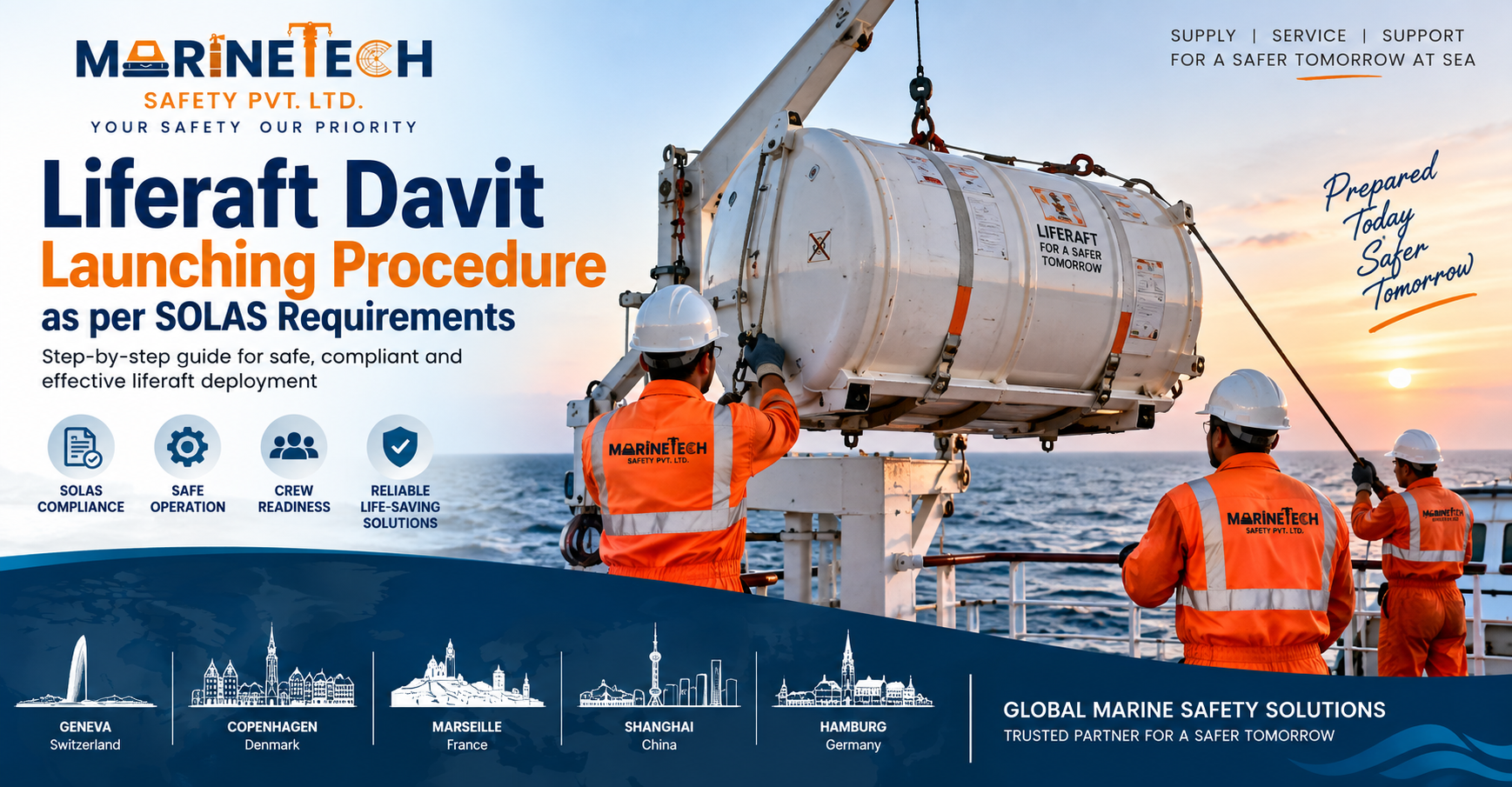
Liferaft Davit Launching Procedure as per SOLAS Requirements: Step-by-Step Guide
A liferaft davit launching
procedure is an important part of shipboard emergency preparedness. A
davit-launched liferaft is designed to provide a controlled method of launching
a survival craft from the ship's deck into the water when abandonment of the
vessel becomes necessary.
For shipowners, ship managers,
masters, chief officers, safety officers and crew, understanding the correct liferaft
davit launching procedure as per SOLAS requirements is essential for
maintaining operational readiness and ensuring that the launching arrangement
can be used safely during an emergency.
SOLAS Chapter III covers
life-saving appliances and arrangements, while the International Life-Saving
Appliance (LSA) Code provides detailed technical requirements for life-saving
appliances, including survival craft and launching arrangements. The LSA Code
is mandatory under SOLAS.
This guide explains the general
procedure for launching a davit-launched liferaft, the important SOLAS
considerations, pre-launch checks, crew safety precautions and the importance
of professional liferaft servicing.
Important: Actual launching
and servicing procedures must always follow the vessel's approved procedures,
the liferaft and davit manufacturer's instructions, the applicable Flag State
requirements and the approved onboard training/drill arrangements. This article
is an educational guide and does not replace the manufacturer's manual or
vessel SMS.
What Is a Davit-Launched Liferaft?
A davit-launched liferaft is
an inflatable survival craft designed to be launched into the water using an
approved launching appliance or davit arrangement.
Unlike a conventional
throw-overboard liferaft, the davit-launched arrangement provides a controlled
method of transferring the inflated or appropriately prepared liferaft from its
stowed position to the embarkation and launching position.
The arrangement may include
components such as:
- Liferaft container
- Davit or launching appliance
- Winch
- Falls or lifting wires
- Hooks and lifting arrangement
- Painter
- Inflation system
- Release arrangement
- Embarkation arrangement
- Securing arrangements
- Hydrostatic release arrangement, where applicable
The exact arrangement differs
according to the ship design, liferaft manufacturer, davit manufacturer and
approved installation.
SOLAS Requirements for Liferafts and Launching Arrangements
SOLAS Chapter III establishes
requirements for life-saving appliances and arrangements. The IMO's summary of
Chapter III includes requirements covering survival craft, launching stations,
survival craft launching and recovery arrangements, emergency training and
drills, and operational readiness, maintenance and inspections.
SOLAS also requires life-saving
appliances and arrangements to comply with the applicable requirements of the
LSA Code.
For launching arrangements, the
relevant requirements include considerations such as:
- Safe stowage of survival craft
- Proper launching stations
- Suitable embarkation arrangements
- Safe lowering into the water
- Adequate length and arrangement of falls where
applicable
- Operational readiness of launching appliances
- Maintenance and inspection
- Safe operation during drills and emergencies
The IMO has also introduced
mandatory requirements concerning maintenance, thorough examination,
operational testing, overhaul and repair of survival craft launching appliances
and release gear. These requirements are intended to establish a consistent and
documented safety standard for such equipment.
Liferaft Davit Launching Procedure – Step by Step
The following is a general overview
of the davit-launched liferaft launching procedure.
1. Raise the Alarm and Muster the Crew
In an actual emergency, the first
step is to follow the vessel's emergency response procedure.
The general sequence includes:
- Raise or respond to the general emergency alarm.
- Proceed to the designated muster station.
- Wear the required personal protective equipment and
lifejacket.
- Report to the assigned muster station.
- Follow the instructions of the Master and
responsible officers.
- Confirm the personnel assigned to the liferaft
station.
The crew should never attempt to
launch a liferaft independently without following the vessel's emergency
procedures.
2. Check the Launching Area
Before operating the davit, the
responsible crew should verify that the launching area is as clear and safe as
practicable.
Check for:
- Obstructions around the davit
- Loose equipment
- Mooring lines or wires
- Cargo or deck equipment
- Personnel in hazardous positions
- Discharge from overboard outlets
- Ship-side obstructions
- Sea conditions
- Clearance below and alongside the launching station
The operator should have a clear
understanding of the approved launching arrangement and emergency procedure.
3. Release the Liferaft from Its Securing Arrangement
The liferaft is normally secured in
its stowed position to prevent movement during normal vessel operations.
The securing arrangement should be
released according to the manufacturer's and vessel's approved procedure.
Crew should confirm that:
- The correct liferaft is being prepared.
- The painter is correctly arranged.
- The lifting arrangement is properly connected.
- The davit and falls are correctly positioned.
- No person is standing underneath suspended
equipment.
- The launching path is clear.
4. Connect the Liferaft to the Davit
For a davit-launched liferaft, the
approved lifting arrangement is connected to the liferaft lifting points.
The connection must be checked
carefully before lifting.
Verify:
- Correct lifting hooks
- Correct attachment points
- Proper engagement of hooks
- Correct fall arrangement
- No twisted or damaged wire
- No loose connections
- No personnel inside an unsafe area
Never improvise a lifting
connection.
5. Operate the Liferaft Inflation System
Depending on the approved system,
the liferaft is inflated using its gas inflation arrangement before launching
or in accordance with the manufacturer's approved launching sequence.
The crew should ensure that:
- The painter is correctly connected.
- Inflation equipment is correctly operated.
- The liferaft has inflated adequately.
- The canopy and buoyancy chambers have deployed
correctly.
- The liferaft is stable.
- No visible abnormality prevents safe launching.
The exact inflation sequence can
differ between liferaft models and manufacturers.
6. Position the Liferaft for Embarkation
Once the liferaft is correctly
prepared, it is positioned for embarkation according to the ship's approved
arrangement.
The responsible officer should
ensure that the embarkation area is ready and that personnel can transfer
safely.
Particular attention should be
given to:
- Ship movement
- Wind and sea conditions
- Liferaft stability
- Fall arrangement
- Embarkation ladder or platform
- Personnel positioning
- Communication between the operator and embarkation
team
7. Embark the Assigned Personnel
Personnel should board according to
the vessel's muster list and emergency instructions.
Crew should:
- Follow the responsible officer's instructions.
- Avoid overcrowding.
- Maintain three-point contact where applicable.
- Avoid jumping into the liferaft.
- Keep clear of moving equipment.
- Maintain communication with the launching team.
The number of persons permitted in
the liferaft must never exceed its approved capacity.
8. Lower the Liferaft to the Water
The davit operator then operates
the launching appliance in accordance with the approved operating instructions.
The liferaft should be lowered in a
controlled manner.
During lowering:
- Keep personnel clear of the falls and moving
machinery.
- Monitor the liferaft continuously.
- Maintain communication with the embarkation team.
- Watch for vessel movement.
- Watch for obstructions.
- Stop the operation if an unsafe condition develops.
The operator should never bypass or
defeat safety devices provided with the launching appliance.
9. Ensure Safe Waterborne Position
Once the liferaft reaches the
water, the crew should ensure that it is correctly positioned and clear of the
vessel as far as the approved arrangement permits.
The painter arrangement is
particularly important because it provides the connection between the vessel
and the inflated liferaft during deployment.
The liferaft should not be released
prematurely unless the approved operating procedure requires it.
10. Release the Liferaft
The liferaft should be released
from the launching appliance using the approved release arrangement and only at
the appropriate stage of the launching procedure.
The exact release sequence depends
on the design of the davit, lifting hooks and liferaft.
Crew must follow the manufacturer's
operating instructions.
Incorrect operation of release
arrangements can create a serious risk of injury or loss of the survival craft.
Important Safety Precautions During Liferaft Davit Launching
A liferaft launching operation
involves suspended loads, moving machinery, wires, hooks and ship movement.
Therefore, crew safety is critical.
Important precautions include:
Keep Clear of Suspended Loads
No crew member should stand beneath
a suspended liferaft or directly below the davit load.
Avoid Standing in the Line of
Fire
Crew should stay away from
potential snap-back zones, moving falls, wires and mechanical components.
Follow the Muster List
Only personnel assigned to the
launching station should perform designated duties.
Maintain Communication
The davit operator, responsible
officer and embarkation team should maintain effective communication throughout
the operation.
Follow Manufacturer Instructions
Davit and liferaft designs differ.
Therefore, a generic procedure should never override the manufacturer's
approved instructions.
Consider Weather and Sea
Conditions
Wind, swell, list, trim and vessel
movement can significantly affect a launching operation.
Never Bypass Safety Devices
Safety devices and operational
controls provided by the manufacturer should not be modified or bypassed.
Liferaft Davit Launching and SOLAS Maintenance Requirements
A launching appliance is only
useful if it is maintained in an operational condition.
SOLAS requirements address the
operational readiness, maintenance and inspection of life-saving appliances.
IMO requirements also cover maintenance, thorough examination, operational
testing, overhaul and repair of launching appliances and release gear.
The IMO's published guidance also
addresses testing of liferaft launching appliances and release arrangements,
including checking that automatic release arrangements do not release while the
load is still applied.
Therefore, ship operators should
maintain appropriate records for:
- Liferaft servicing
- Launching appliance inspection
- Davit examination
- Winch and brake testing where applicable
- Falls and wires
- Hooks and release arrangements
- HRU condition where fitted
- Manufacturer-required inspections
- Repairs and replacement parts
- Operational tests
- Certificates and service reports
Why Regular Liferaft Servicing Is Important
A liferaft may remain unused for
months or years, but it must be capable of functioning when an emergency
occurs.
Environmental conditions can
affect:
- Liferaft fabric
- Seams
- Inflation valves
- Gas cylinders
- Painter arrangements
- Canopy
- Floor
- Survival equipment
- Emergency supplies
- Hydrostatic release components
Professional servicing helps
identify deterioration before the equipment is required in an emergency.
For vessels requiring liferaft
servicing in India, Marinetech Safety Pvt. Ltd. provides inspection,
maintenance, repacking, testing and certification-related liferaft services.
You can learn more about the
company's services here:
Liferaft
Servicing by Marinetech Safety Pvt. Ltd.
Marinetech Safety Pvt. Ltd. – Liferaft Servicing in India
Marinetech Safety Pvt. Ltd.
provides marine safety equipment servicing and supply solutions for commercial
vessels in India.
The company's liferaft service
offering includes inspection, maintenance, repacking and certification-related
services for applicable liferaft systems. Its service information lists
approvals and recognition involving major classification societies and liferaft
manufacturers.
Marinetech's liferaft service
capabilities include:
- Liferaft inspection
- Liferaft annual servicing
- Liferaft repacking
- Liferaft testing
- Liferaft maintenance
- Liferaft emergency repairs
- Liferaft certification-related services
- Inspection of liferaft components
- HRU-related inspection and replacement as
applicable
- Support for different liferaft makes and models
The company's published service
information states that its liferaft servicing is supported by class approvals,
manufacturer approvals, dedicated facilities and trained personnel.
For shipowners, managers and
operators looking for liferaft servicing in India, the service can be
explored here:
Explore
Marinetech Safety Pvt. Ltd. Liferaft Servicing ?
Liferaft Servicing for Indian Ports
Marinetech Safety Pvt. Ltd.
supports marine safety requirements for vessels operating through India's major
maritime locations.
Ship operators can arrange liferaft
servicing according to vessel schedules, applicable requirements and
service-station availability.
For vessels calling at ports such
as:
- Mumbai
- Nhava Sheva / JNPT
- Mundra
- Kandla
- Surat
- Sikka
- Jamnagar
- Chennai
- Ennore / Kamarajar Port
- Visakhapatnam
- Paradip
timely servicing can help ship
operators maintain the readiness of their lifesaving appliances.
For port-specific requirements,
vessel operators should confirm the applicable Flag State, classification
society, manufacturer and local service requirements before arranging work.
Liferaft Davit Inspection Checklist
Before a planned drill or
operational test, the responsible personnel should verify the applicable vessel
procedure and manufacturer requirements.
A general checklist can include:
|
Inspection Item |
What to Check |
|
Liferaft |
Correct type, capacity and
service status |
|
Container |
Condition and securing |
|
Painter |
Correct connection and condition |
|
Davit |
Structural and operational
condition |
|
Falls |
Condition, arrangement and
certification |
|
Winch |
Operational condition |
|
Brake |
Function and approved testing
requirements |
|
Hooks |
Correct engagement and condition |
|
Release system |
Correct operation |
|
HRU |
Validity and installation where
applicable |
|
Embarkation area |
Clear and safe |
|
Launching area |
Free from obstructions |
|
Documentation |
Current certificates and records |
|
Crew |
Trained and assigned according to
muster list |
This checklist is a general guide
and should not replace the vessel's approved maintenance and drill procedures.
Common Problems Found During Liferaft and Davit Inspections
Some issues that may affect
readiness include:
Expired Liferaft Service
A liferaft that has exceeded its
required service interval may not be considered ready for emergency use.
Incorrect HRU Status
Where an HRU is fitted, its
service/replacement requirements must be checked according to the applicable
requirements and manufacturer's instructions.
Damaged or Corroded Davit
Components
Corrosion, deformation or
mechanical damage can affect the launching arrangement.
Poor Wire/Fall Condition
Falls and wires require regular
inspection and replacement in accordance with applicable requirements and
manufacturer specifications.
Improper Securing
Incorrect securing arrangements can
interfere with emergency deployment.
Missing Documentation
Incomplete servicing, inspection or
maintenance records can create difficulties during surveys and inspections.
Lack of Crew Familiarity
Even technically sound equipment
may not be used effectively if crew members are unfamiliar with the approved
operating procedure.
Liferaft Launching Drills and Crew Training
Training and drills are an
essential part of emergency preparedness.
Crew members should understand:
- Their assigned muster station
- Their role during liferaft launching
- Liferaft location
- Davit operating controls
- Painter arrangement
- Embarkation method
- Communication procedures
- Emergency release arrangements
- Personal safety precautions
SOLAS Chapter III includes
requirements related to emergency training and drills and operational
readiness.
Drills should be conducted under
controlled conditions and in accordance with the vessel's approved SMS, Flag
State requirements and applicable safety guidance.
8 Frequently Asked Questions About Liferaft Davit Launching
1. What is a davit-launched liferaft?
A davit-launched liferaft is an
inflatable survival craft designed to be transferred from its stowed position
and lowered into the water using an approved davit or launching appliance.
2. What is the liferaft davit launching procedure?
The general procedure involves
preparing the launching station, releasing the liferaft securing arrangement,
connecting the approved lifting arrangement, inflating the liferaft according
to the manufacturer's instructions, positioning it for embarkation, boarding
assigned personnel, lowering the liferaft and releasing it using the approved
arrangement.
3. Is a davit-launched liferaft covered by SOLAS?
Yes. SOLAS Chapter III establishes
requirements for life-saving appliances and arrangements, while the LSA Code
provides applicable technical requirements.
4. What should be checked before launching a liferaft?
The crew should check the
liferaft's service status, securing arrangement, painter, lifting connection,
davit, falls, hooks, release arrangement, launching area, embarkation area and
applicable documentation.
5. How often should a liferaft be serviced?
The servicing interval depends on
the applicable SOLAS requirements, Flag State requirements, liferaft
manufacturer instructions and approved servicing arrangements. For inflatable
liferafts, periodic servicing is required, and ship operators should follow the
applicable approved service schedule rather than relying on a generic interval.
6. Why is professional liferaft servicing important?
Professional servicing helps
identify defects in the raft, inflation system, fabric, seams, valves,
equipment and associated components and helps maintain the equipment in an
operational condition.
7. Can the same launching procedure be used for every liferaft?
No. Liferaft, davit and
release-system designs vary. The manufacturer's approved instructions and the
vessel's approved operating procedure should always be followed.
8. Where can I arrange liferaft servicing in India?
Marinetech Safety Pvt. Ltd.
provides liferaft inspection and servicing solutions in India. Details of its
liferaft service capabilities and service facilities are available on its Liferaft
Servicing service page.
Related Marinetech Safety Pvt. Ltd. Blogs
For additional information about
liferafts and marine safety equipment, readers can explore:
- SOLAS
Chapter III: Liferaft Requirements for Merchant Ships – Overview
of SOLAS Chapter III liferaft requirements for merchant vessels.
- Liferaft
Service in Mumbai: SOLAS Requirements, Inspection & Certification
– Information about liferaft servicing and inspection for vessels
operating around Mumbai.
- Liferaft
Service Interval as per IMO and SOLAS – Guide to liferaft
servicing intervals and maintenance considerations.
- Life
Raft Launching Procedure: Step-by-Step Guide – General guidance on
life raft launching procedures.
- The
Role of a Hydrostatic Release Mechanism for a Liferaft – Learn
about the role of HRUs in liferaft deployment arrangements.
- Liferaft
Servicing in India: Complete Guide for Ship Owners – Practical
information about liferaft servicing requirements in India.
Why Choose Marinetech Safety Pvt. Ltd.?
Marinetech Safety Pvt. Ltd.
provides marine safety equipment service and supply solutions for
commercial vessels.
Its marine safety service portfolio
includes lifesaving and firefighting equipment servicing along with other
marine safety and technical services.
For liferafts, Marinetech's
published service information includes inspection, maintenance, repacking,
certification-related services and support for multiple liferaft types. The
company also publishes class and manufacturer approval information for its liferaft
service activities.
For detailed information, visit:
Marinetech
Safety Pvt. Ltd. – Liferaft Servicing
A properly executed liferaft davit launching procedure is an important component of shipboard emergency preparedness. The effectiveness of the operation depends not only on crew training but also on the condition of the liferaft, davit, winch, falls, hooks, release arrangements and associated equipment.
SOLAS Chapter III and the LSA Code
provide the regulatory framework for life-saving appliances and arrangements,
while the applicable manufacturer instructions, Flag State requirements and
vessel SMS provide the operational details that must be followed onboard.
Regular inspection, maintenance,
servicing and operational testing help ensure that the liferaft and its
launching arrangement remain ready for use when required.
For professional liferaft
servicing in India, contact Marinetech Safety Pvt. Ltd.
Service Page: https://marinetechss.com/services/liferaft-servicing
Email: info@marinetechss.com
Marinetech Safety Pvt. Ltd. —
Marine Safety Equipment Service & Supply