Blog Post
SOLAS Chapter III: Liferaft Requirements for Merchant Ships | Complete Guide
Posted By: Harsh Bamnolia
Posted On : 14-Sep-2026
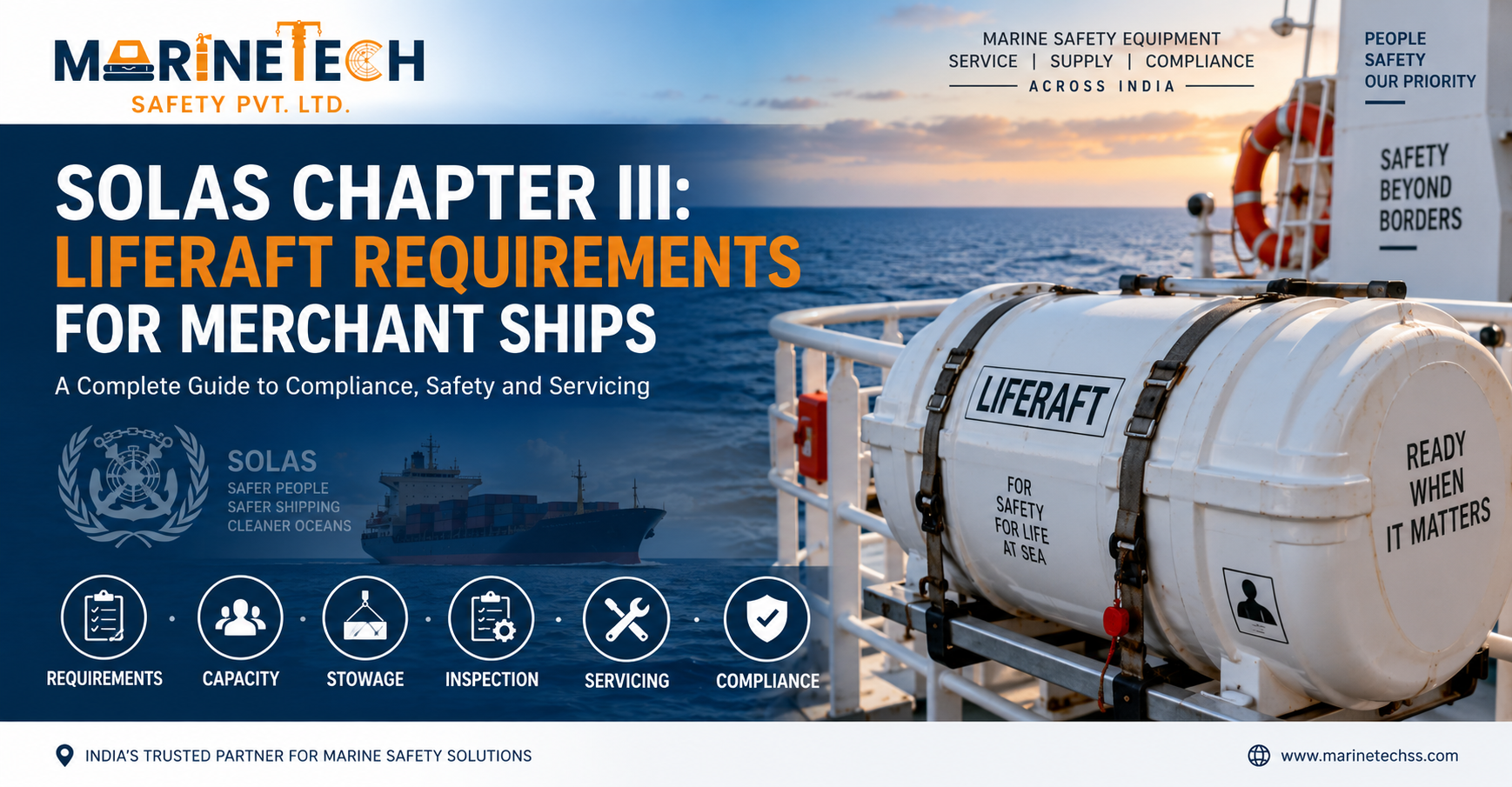
SOLAS Chapter III: Liferaft Requirements for Merchant Ships
For every merchant ship,
life-saving appliances are critical equipment designed to protect crew and
passengers during emergencies such as fire, collision, grounding, flooding or
abandonment of the vessel. Among these appliances, liferafts play a
vital role as survival craft when evacuation from the vessel becomes necessary.
The requirements for liferafts
carried onboard merchant ships are primarily governed by the International
Convention for the Safety of Life at Sea (SOLAS), Chapter III – Life-Saving
Appliances and Arrangements, together with the International Life-Saving
Appliance (LSA) Code.
For shipowners, ship managers,
technical superintendents and vessel operators, understanding these
requirements is essential not only for crew safety but also for maintaining
statutory compliance and avoiding deficiencies during Flag State
inspections, Port State Control (PSC) inspections, class surveys and safety
audits.
In this guide, we explain the
important SOLAS Chapter III liferaft requirements for merchant ships,
liferaft capacity and arrangements, servicing requirements, inspection
considerations and how professional liferaft servicing helps maintain emergency
readiness.
What Is SOLAS Chapter III?
SOLAS Chapter III establishes
requirements for life-saving appliances and arrangements carried on
ships.
The chapter covers a wide range of
equipment, including:
- Lifeboats
- Liferafts
- Rescue boats
- Lifejackets
- Immersion suits
- Lifebuoys
- Marine evacuation systems
- Launching appliances
- Embarkation arrangements
- Other life-saving appliances
The technical requirements for many
of these appliances are contained in the International LSA Code, which
is mandatory under SOLAS.
The LSA Code provides detailed
requirements relating to the construction, performance, equipment and
arrangements of survival craft and other life-saving appliances.
For merchant ships, therefore,
liferaft compliance should be considered from two perspectives:
- SOLAS Chapter III statutory requirements
- Technical requirements of the International LSA
Code
1. Liferaft Capacity Must Be Adequate
One of the most important
considerations is the capacity of the survival craft.
The liferaft arrangement must
provide sufficient survival-craft capacity for the persons onboard as required
by the applicable SOLAS provisions.
Depending on the vessel
configuration, liferafts may be arranged on different sides of the ship and may
be associated with launching appliances or other approved arrangements.
The objective is to ensure that
personnel have an effective means of abandoning the vessel and entering
survival craft during an emergency.
Why Is Liferaft Capacity
Important?
Incorrect or insufficient capacity
can become a serious safety and compliance issue.
During vessel inspections, ship
operators should verify:
- Number of persons onboard
- Approved liferaft capacity
- Number of liferafts
- Location of each liferaft
- Port and starboard survival-craft arrangements
- Launching arrangements where applicable
- Stowage position
- Accessibility
- Hydrostatic release arrangements
- Valid servicing status
Any change in crew complement or
vessel configuration should be reviewed against the approved safety equipment
arrangements.
2. Liferafts Must Be Properly Stowed
Liferafts must be arranged so that
they can be readily available for use in an emergency.
Correct stowage is essential
because even a fully serviceable liferaft becomes ineffective if it cannot be
released or launched when required.
Important stowage considerations
include:
- Secure attachment
- Correct securing arrangements
- Accessibility
- Proper location
- Clear deployment area
- Correct painter arrangement
- Hydrostatic release arrangement where applicable
- Protection from damage
- Correct identification and markings
The liferaft should not be
obstructed by cargo, equipment or structural modifications that could interfere
with deployment.
3. Hydrostatic Release Units and Liferaft Deployment
Where liferafts are arranged for
automatic release, the Hydrostatic Release Unit (HRU) is an important
component of the deployment arrangement.
The HRU is designed to release the
liferaft container or securing arrangement when a vessel sinks and reaches the
required water pressure.
Ship operators should verify:
- HRU approval
- Installation condition
- Correct connection
- Expiry/replacement date
- Weak link condition
- Correct securing arrangement
- Manufacturer instructions
An expired or incorrectly installed
HRU can compromise the intended automatic release arrangement.
Therefore, HRU inspection should
form part of the vessel's life-saving appliance maintenance programme.
4. Liferaft Equipment Must Meet Applicable Requirements
A SOLAS liferaft is not simply an
inflatable survival chamber.
It is supplied with a range of
survival equipment intended to support persons until rescue.
Depending on the applicable
liferaft type and equipment pack, items can include:
- Paddles
- Buoyant rescue knife
- Bailer
- Sponge
- Sea anchor
- Repair kit
- Inflation pump or bellows where applicable
- Waterproof torch
- First-aid equipment
- Signalling equipment
- Pyrotechnic distress signals
- Drinking water
- Food rations
- Thermal protective aids
- Fishing equipment
- Radar reflector or equivalent equipment where
applicable
The exact equipment configuration
should always be checked against the approved liferaft specification,
applicable LSA Code requirements, manufacturer instructions and Flag State
requirements.
During servicing, expired, damaged
or missing items should be identified and replaced with approved equipment as
applicable.
5. Liferaft Servicing Is a Critical SOLAS Maintenance Requirement
A liferaft may remain packed inside
its container for months without being deployed.
This does not mean that it remains
automatically ready for use.
Marine environmental conditions can
affect:
- Fabric
- Seams
- Valves
- Inflation system
- CO2 cylinder
- Container
- Canopy
- Floor
- Painter
- Survival equipment
- HRU
- Other associated components
For this reason, inflatable
liferafts require periodic servicing at an approved servicing station in
accordance with applicable requirements.
SOLAS Regulation III/20 contains
requirements relating to operational readiness, maintenance and inspections of
life-saving appliances, including servicing arrangements for inflatable
liferafts.
6. What Happens During Liferaft Servicing?
Professional liferaft servicing
normally involves a systematic inspection, testing, maintenance and repacking
process.
The exact procedure depends on the
liferaft manufacturer, model, approval and applicable servicing requirements.
A typical service may include:
Step 1 – Identification and
Documentation
The liferaft is identified using
information such as:
- Manufacturer
- Model
- Serial number
- Capacity
- Manufacturing information
- Previous service details
- Service station records
The service history is reviewed
before opening the liferaft.
Step 2 – Container Inspection
The container or valise is examined
for:
- Cracks
- Damage
- Corrosion
- UV deterioration
- Fastener problems
- Identification markings
- Securing arrangements
Step 3 – Inflation
The liferaft is inflated in a
controlled servicing environment.
Technicians examine:
- Buoyancy chambers
- Valves
- Seams
- Fabric
- Canopy
- Floor
- Boarding arrangements
- Internal and external components
Step 4 – Leak and Pressure
Checks
The inflated raft is checked for
pressure retention and leakage according to the applicable servicing procedure.
This helps identify defects that
may not be visible during a simple external inspection.
Step 5 – CO2 Inflation System
Inspection
The inflation system and cylinder
are examined as applicable.
Checks can include:
- Cylinder condition
- Weight
- Valve condition
- Connection
- Corrosion
- Expiry or test status
- Manufacturer requirements
Step 6 – Emergency Equipment Inspection
The equipment pack is opened and
checked.
Expired, missing or damaged items
are replaced as required.
Step 7 – Repairs
If defects are identified, repairs
should be performed using appropriate manufacturer-approved procedures,
materials and components.
Step 8 – Cleaning, Drying and
Repacking
After completion of the servicing
procedure, the liferaft is properly dried, folded and repacked according to the
manufacturer's approved procedure.
Step 9 – Sealing and
Certification
The serviced liferaft is sealed and
relevant service documentation/certification is issued in accordance with the
applicable requirements.
7. Liferaft Servicing Frequency
The servicing interval for an
inflatable liferaft should be determined according to SOLAS requirements,
applicable IMO servicing guidelines, manufacturer instructions and the
requirements of the Administration/Flag State.
For most conventional inflatable
liferafts on merchant ships, annual servicing at an approved service station
is the normal maintenance requirement.
Shipowners should not rely solely
on the date printed on an old certificate.
The vessel's planned maintenance
system should track:
- Liferaft service due date
- HRU replacement date
- Liferaft certificate
- Manufacturer requirements
- Emergency equipment expiry dates
- Other associated inspection requirements
For vessels with upcoming PSC
inspections, Flag State surveys, class surveys or SMC/DOC-related audits,
the life-saving appliance records should be reviewed in advance.
8. Why Approved Liferaft Servicing Matters
Liferaft servicing should not be
treated simply as a certificate-renewal exercise.
The objective is to verify that the
liferaft can perform its intended safety function.
Using an appropriate approved
service station helps ensure that:
- Correct servicing procedures are followed
- Trained technicians conduct the inspection
- Manufacturer requirements are considered
- Defects are identified
- Expired equipment is replaced
- Liferafts are correctly repacked
- Service documentation is maintained
- Statutory compliance can be demonstrated
For shipowners and ship managers,
choosing the correct service provider is therefore an important part of the
vessel's safety management system.
SOLAS Liferaft Requirements and Port State Control
Port State Control officers may
examine life-saving appliances during vessel inspections.
Potential areas of concern can
include:
- Expired liferaft servicing
- Damaged liferaft container
- Incorrect stowage
- Defective securing arrangements
- Expired HRU
- Missing equipment
- Damaged liferaft fabric
- Defective inflation arrangements
- Incomplete maintenance records
- Incorrect certification
- Obstructed launching arrangements
A vessel's life-saving appliances
should therefore be maintained in a condition that allows them to be immediately
used in an emergency.
Regular inspection and proper
documentation can significantly reduce the risk of avoidable deficiencies.
Marinetech Safety Pvt. Ltd. – Liferaft Servicing in India
Marinetech Safety Pvt. Ltd.
provides marine safety equipment servicing and supply solutions for shipowners,
ship managers, operators and vessels calling at ports across India.
Our liferaft service capabilities
include:
- Liferaft annual servicing
- Liferaft inspection
- Inflation and pressure testing
- Liferaft repacking
- Emergency equipment inspection
- CO2 cylinder inspection
- HRU inspection/replacement as applicable
- Liferaft repairs
- Floor seam testing where applicable
- NAP testing where applicable
- GI testing where applicable
- Service documentation and certification
Marinetech's liferaft servicing
operation is supported by class and manufacturer approvals for applicable
liferaft makes and models.
Our service information identifies
approvals/recognition involving major classification societies and manufacturer
approvals for various liferaft brands.
For shipowners and managers looking
for liferaft servicing in India, our service network supports vessels
calling at major Indian maritime locations.
Liferaft Servicing Locations
Depending on vessel requirements
and service arrangements, Marinetech supports customers around major Indian
ports including:
- Mumbai
- JNPT / Nhava Sheva
- Mundra
- Kandla
- Hazira
- Dahej
- Surat
- Sikka
- Vadinar
- Pipavav
- Goa
- Mangalore
- Kochi
- Chennai
- Ennore
- Visakhapatnam
- Kakinada
- Paradip
- Haldia
- Kolkata
- Other Indian ports as required
For detailed information about our
capabilities, inspection process, approvals and service locations, visit the Marinetech
Safety Pvt. Ltd. Liferaft Servicing service page.
Frequently Asked Questions About SOLAS Liferaft Requirements
1. What SOLAS chapter covers liferaft requirements?
Liferaft requirements for ships are
primarily covered under SOLAS Chapter III – Life-Saving Appliances and
Arrangements, together with the mandatory International LSA Code.
2. How often should an inflatable liferaft be serviced?
Inflatable liferafts on merchant
ships are generally serviced at 12-month intervals by an appropriately
approved service station, subject to applicable SOLAS/IMO requirements,
manufacturer instructions and Flag State requirements.
3. What is checked during liferaft servicing?
Depending on the liferaft type and
applicable procedure, servicing can include inspection of the container,
inflation system, buoyancy chambers, seams, valves, floor, canopy, CO2
cylinder, emergency equipment, painter, sea anchor, HRU and other applicable
components.
4. Is liferaft servicing required by SOLAS?
Yes. SOLAS Chapter III includes
requirements for the maintenance, inspection and servicing of life-saving
appliances, including inflatable liferafts. Applicable IMO servicing guidelines
and manufacturer requirements should also be followed.
5. What is the International LSA Code?
The International Life-Saving
Appliance (LSA) Code provides detailed technical requirements for life-saving
appliances covered by SOLAS, including survival craft such as liferafts and
lifeboats.
6. What is an HRU on a liferaft?
An HRU, or Hydrostatic Release
Unit, is a device used in applicable liferaft arrangements to release the
liferaft from its securing arrangement when the vessel sinks to a specified
depth, allowing the raft to float free.
7. Can any marine company service a SOLAS liferaft?
Liferaft servicing should be
performed by an appropriately approved/authorized service station using
qualified personnel and procedures applicable to the liferaft's manufacturer,
model and approval requirements.
8. Where does Marinetech Safety Pvt. Ltd. provide liferaft servicing?
Marinetech supports liferaft
servicing requirements at major Indian maritime locations, including Mumbai,
JNPT, Mundra, Kandla, Hazira, Dahej, Chennai, Ennore, Visakhapatnam, Paradip
and other ports depending on vessel and service requirements.