Blog Post
Marine Calibration Services in India: Ports, Equipment & Service Process
Posted By: Harsh Bamnolia
Posted On : 19-Aug-2026
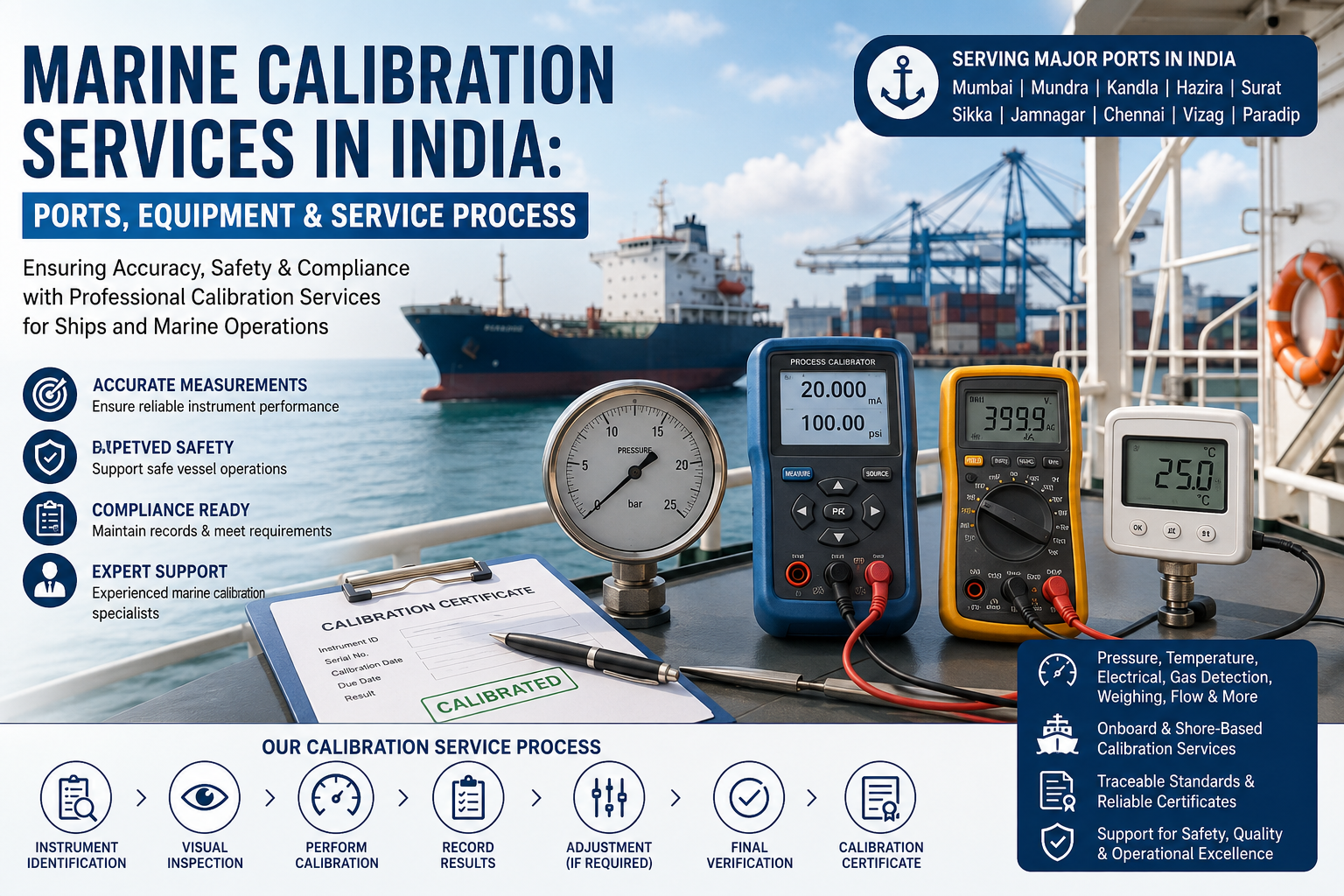
Marine Calibration Services in India: Ports, Equipment and Service Process
Accurate measurement is essential
for the safe operation, maintenance and regulatory management of ships.
Marine vessels rely on a wide range
of instruments to measure pressure, temperature, electrical parameters, weight,
gas concentration, flow and other critical operating conditions. If these
instruments provide inaccurate readings, engineers may make incorrect
operational or maintenance decisions.
This is why marine instrument
calibration is an important part of a vessel's maintenance and
measurement-control program.
India has several major maritime
hubs where vessels regularly require technical inspection, servicing, testing
and calibration support. These include Mumbai, Mundra, Kandla, Hazira,
Surat, Sikka, Jamnagar, Chennai, Visakhapatnam (Vizag) and Paradip, among
others.
This guide explains:
- What marine calibration services are
- Which instruments are commonly calibrated
- Why calibration is important for ships
- How the marine calibration process works
- What documentation should be maintained
- Where calibration services can be arranged in India
- How shipowners and managers can select a
calibration service provider
What Are Marine CalibrationServices?
Marine calibration services involve
the inspection, testing and comparison of measurement instruments against
suitable reference standards.
The purpose is to determine whether
an instrument is measuring within its specified accuracy or tolerance.
Depending on the instrument,
calibration may involve parameters such as:
- Pressure
- Temperature
- Voltage
- Current
- Resistance
- Frequency
- Weight
- Gas concentration
- Flow
- Humidity
A calibration service may include:
- Instrument identification
- Visual inspection
- Reference-standard verification
- Measurement testing
- Error determination
- Adjustment where applicable
- Final verification
- Calibration documentation
The exact procedure depends on the
instrument type, manufacturer instructions, measurement range and applicable
calibration requirements.
Why Is Marine Calibration Important?
Marine instruments often operate in
demanding conditions.
Ships are exposed to:
- Continuous vibration
- Temperature fluctuations
- Humidity
- Salt-laden atmosphere
- Corrosion
- Mechanical shock
- Electrical disturbances
- Heavy operating cycles
Over time, these conditions can
cause measurement drift.
Regular calibration helps ship
operators maintain confidence in instrument readings.
Key Benefits
Accurate Measurements
Calibration helps verify that instruments
are providing measurements within their specified tolerance.
Improved Operational Safety
Accurate readings are important
when monitoring safety-critical systems and machinery.
Better Maintenance Decisions
Engineers rely on accurate
measurements when diagnosing machinery and equipment.
Regulatory and Quality Support
Depending on the equipment and
application, calibration records may be required to demonstrate measurement
control.
Reduced Risk of Incorrect Readings
Calibration can identify
measurement errors before they contribute to operational problems.
Which Marine Instruments Require Calibration?
The exact equipment requiring
calibration depends on the vessel and its measurement-control program.
Common examples include:
1. Pressure Gauges
Pressure gauges can be found
throughout marine machinery and safety systems.
Applications may include:
- Fuel systems
- Lubricating oil systems
- Hydraulic systems
- Air systems
- Steam systems
- Fire-fighting systems
- Refrigeration systems
Calibration verifies the gauge's
indication against a suitable pressure reference.
2. Pressure Transmitters
Pressure transmitters are commonly
used with automation and monitoring systems.
Calibration may verify:
- Input pressure
- Output signal
- Measurement accuracy
- Zero point
- Span
- Response
3. Temperature Instruments
Marine temperature measurement
equipment can include:
- RTDs
- Thermocouples
- Temperature gauges
- Digital thermometers
- Temperature transmitters
- Temperature controllers
Applications may include:
- Main engine
- Auxiliary engines
- Cooling water
- Lubricating oil
- Fuel
- Exhaust systems
- Refrigeration
4. Gas Detectors
Gas detection instruments are
important safety equipment on many types of vessels.
Depending on the equipment and
application, calibration may involve testing against known gas concentrations.
The calibration frequency and
procedure should follow the manufacturer's instructions and applicable
vessel/company requirements.
5. Electrical Test Instruments
Marine workshops and engineering
departments commonly use:
- Digital multimeters
- Clamp meters
- Insulation resistance testers
- Voltage testers
- Current meters
- Frequency meters
Calibration helps ensure that
electrical measurements used during troubleshooting and maintenance are
reliable.
6. Weighing Scales
Marine service workshops may use
weighing equipment for:
- Gas cylinders
- Fire extinguishing agents
- Liferaft cylinders
- Marine equipment servicing
- Workshop measurements
The required calibration accuracy
depends on the application.
7. Flow Instruments
Flow measurement equipment can be
used for:
- Fuel
- Water
- Cooling systems
- Process systems
- Other shipboard applications
The calibration method depends on
the instrument technology and required measurement range.
8. Torque Measuring Equipment
Torque tools and measuring devices
used for machinery maintenance may require periodic calibration.
Accurate torque measurement is
important when equipment requires controlled tightening according to
manufacturer's specifications.
Marine Calibration Service Process
A professional marine calibration
service should follow a structured process.
Step 1: Identify the Instrument
The first step is to record the
instrument's:
- Manufacturer
- Model
- Serial number
- Instrument ID
- Measurement range
- Location
- Vessel name
- Application
This information should be recorded
accurately on the calibration documentation.
Step 2: Review Calibration Requirements
Before testing, the service
provider should determine the applicable requirements.
These may come from:
- Manufacturer instructions
- Company procedures
- Planned Maintenance System
- Instrument specifications
- Class requirements
- Flag requirements
- Applicable statutory requirements
- Customer specifications
Step 3: Visual Inspection
The instrument is inspected for
obvious problems such as:
- Physical damage
- Corrosion
- Cracks
- Broken connectors
- Damaged cables
- Display problems
- Contamination
- Signs of unauthorized modification
If an instrument is damaged, it may
require repair before calibration.
Step 4: Select Suitable Reference Equipment
The calibration should be performed
against an appropriate reference standard suitable for the measurement
parameter and required accuracy.
Examples include:
- Pressure calibrators
- Temperature calibrators
- Multifunction calibrators
- Electrical reference meters
- Certified weights
- Gas calibration equipment
The reference equipment should have
appropriate calibration and traceability documentation.
Step 5: Perform Calibration
The instrument is tested at
appropriate points across its measurement range.
For example, a pressure instrument
may be tested at several points such as:
- Low range
- Mid range
- High range
The actual test points and
procedure depend on the instrument and applicable calibration method.
Step 6: Record Results
Calibration results should be
recorded systematically.
Depending on the instrument,
records can include:
- Applied value
- Indicated value
- Error
- Tolerance
- Measurement uncertainty where applicable
- Reference standard
- Environmental conditions where relevant
Step 7: Adjustment or Repair
If the instrument is outside the
specified tolerance, an adjustment or repair may be considered if permitted by
the manufacturer and applicable procedure.
After adjustment, the instrument
should normally be rechecked.
Step 8: Final Verification
The instrument is tested again to
confirm its final performance.
The final result should clearly
indicate whether the instrument meets the applicable acceptance criteria.
Step 9: Issue Calibration Documentation
A calibration certificate or report
should be issued according to the service scope.
The document should provide
sufficient information to identify the instrument and understand the
calibration performed.
What Should a Marine Calibration Certificate Contain?
A calibration certificate may
include:
- Certificate number
- Customer name
- Vessel name
- Instrument identification
- Manufacturer
- Model
- Serial number
- Measurement range
- Calibration date
- Calibration location
- Reference standards
- Test points
- Calibration results
- Error values
- Acceptance criteria
- Traceability information
- Environmental conditions where applicable
- Technician/service details
- Calibration status
- Next calibration due date, where applicable
The exact certificate content
depends on the calibration procedure and applicable requirements.
Calibration Traceability
Traceability is an important part
of a reliable calibration system.
The reference equipment used for
calibration should have suitable documentation demonstrating its own
calibration status and traceability.
Shipowners should review
calibration certificates to verify:
- Reference standard identification
- Calibration status
- Certificate number
- Validity
- Measurement range
- Applicable traceability information
A certificate should not simply be
filed without checking whether the documented information is appropriate for
the instrument being calibrated.
Where Are Marine CalibrationServices Available in India?
India's maritime industry is
supported by several major ports and marine service hubs.
Shipowners and managers may require
calibration support based on vessel schedules, port calls, dry-docking
activities, repair periods and planned maintenance requirements.
Mumbai
Mumbai is a major maritime and
commercial hub with extensive ship management, marine engineering and
vessel-support activity.
Marine calibration requirements may
arise during:
- Port calls
- Ship repairs
- Equipment servicing
- Planned maintenance
- Pre-inspection preparation
Target SEO terms: Marine
Calibration Services Mumbai, Ship Instrument Calibration Mumbai, Marine
Equipment Calibration Mumbai
Mundra
Mundra is one of India's major
commercial and maritime hubs and handles significant vessel traffic.
Calibration services may be
required for vessels undergoing:
- Port operations
- Maintenance
- Cargo-related activities
- Marine equipment servicing
- Inspection preparation
Target SEO terms: Marine
Calibration Services Mundra, Ship Calibration Mundra, Marine Instrument
Calibration Mundra
Kandla
Kandla and the wider Kutch maritime
region support significant commercial shipping and marine operations.
Calibration support may be required
for shipboard measurement equipment and marine service workshops.
Target SEO terms: Marine
Calibration Services Kandla, Ship Instrument Calibration Kandla
Hazira and Surat
Hazira and Surat are important
industrial and maritime locations in Gujarat.
Marine calibration requirements can
arise from:
- Ship operators
- Marine workshops
- Industrial vessels
- Offshore support operations
- Equipment servicing companies
Target SEO terms: Marine
Calibration Services Hazira, Marine Calibration Services Surat, Ship Instrument
Calibration Surat
Sikka and Jamnagar
Sikka and Jamnagar are important
locations for marine and energy-related operations.
Calibration services can support
measurement instruments used onboard vessels and during marine equipment
maintenance.
Target SEO terms: Marine
Calibration Services Sikka, Marine Calibration Services Jamnagar, Ship
Calibration Sikka
Chennai
Chennai is a major maritime and
ship-service hub on India's east coast.
Vessels may require calibration
support during:
- Port calls
- Ship repair
- Dry-docking
- Marine equipment servicing
- Technical inspections
Target SEO terms: Marine
Calibration Services Chennai, Ship Instrument Calibration Chennai
Visakhapatnam (Vizag)
Vizag is an important port and
shipbuilding, repair and marine engineering center.
Calibration requirements may arise
from vessels, shipyards and marine technical operations.
Target SEO terms: Marine
Calibration Services Vizag, Marine Instrument Calibration Visakhapatnam
Paradip
Paradip is a major eastern Indian
port supporting bulk cargo and industrial maritime operations.
Marine calibration services can
support vessels during port calls, maintenance and technical service
activities.
Target SEO terms: Marine
Calibration Services Paradip, Ship Instrument Calibration Paradip
Onboard vs Shore-Based Calibration
Depending on the instrument and
vessel schedule, calibration can be performed onboard or at a suitable
shore-based facility.
Onboard Calibration
Onboard service can be useful when:
- The vessel is operational
- Equipment cannot easily be removed
- Port time is limited
- Multiple instruments require inspection
- Calibration needs to be completed during a port
call
Advantages can include reduced equipment
removal and minimal disruption to vessel operations.
Shore-Based Calibration
Shore-based calibration may be
preferred when:
- Specialized laboratory equipment is required
- The instrument needs repair
- High-accuracy calibration is required
- Equipment must be removed from the vessel
- The manufacturer specifies a particular calibration
method
The appropriate approach depends on
the instrument and calibration requirements.
How Often Should Marine Instruments Be Calibrated?
There is no universal calibration
interval for every marine instrument.
The appropriate interval should
consider:
- Manufacturer recommendations
- Instrument criticality
- Operating conditions
- Frequency of use
- Historical calibration results
- Accuracy requirements
- Company procedures
- Class requirements
- Flag requirements
- Applicable statutory requirements
Many organizations use 12 months
as a common planning interval, but this should not automatically be
considered a mandatory requirement for every instrument.
Safety-critical or high-drift
instruments may require more frequent verification or calibration.
How to Choose a Marine Calibration Service Provider in India
Shipowners should consider several
factors before selecting a calibration service provider.
Technical Capability
The provider should have suitable
equipment and competence for the required measurement parameters.
Suitable Reference Standards
Calibration should be performed
using appropriate reference equipment with relevant calibration and
traceability documentation.
Marine Experience
Marine applications have specific
operational requirements. Experience with shipboard equipment can help ensure
the service is practical and relevant.
Documentation
The service provider should issue
clear calibration documentation that identifies the instrument and records the
results.
Port Coverage
For vessels, service availability
at major ports can be important.
Response Time
Port calls often have limited time.
A service provider should be able to coordinate efficiently with the vessel's
schedule.
Service Scope
Shipowners should confirm whether
the provider can support the complete requirement, including:
- Inspection
- Calibration
- Adjustment
- Repair
- Recalibration
- Certification
- Documentation
Common Marine Calibration Problems
Expired Calibration
Instruments may remain in service
after their calibration due date if records are not properly monitored.
Incorrect Instrument
Identification
Incorrect serial numbers or
equipment descriptions can make certificates difficult to trace.
Inadequate Reference Equipment
The reference standard must be
suitable for the instrument and required measurement accuracy.
Poor Documentation
Missing calibration results,
traceability details or instrument identification can weaken calibration
records.
No Follow-Up After Failure
An out-of-tolerance instrument
should be assessed and corrective action should be documented.
Marine Calibration Checklist for Shipowners
Before arranging calibration,
shipowners or technical managers can prepare the following information:
- Vessel name
- Port and expected service date
- Instrument list
- Manufacturer
- Model
- Serial number
- Measurement range
- Required accuracy
- Last calibration date
- Calibration certificate
- Calibration due date
- Instrument location
- Equipment condition
- Applicable manufacturer requirements
- Class/flag requirements where applicable
- Required calibration points
- Required certificate format
Preparing this information in
advance can help reduce delays during vessel service.
Marine Calibration Services by Marinetech Safety Pvt. Ltd.
Marinetech Safety Pvt. Ltd.
provides marine safety equipment servicing, inspection and calibration support
for shipowners, ship managers and marine operators.
Our marine calibration services can
support applicable measurement instruments depending on:
- Instrument type
- Measurement parameter
- Measurement range
- Required accuracy
- Calibration method
- Service location
- Customer requirements
Services can be coordinated at
major Indian maritime locations including:
Mumbai | Mundra | Kandla |
Hazira | Surat | Sikka | Jamnagar | Chennai | Vizag | Paradip
Our team can support ship operators
with calibration planning, instrument identification, testing, calibration
documentation and related marine equipment service requirements.
For statutory or safety-critical
instruments, the applicable manufacturer, flag, class and regulatory
requirements should be confirmed before finalizing the calibration scope.
Frequently Asked Questions
1. What are marine calibration services?
Marine calibration services involve
testing and comparing shipboard measurement instruments against suitable
reference standards to verify their accuracy and performance.
2. Which marine instruments require calibration?
Common examples include pressure
gauges, temperature instruments, gas detectors, electrical test meters,
weighing scales, flow instruments and other measurement equipment.
3. How often should marine instruments be calibrated?
The interval depends on the
instrument, manufacturer recommendations, criticality, operating environment,
historical performance and applicable requirements. Twelve months is commonly
used as a planning interval for many instruments.
4. Is annual calibration mandatory for all marine instruments?
No. There is no universal rule requiring
every marine instrument to be calibrated annually. The applicable interval
should be determined based on the relevant technical and regulatory
requirements.
5. Can marine instruments be calibrated onboard?
Yes, where the instrument,
calibration method, reference standards and service conditions permit. Some
instruments may instead require shore-based or laboratory calibration.
6. What is included in a calibration certificate?
A calibration certificate can
include instrument identification, calibration date, reference standards,
measurement results, errors, tolerances and traceability information.
7. Can calibration services be arranged at Indian ports?
Yes, marine calibration services
can be coordinated at major Indian maritime locations, subject to equipment
type, scope, vessel schedule and service requirements.
8. Why is calibration important for ship safety?
Accurate instruments provide
reliable measurement information to the crew and engineers. This can support
safe operation, effective maintenance and identification of abnormal
conditions.
Conclusion
Marine calibration services in
India play an important role in maintaining accurate measurement systems
onboard ships and within marine service operations.
From pressure gauges and
temperature sensors to gas detectors, electrical test equipment and weighing
instruments, calibration helps shipowners verify that measurement equipment
remains within its required accuracy.
A successful marine calibration
program should combine:
- Appropriate calibration intervals
- Suitable reference standards
- Competent service personnel
- Accurate instrument identification
- Proper calibration procedures
- Traceable documentation
- Effective due-date management
- Corrective action for failed instruments
With major maritime hubs such as Mumbai,
Mundra, Kandla, Hazira, Surat, Sikka, Jamnagar, Chennai, Vizag and Paradip,
shipowners have multiple locations where marine technical services can be
coordinated according to vessel schedules.
Marinetech Safety Pvt. Ltd.
supports shipowners and marine operators with calibration, inspection and
marine equipment service requirements across major Indian ports.
Need Marine Calibration Servicesin India?
Marinetech Safety Pvt. Ltd.
Phone: +91 79 7743 0002 |
+91-72270 38216
Email: info@marinetechss.com
Contact us for marine instrument
calibration, shipboard equipment calibration, inspection and marine technical
service support at major Indian ports.
Related Blogs
1. IMO MSC.1/Circ.1318/Rev.1
Explained: Complete Guide to Fixed CO2 Fire Extinguishing System Inspection
(2026)
SEO Keywords: fire fighting
equipment, ship fire fighting system, IMO MSC.1/Circ.1318/Rev.1, Fixed CO2
System, Fixed CO2 Fire Extinguishing System, CO2 System Inspection, CO2 System
Maintenance, CO2 Fire Suppression System, Marine Fire Safety, Marine Safety,
SOLAS Compliance, SOLAS Chapter II-2
2. Marine Navigation &
Communication Equipment Supplier in India: Complete Guide for Ship Managers
SEO Keywords: AIS
transponder supplier India, ECDIS supplier India, VHF radio ship India,
Inmarsat terminal supplier India, navcom equipment India, marine radar supplier
India
3. Life Saving Equipment for
Ships: What SOLAS Requires & What Marinetech Supplies
SEO Keywords: life saving
equipment ship India, LSE supplier India, lifejacket supplier India, immersion
suit supplier India, EPIRB supplier India, SART supplier India, SOLAS life
saving equipment India
Read More:
https://marinetechss.com/blog/life-saving-equipment-ships-solas-requirements
4. Fire Fighting Equipment on
Ships: What SOLAS Requires & What Marinetech Supplies
SEO Keywords: fire fighting
equipment ship India, SOLAS fire fighting equipment requirements, marine fire
fighting equipment supplier India, fireman outfit supplier India, SCBA supplier
India, fire extinguisher ship India
5. Fire Fighting Appliances
Service in India 2026: Complete Guide
SEO Keywords: fire fighting
appliances service India 2026, LSA FFA inspection India, fire fighting
equipment service ship India, marine fire safety India, SOLAS fire fighting
requirements, DG Shipping approved fire fighting service India
Read More:
https://marinetechss.com/blog/fire-fighting-appliances-service-india-2026