Blog Post
SOLAS Liferaft Requirements 2026: Capacity, Types & Carriage Rules Explained
Posted By: Harsh Bamnolia
Posted On : 20-May-2026
SOLAS Liferaft Requirements 2026: Capacity, Types & Carriage Rules Explained
Every ship manager and superintendent responsible for a SOLAS vessel has at some point faced a version of the same question: how many liferafts does this vessel actually need to carry, where must they be positioned, what type must they be, and what must they contain? The answer sits across SOLAS Chapter III, the LSA Code, and a set of amendments and circulars that have refined the requirements over decades — which is precisely why the question is still asked.
This guide brings together everything in one place — the liferaft carriage requirements for every major vessel type, how capacity is calculated, the difference between SOLAS A Pack and B Pack, the distinction between throw-overboard and davit-launched configurations, what HRUs are required and when they must be replaced, and what PSC officers are specifically checking on liferafts in 2026.
The Legal Basis: SOLAS Chapter III and the LSA Code
Liferaft requirements for SOLAS vessels are set out in SOLAS Chapter III, with detailed technical specifications contained in the International Life-Saving Appliance (LSA) Code, made mandatory by SOLAS. The primary regulations are SOLAS III/6 (survival craft and rescue boats), III/7 (personal life-saving appliances), III/20 (operational readiness, maintenance and inspections), and the relevant chapters of the LSA Code covering inflatable liferafts, rigid liferafts, and their associated equipment.
The LSA Code distinguishes between inflatable liferafts — by far the most common type on commercial vessels — and rigid liferafts, which are less common but still found on some vessel types and trading areas. The requirements discussed in this guide focus on inflatable liferafts, which are what the vast majority of ship managers are dealing with in practice.
How Many Liferafts Does a Ship Need?
This is the most commonly asked question about liferaft carriage requirements — and the answer depends on vessel type and the specific arrangement chosen from the SOLAS options available.
The overarching requirement is that every person on board must be able to embark into a survival craft within the abandonment time set by SOLAS. For liferafts, SOLAS requires that every person on board can be accommodated in liferafts. The specific carriage arrangement, distribution, and type depend on whether the vessel meets certain size and structural criteria.
Cargo Ships
For cargo ships, SOLAS provides two primary carriage options for liferafts alongside lifeboats.
The first option is carrying liferafts on each side of the vessel with sufficient aggregate capacity to accommodate the total number of persons on board from either side. Combined with lifeboats that also provide 100% coverage from each side, this creates overlapping survival craft coverage that gives every person multiple evacuation options regardless of the vessel's list or condition at the time of abandonment.
The second option — available for cargo ships where the arrangement of the vessel makes the first option impractical — is carrying liferafts with aggregate capacity for the total number of persons on board, positioned and arranged so that they can be quickly transferred to either side of the vessel.
In practice, most modern cargo ships carry liferafts to supplement their lifeboats, providing additional survival craft capacity above the minimum required by the lifeboat arrangement alone. The positioning and total capacity of liferafts must be documented in the vessel's Safety Equipment Certificate and its Record of Equipment.
Passenger Ships
Passenger ships have the most demanding liferaft carriage requirements under SOLAS, reflecting their potential to carry large numbers of persons who are not trained seafarers.
Every passenger ship must carry liferafts with aggregate capacity sufficient to accommodate every person on board — passengers and crew combined — regardless of the lifeboat arrangement. This means the total survival craft capacity on a passenger ship is effectively twice the number of persons on board when lifeboats and liferafts are combined. The liferafts must be positioned on both sides of the vessel and must be accessible from the embarkation stations without the vessel being listed more than 20 degrees.
Marine Evacuation Systems (MES) — large inflatable slides that deploy from the ship's side and guide persons into liferafts positioned in the water — are an alternative liferaft embarkation system accepted by SOLAS for passenger ships where conventional embarkation from deck level is impractical due to the height of the embarkation deck above the waterline. Vessels fitted with MES have the MES servicing requirement in addition to the annual liferaft service.
Vessels Not Required to Carry Lifeboats
Certain vessel types — small vessels on short coastal voyages, vessels engaged in specific trades, and some special purpose vessels — may be exempted by the flag state from the requirement to carry lifeboats but are still required to carry liferafts. For these vessels, the liferaft carriage requirement is typically 100% of persons from either side of the vessel, positioned for rapid deployment.
Liferaft Capacity: How It Is Calculated
Each liferaft is approved for a specific maximum number of persons — this approval is stated on the liferaft's nameplate and in its approval documentation. The capacity is calculated based on the floor area of the inflated liferaft at a standard occupant size.
SOLAS sets minimum floor area requirements per person — typically 0.4 m² per person for liferafts in SOLAS A Pack configuration. The actual capacity of a specific liferaft model is determined by the manufacturer based on its approved floor area, tested to confirm that the stated number of persons can be accommodated in the inflated raft.
For carriage requirement purposes, the total capacity of all liferafts on board must equal or exceed the total number of persons on board. The calculation uses the capacity stated on each liferaft's nameplate — not an estimate or approximation. Where a vessel's crew number changes between voyages, the Safety Equipment Certificate and its Record of Equipment must reflect the current maximum number of persons carried, and the total liferaft capacity must be confirmed to be sufficient.
SOLAS A Pack vs SOLAS B Pack: What Is the Difference?
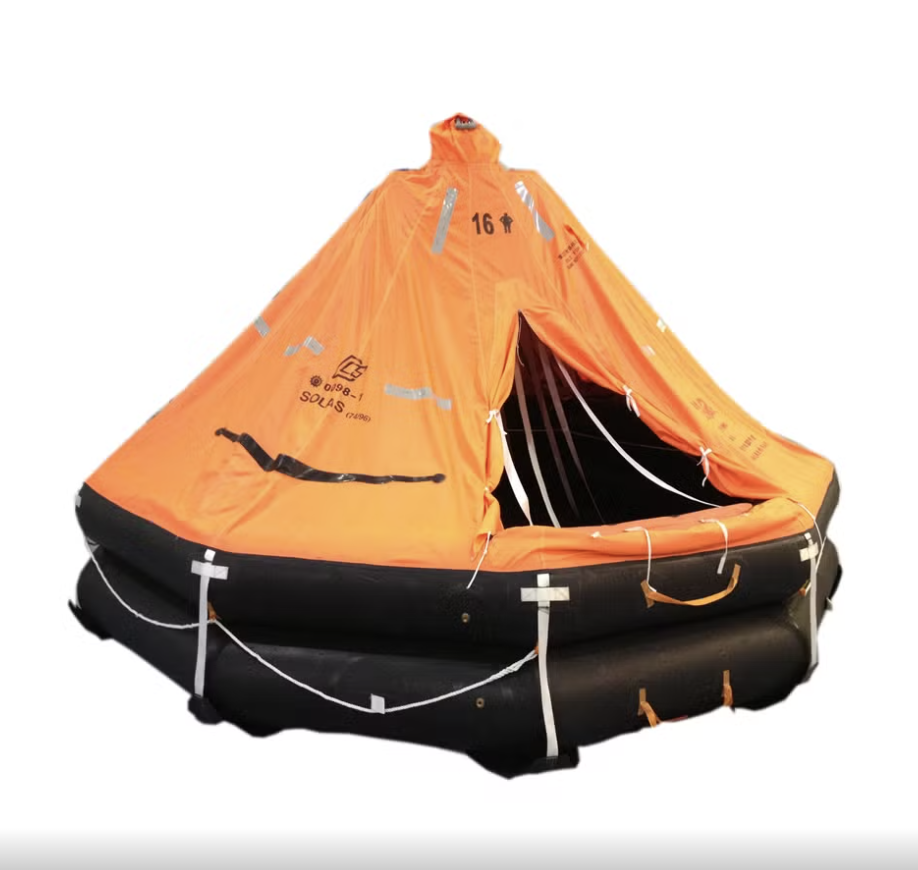
Every inflatable liferaft carried on a SOLAS vessel must be packed with either a SOLAS A Pack or a SOLAS B Pack — a set of survival equipment contained inside the liferaft canister that inflates with the raft and is available to survivors after embarkation.
SOLAS A Pack
The SOLAS A Pack is the more comprehensive of the two equipment sets and is required for vessels on unrestricted international voyages — vessels sailing beyond coastal areas where rescue can be expected within a relatively short time. The A Pack contains a full survival equipment set designed to sustain survivors for an extended period at sea.
The SOLAS A Pack contains, per person, a minimum of 3 litres of fresh water or an equivalent approved desalting apparatus, food rations providing a minimum of 10,000 kJ, a first aid kit in a waterproof case, seasickness tablets and anti-seasickness bags, a graduated drinking vessel, a knife or multi-tool, a bailer, a sponge, sea anchors, paddles, a fishing line and hooks, a repair kit, thermal protective aids, a waterproof flashlight, a signal mirror, a whistle, a daylight signalling mirror, and pyrotechnics including rocket parachute flares, hand flares, and smoke signals.
SOLAS B Pack
The SOLAS B Pack is a reduced equipment set accepted for vessels on near-coastal voyages — typically those trading within 20 miles of shore and in areas where rescue response can be expected quickly. The B Pack contains a subset of the A Pack items, omitting some of the longer-duration survival items on the basis that survivors are unlikely to need them before rescue arrives.
The vessel's flag state specifies which pack standard applies based on the vessel's trading area. The applicable pack standard is stated in the liferaft's type approval documentation and must match what is declared in the vessel's Safety Equipment Certificate. Using a B Pack liferaft on a vessel certificated for A Pack — or allowing an A Pack liferaft to be repacked with B Pack contents at service — is a non-compliance that PSC officers and class surveyors are trained to identify.
Marinetech supplies both SOLAS A Pack and SOLAS B Pack liferafts across all major Indian ports. When ordering, provide the vessel's flag state and trading area so we can confirm the correct pack standard for your certificate. View our life raft and accessories supply range.
Throw-Overboard vs Davit-Launched Liferafts
Inflatable liferafts are deployed in one of two ways — thrown overboard from deck level, or launched using a davit system. The method of deployment determines the structural requirements of the liferaft and its canister, and has implications for the servicing process.
Throw-overboard liferafts are the simpler and more common configuration, particularly on cargo ships. The liferaft is stored in a GRP canister or a soft valise on deck, attached to the vessel by a painter line. When deployed, the canister or valise is thrown into the water, the painter line reaches its full extension, and pulling the line inflates the raft automatically. The HRU on the bracket ensures the raft floats free and inflates automatically if the vessel sinks.
Davit-launched liferafts are used where the height of the deck above the water makes a throw-overboard deployment impractical or unsafe — typically on larger vessels, passenger ships, and offshore units. The liferaft is mounted in a canister on a davit arm and is lowered to the waterline before inflation and boarding. Davit-launched systems require a compatible davit, a winch and wire, and an automatic release hook — all of which require inspection and servicing alongside the liferaft itself.
The choice of throw-overboard or davit-launched configuration is determined by the vessel's design and the flag state's approval of the liferaft arrangement. The configuration stated in the Safety Equipment Certificate must match what is physically installed on board.
The Hydrostatic Release Unit: The Most Commonly Missed Compliance Item
Every throw-overboard liferaft installed on a float-free bracket must be equipped with a Hydrostatic Release Unit. The HRU is a pressure-sensitive device that automatically releases the liferaft from its storage bracket when submerged to a depth of between 1.5 and 4 metres — ensuring the raft floats free and inflates even if the vessel sinks without anyone having time to manually deploy it.
The HRU has a mandatory SOLAS replacement interval of 2 years. This interval is calendar-based and applies regardless of the HRU's apparent condition — internal components can deteriorate without any visible external signs. The replacement date is printed on every HRU, and PSC officers check this date specifically during every LSA inspection.
The HRU is the single most commonly found liferaft deficiency at Indian ports. Vessels arrive with HRUs that passed their replacement date months or years prior — not through negligence, but because the HRU replacement date was not being tracked separately from the liferaft annual service date. These are different intervals: 2 years for the HRU, 12 months for the liferaft service. A liferaft with a current service certificate but an expired HRU is non-compliant.
Marinetech supplies Hammar, Survitec, and other SOLAS-approved HRU brands at all major Indian ports, with immediate availability for vessels found deficient during PSC inspection. We also replace HRUs as part of every scheduled liferaft annual service where the replacement date falls within 6 months of the service date. Read our complete guide to liferaft servicing in India.
What PSC Officers Check on Liferafts in 2026
PSC officers conducting LSA inspections at Indian ports in 2026 check liferafts systematically. The annual service certificate is the first document reviewed — the officer checks the date of service, the identity of the service station, and whether the station is genuinely approved by the manufacturer and recognised by the relevant class society. An expired certificate or a certificate from a non-approved station are immediate deficiency findings.
The HRU replacement date is the second specific check — the officer looks at the HRU itself, not just the service record, to confirm the date printed on the unit. The painter line attachment and weak link are checked for correct installation. The liferaft container is inspected for physical damage, correct marking, and security in its bracket. Where a davit-launched system is fitted, the davit condition, wire, and release hook are also examined.
For vessels where the Safety Equipment Certificate specifies SOLAS A Pack liferafts, the officer may ask to verify at service that the correct pack contents were repacked at the last service — a service certificate from an approved station that specifies B Pack contents on an A Pack certificate vessel is a deficiency. Read our guide on how to choose an approved liferaft service station in India.
Frequently Asked Questions
How many liferafts does a cargo ship of 5,000 GT need to carry?
The specific number depends on the vessel's crew complement and lifeboat arrangement. For a standard cargo ship with conventional lifeboats providing 100% coverage from each side, liferafts are typically carried as supplementary survival craft. The total liferaft capacity must at minimum cover all persons on board from either side of the vessel. Consult your flag state or class society for vessel-specific carriage requirements.
Can liferafts substitute for lifeboats on cargo ships?
In limited circumstances, flag states may permit liferaft-only arrangements on small cargo ships on restricted voyages. For standard cargo ships on international voyages, lifeboats are mandatory in addition to liferafts. Liferafts supplement lifeboats — they do not substitute for them on standard SOLAS cargo ships.
How often must inflatable liferafts be serviced?
Every 12 months at an approved service station. The maximum permitted interval is 17 months with formal flag state or class society approval. The HRU must be replaced every 2 years — this is a separate interval from the annual liferaft service.
What is the difference between a valise liferaft and a canister liferaft?
A canister liferaft is stored in a rigid GRP container designed for deck mounting on a bracket with an HRU. A valise liferaft is packed in a soft bag and is typically used in situations where deck space for a canister is limited or where the raft must be stored below deck. Canister liferafts are more common on commercial vessels. Valise liferafts are common on smaller vessels and yachts.
Does Marinetech supply liferafts for immediate delivery at Indian ports?
Yes. Marinetech stocks SOLAS A Pack and B Pack liferafts at major Indian ports for immediate supply to vessels requiring replacement liferafts or additional capacity. Contact our supplies team with your requirements and expected arrival date and we will confirm availability and delivery arrangements.
Who approves the liferaft arrangement on a vessel?
The liferaft arrangement — number, type, capacity, and positioning — is approved as part of the vessel's initial construction survey by the classification society and the flag state administration. Changes to the arrangement after the initial survey require class and flag state approval and must be reflected in an updated Safety Equipment Certificate.
Order SOLAS-Compliant Liferafts and Accessories in India
Contact Marinetech Safety & Shipping Corporation to order liferafts, HRUs, and liferaft accessories at any major Indian port, or to schedule your annual liferaft service at an approved Marinetech service station.
Supplies email: supply@marinetechss.com
Services email: info@marinetechss.com
Phone: +91-8866475732 | +91-72270 38216
View Our Life Raft & Accessories Supply Range
Get a Free Quote for Liferaft Servicing
Related reading: Liferaft Servicing in India 2026: Complete Guide | How to Choose a Liferaft Service Station in India | Life Saving Equipment for Ships: SOLAS Requirements | How to Prepare for a PSC Inspection: Checklist 2026