Blog Post
SOLAS Life Raft Supplier in India: Brands, Types & How to Order
Posted By: Harsh Bamnolia
Posted On : 25-Jun-2026
SOLAS Life Raft Supplier in India: Brands, Types & How to Order
A condemned liferaft at an Indian port puts a ship manager in a specific and urgent situation. The vessel cannot sail with a survival craft that has been condemned at annual service — the raft must be replaced before departure. The replacement must be the correct capacity, the correct SOLAS pack standard, the correct configuration for the vessel's Safety Equipment Certificate, and available quickly enough not to delay the vessel's cargo operation or voyage schedule.
This is the scenario that tests whether a liferaft supplier in India is genuinely prepared to serve commercial shipping — or just capable of supplying in non-urgent circumstances. It is also not an uncommon scenario. Liferafts get condemned at annual service more frequently than ship managers expect — the most common reasons are fabric deterioration beyond the manufacturer's repair standard, inflation system failures where the cylinder thread is corroded beyond re-use, and structural delamination in older canisters that cannot safely contain the raft through another service cycle.
This guide covers what ship managers need to know about sourcing SOLAS liferafts in India — the major brands, how they compare, what configuration options exist, the liferaft exchange model, how to order with the right documentation, and what to do when the need is urgent.
The Major SOLAS Liferaft Brands in India and How They Differ
The Indian commercial shipping market is served by a defined set of liferaft manufacturers whose products are stocked or available from suppliers in the country. Understanding the differences between them helps procurement teams make better decisions — not every brand is appropriate for every vessel type, flag state, or operating environment.
Survitec is the largest marine safety equipment company in the world by revenue, formed from the merger of Survitec Group with Zodiac Marine, RFD, Beaufort, and Crewsaver. In India, Survitec products are most commonly encountered under the Zodiac and RFD brands on older vessels, with newer vessels carrying Survitec-branded products directly. Survitec liferafts are manufactured to the highest build standards, are approved by all major flag states and classification societies, and their approved service station network in India is among the most extensive of any manufacturer. The price premium over Chinese-manufactured alternatives is real but reflects superior materials, more consistent quality control, and stronger manufacturer support for service station training and authorisation.
Viking is a Danish manufacturer founded in 1960 and is the other globally dominant brand in commercial SOLAS liferafts alongside Survitec. Viking liferafts are found extensively on vessels of all types calling at Indian ports — particularly on European and Scandinavian-flag vessels where Viking has historically had the strongest market position. Viking's build quality is comparable to Survitec, their service station approval process is rigorous, and their global service network is well-established in India through authorised service stations. Viking liferafts are available in capacities from 4 to 150 persons in both SOLAS A and B Pack configurations, throw-overboard and davit-launched versions.
Jiangyin Neptune and other Chinese manufacturers — including Chongqing Gathering Marine Equipment and Jiangsu Yasi Security Technology — supply a significant proportion of the liferafts on vessels in the Indian market, particularly on vessels flagged under cost-sensitive administrations. Chinese-manufactured SOLAS liferafts can hold valid type approvals from major classification societies including CCS, DNV GL, and Bureau Veritas, and are legal for use on SOLAS vessels whose flag state accepts them. The practical differences compared to Survitec and Viking include shorter service life expectancy, more variable quality control between production batches, and a less well-established service station authorisation network in India — meaning finding a genuinely approved service station for these brands at short notice in Indian ports can be more challenging than for Survitec or Viking.
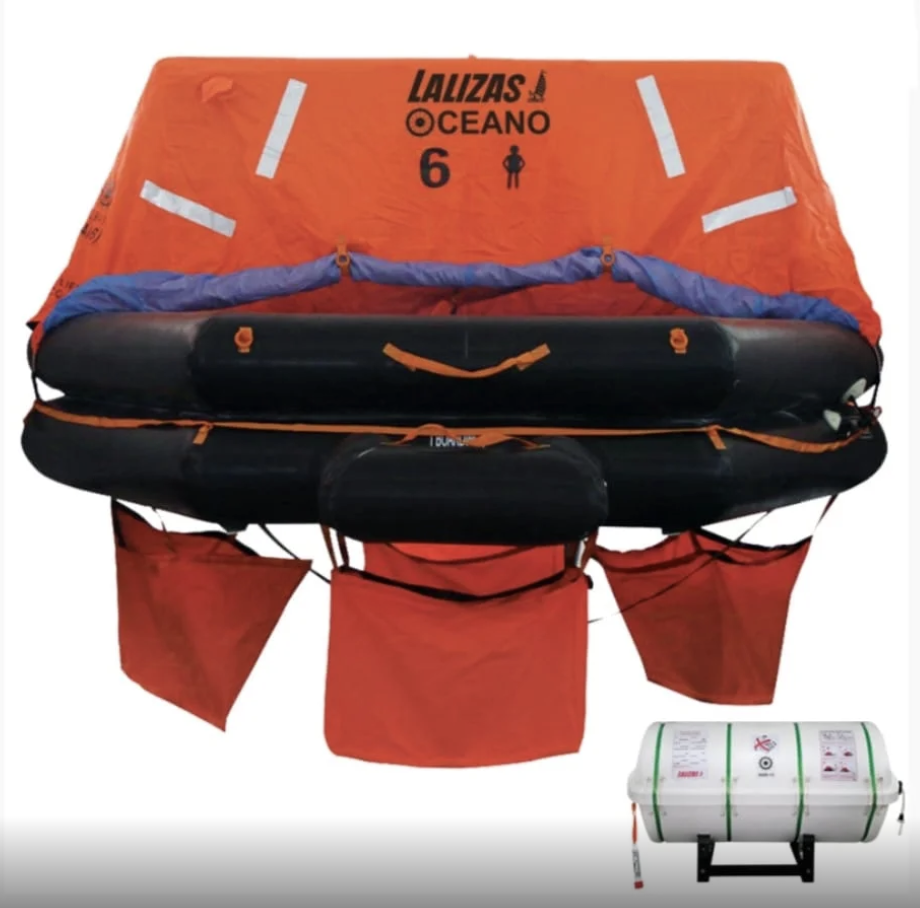
Lalizas is a Greek manufacturer with a growing presence in the Indian market, particularly on vessels with Mediterranean connections. Their SOLAS commercial liferafts are approved by major classification societies and are serviced by an authorised service station network that includes providers in India.
The practical guidance for procurement: if the vessel's flag state and class society accept Chinese-manufactured liferafts and cost is a primary consideration, they are legally viable. If the vessel operates across multiple flag states with varying approval requirements, or if service station availability at short notice across Indian ports is important, Survitec and Viking are the more reliably supported options.
Canister vs Valise: Which Configuration for Your Vessel
Every SOLAS liferaft is packed in one of two storage configurations — a rigid GRP canister or a soft valise. The choice affects the mounting arrangement, the deployment method, and in some cases the approved service interval.
A canister liferaft is stored in a rigid fibreglass container designed for permanent deck mounting on a bracket with a hydrostatic release unit. The canister protects the liferaft from UV exposure, physical damage, and the marine environment more effectively than a valise. The HRU on the bracket ensures automatic float-free deployment if the vessel sinks. Canister liferafts are the standard choice for most commercial vessels where deck space for bracket mounting is available — cargo ships, tankers, bulk carriers, and most offshore vessels.
A valise liferaft is packed in a soft canvas or nylon bag. Valise configuration is typically used where deck space for a canister bracket is not available, where the raft must be stowed below deck and carried to the deployment point, or on smaller vessels where the weight of a canister is a practical concern. The valise configuration is less common on large commercial vessels but is found on smaller coastal and offshore support vessels in the Indian market.
For replacement procurement, the replacement raft must match the configuration of the condemned raft — a canister replacement for a canister raft, a valise replacement for a valise raft — unless the Safety Equipment Certificate is being updated to reflect a configuration change, which requires class society involvement. Confirm the configuration of the condemned raft with the service station before ordering the replacement.
The Liferaft Exchange Model: The Fastest Route to a Replacement
The single most practical and fastest route to replacing a condemned liferaft at an Indian port is the liferaft exchange — a model where a pre-serviced, certified, ready-to-install liferaft is supplied immediately in exchange for the condemned unit, rather than waiting for a new raft to be manufactured, shipped, and delivered.
The liferaft exchange works as follows. Marinetech holds a stock of pre-serviced SOLAS-compliant liferafts at our major Indian port locations, maintained at our approved service stations. When a liferaft is condemned at annual service, we supply a pre-serviced replacement of the correct capacity, pack standard, and configuration from this stock. The condemned raft is returned to our service station for assessment — if it can be repaired and recertified, it re-enters the exchange stock. If it cannot, it is disposed of.
The exchange model has three significant advantages for ship managers in an urgent condemnation situation. First, it is fast — a pre-serviced raft from local stock can typically be delivered to the berth within 24 hours, compared to weeks for a new raft to be ordered, manufactured, and shipped. Second, it is compliant — the exchange raft comes with a current service certificate, ready for immediate installation and PSC inspection. Third, it avoids the customs and import complications that affect new raft procurement from overseas manufacturers.
When booking a liferaft service with Marinetech, advise us of the raft make, model, capacity, pack standard, and configuration in advance — this allows us to confirm exchange stock availability at your port before the service is conducted, so that if condemnation occurs, the replacement can be mobilised immediately.
What Documentation Comes with a Replacement Liferaft
This is where many urgent procurement situations create a secondary compliance problem. A replacement liferaft — whether new or exchange — must be accompanied by the documentation required to update the vessel's Safety Equipment Certificate. Without this documentation, the new raft cannot be formally entered on the certificate, and an undocumented liferaft on a vessel is a certificate discrepancy that PSC officers and class surveyors will flag.
The documentation required for a replacement liferaft installation includes the service certificate (for an exchange raft) or the manufacturer's certificate and initial service certificate (for a new raft), the type approval certificate confirming the raft is approved for the vessel's flag state, the HRU certificate confirming the HRU is within its 2-year replacement date, and the installation record confirming the raft has been correctly mounted and the painter line correctly attached.
Marinetech provides the complete documentation package with every liferaft supplied — whether new or exchange — in the format required by all major class societies operating in India. The vessel's Safety Equipment Certificate should be updated by the class society's surveyor or through the class society's digital update process as soon as possible after the replacement installation.
Flag State Approval: Why It Must Be Verified Before Purchase
Every SOLAS liferaft must be type-approved for the flag state under which the vessel is registered. Flag state type approval is not universal — a liferaft approved by DNV GL under Panamanian flag rules is not automatically approved for a Marshall Islands-flag vessel, a vessel under Indian flag, or a vessel sailing under the Liberian register.
In practice, the major Survitec and Viking products hold type approvals from the vast majority of major flag state administrations globally. Chinese-manufactured liferafts may hold approvals from a more limited set of flag states — typically CCS, DNV GL, and Bureau Veritas for the largest export markets, but not necessarily from all flag states operating vessels at Indian ports.
Before confirming any liferaft procurement, verify that the specific product holds a current type approval for the vessel's flag state. Marinetech verifies flag state approval status for every replacement liferaft before supply — do not accept a supplier's verbal assurance that a raft is "approved for all flags" without seeing the specific flag state approval documentation.
Lead Times for New Liferaft Orders in India
When the replacement requirement is not urgent — planned replacement of ageing rafts, fleet standardisation, or new vessel outfitting — lead times for new liferaft orders in India vary significantly by brand and by the specific raft configuration.
For Survitec and Viking standard throw-overboard canister liferafts in common capacities (10, 15, 20, 25 persons) in SOLAS A Pack configuration, lead times from order to delivery at an Indian port typically range from 4 to 8 weeks, depending on current manufacturer stock and India import logistics. For larger capacities (50, 100, 150 persons) or less common configurations, lead times can extend to 12 to 16 weeks.
For Chinese-manufactured brands, ex-factory lead times may be shorter but India customs clearance and documentation requirements for imported safety equipment add time that partially offsets the manufacturing lead time advantage.
The practical recommendation for fleet managers planning ahead: do not wait for a liferaft to fail annual service to initiate replacement procurement. Review the age and service history of every liferaft on every vessel annually — liferafts older than 15 to 20 years should be flagged for replacement at the next service regardless of their current condition, because the probability of condemnation increases significantly with age.
Liferaft Accessories: What Must Be Ordered Separately
A new or exchange liferaft typically includes the raft itself and the SOLAS pack contents sealed inside. The following accessories are supplied separately and must be ordered and installed alongside the raft.
The HRU — fitted on the deck bracket, not inside the raft — must be supplied and installed at the time of raft installation. The weak link connecting the painter line to the bracket must be confirmed as within specification. The deck mounting bracket — if the condemned raft's bracket has corroded or been damaged — may need to be replaced as well. Marinetech supplies Hammar, Survitec, and other SOLAS-approved HRU brands alongside liferaft supply. View our life raft and accessories supply range.
Ordering a Life Raft from Marinetech in India
To order a SOLAS liferaft from Marinetech — whether for urgent condemnation replacement, planned fleet renewal, or new vessel outfitting — provide the following information so we can confirm stock, type approval, and lead time without delay.
Vessel name and IMO number. Flag state and class society. Number of persons the raft must accommodate. SOLAS A Pack or SOLAS B Pack. Throw-overboard canister or valise or davit-launched configuration. Port and expected arrival date. Whether the requirement is urgent (condemned raft replacement) or planned.
We will confirm type approval for the vessel's flag state, stock availability or lead time, pricing, and delivery to the berth arrangement within 24 hours of a complete enquiry.
Supplies email: supply@marinetechss.com
Phone: +91-8866475732 | +91-72270 38216
View Our Life Raft & Accessories Supply Range
Get a Free Quote for Liferaft Servicing
Related reading: SOLAS Liferaft Requirements 2026: Capacity, Types & Carriage Rules | Liferaft Servicing in India 2026: Complete Guide | How to Choose a Liferaft Service Station in India | Life Saving Equipment for Ships: SOLAS Requirements