Blog Post
Gyro Compass on Ships: Working Principle, Errors and Maintenance
Posted By: Harsh Bamnolia
Posted On : 18-Nov-2026
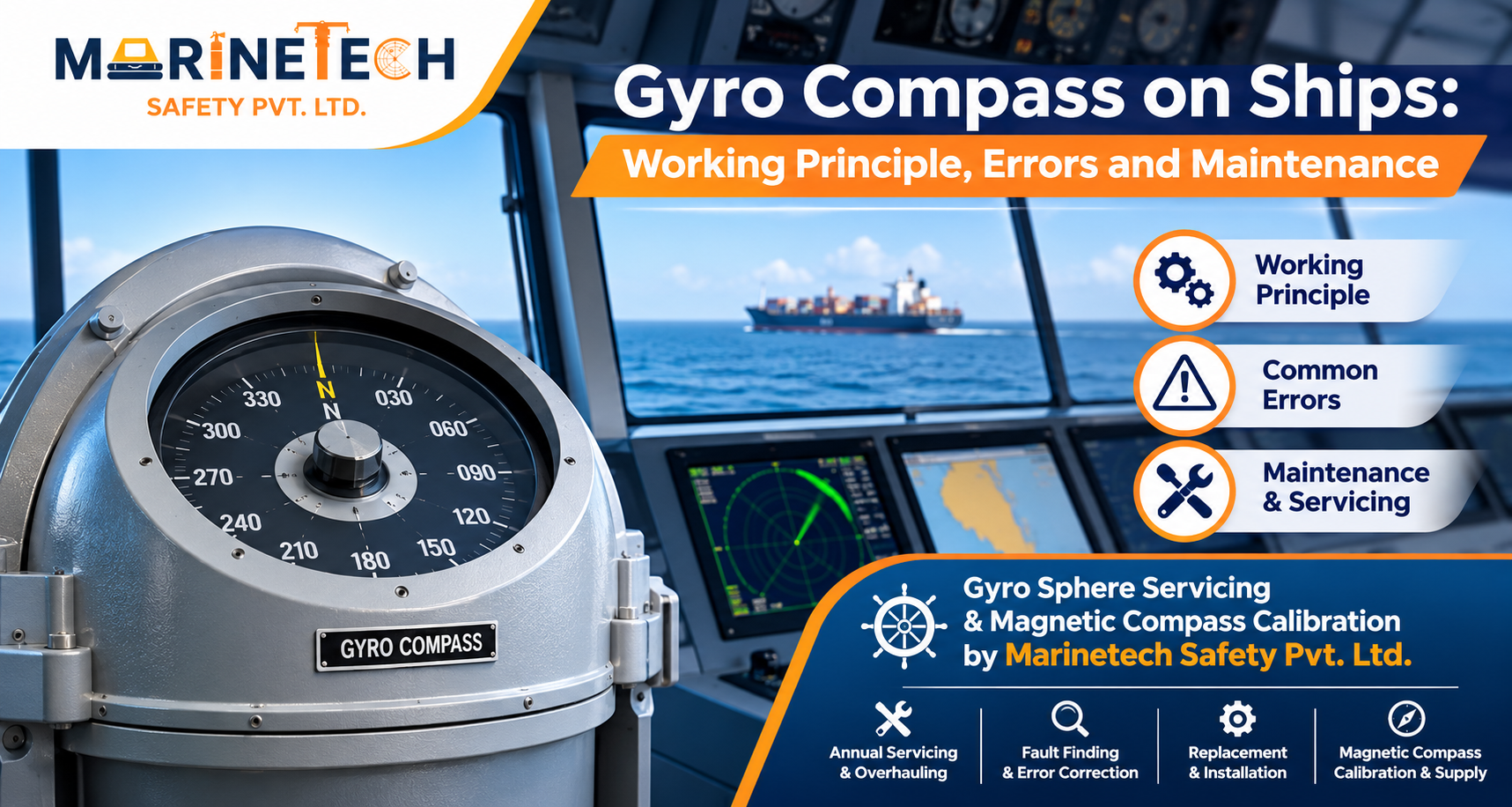
Gyro Compass on Ships: Working Principle, Errors and Maintenance – Complete Marine Guide
Accurate navigation is one of the most important
requirements for safe ship operations. Every merchant vessel depends on
reliable heading information to maintain its planned course, avoid navigational
hazards and coordinate with other navigation equipment on the bridge.
One of the most important instruments used for this purpose
is the gyro compass. Unlike a magnetic compass, which responds to the
Earth's magnetic field, a gyro compass uses the principles of gyroscopic motion
and the Earth's rotation to determine true north.
A properly functioning gyro compass provides accurate
heading information to essential navigational equipment, including radar,
Automatic Radar Plotting Aid (ARPA), Automatic Identification System (AIS),
autopilot and other bridge systems.
However, continuous operation, vibration, electrical
disturbances, mechanical wear and incorrect maintenance can affect gyro compass
performance.
In this guide, we explain the working principle of a marine
gyro compass, its major components, common errors, maintenance procedures,
SOLAS requirements and the importance of professional gyro sphere servicing.
For shipowners and technical managers looking for
professional gyro compass and gyro sphere servicing in India, Marinetech
Safety Pvt. Ltd. provides specialised marine technical services.
1. What Is a Gyro Compass on a Ship?
A gyro compass is a non-magnetic navigational instrument
that determines and indicates the true heading of a vessel.
It works using a rapidly rotating gyroscope and the Earth's
rotational movement. Its north-seeking behaviour allows a vessel to obtain a
reference to true north rather than magnetic north.
Unlike a conventional magnetic compass, a gyro compass is
not affected by the ship's magnetic field or nearby magnetic materials in the
same way.
Why Is a Gyro Compass Important?
A gyro compass is essential for:
- Determining
the vessel's true heading.
- Providing
heading information to radar and ARPA.
- Supplying
heading inputs to the autopilot.
- Supporting
AIS heading transmission.
- Assisting
in collision avoidance.
- Taking
accurate bearings of navigational objects.
- Supporting
safe navigation in coastal and open-sea waters.
A faulty gyro compass can affect multiple interconnected
navigation systems. Therefore, regular inspection, monitoring and servicing are
important for maintaining navigational reliability.
2. Working Principle of a Marine Gyro Compass
The working principle of a gyro compass is based on two
important physical principles:
- Gyroscopic
rigidity.
- Gyroscopic
precession.
A. Gyroscopic Rigidity
A rapidly rotating rotor tends to maintain the direction of
its rotational axis due to angular momentum.
When external forces are not acting on it, the spinning
rotor resists changes in the direction of its axis.
This characteristic is known as gyroscopic rigidity.
B. Gyroscopic Precession
When an external force or torque is applied to a rotating
gyroscope, the resulting movement takes place in a direction approximately 90
degrees ahead in the direction of rotation.
This phenomenon is known as gyroscopic precession.
C. How Does a Gyro Compass Find True North?
A marine gyro compass uses the interaction between
gyroscopic motion, the Earth's rotation and a gravity-controlled arrangement to
develop north-seeking behaviour.
The Earth's rotation produces an apparent movement of the
gyro axis relative to the Earth's surface. The gravity-controlled mechanism
generates the required corrective torque.
Through this controlled interaction, the gyro axis moves
towards the meridian and establishes a north-seeking reference.
Damping mechanisms help reduce oscillations and allow the
compass to settle towards its operating heading.
Important: A free-running gyroscope does not
automatically point towards true north. The north-seeking characteristic is
achieved through the complete gyro compass arrangement and its control and
damping systems.
3. Main Components of a Ship's Gyro Compass
A typical marine gyro compass installation consists of
several interconnected components.
1. Gyro Sphere / Sensitive Element
The gyro sphere or sensitive element contains the gyroscopic
assembly responsible for maintaining the reference direction.
Its condition is critical to the performance of the gyro
compass.
2. Master Compass
The master compass is the primary unit that establishes and
provides the vessel's heading reference.
3. Follow-Up System
The follow-up mechanism ensures that the compass and
associated transmission arrangements maintain the correct heading relationship.
4. Control and Damping System
The control and damping arrangement helps the gyro compass
achieve north-seeking behaviour and reduces oscillations.
5. Power Supply Unit
The electrical power supply supports the operation of the
gyro assembly, control circuits and associated electronic components.
6. Gyro Repeaters
Gyro repeaters display heading information at different
locations on the vessel, such as:
- Bridge
wings.
- Steering
position.
- Emergency
steering position.
- Navigation
bridge.
- Other
designated bridge locations.
7. Heading Transmission System
The heading transmission system distributes gyro information
to other navigational equipment, including radar, ARPA, AIS and autopilot.
4. Types of Gyro Compass Used on Ships
Marine vessels use different gyro compass technologies
depending on vessel requirements, equipment generation and manufacturer design.
A. Conventional Mechanical Gyro Compass
Conventional gyro compasses use a rapidly rotating
mechanical rotor to establish the north-seeking reference.
They include mechanical and electrical control arrangements
and require manufacturer-specified maintenance.
B. Ring Laser Gyro Compass
Ring laser gyro systems use laser beams travelling in
opposite directions through a closed optical path.
The difference in their frequencies due to rotation is used
to measure angular movement.
These systems have no conventional spinning rotor in the
sensing element.
C. Fibre Optic Gyro Compass
Fibre optic gyro systems use light travelling through
optical fibre coils to detect angular rotation.
They offer solid-state sensing technology and are used in
modern marine navigation systems.
Note: Maintenance procedures differ considerably
between mechanical, ring laser and fibre optic gyro systems. Servicing must
always follow the applicable manufacturer's instructions.
5. Common Gyro Compass Errors on Ships
Although gyro compasses provide a true-north reference, they
are not completely free from errors.
Understanding these errors is important for navigators and
marine engineers.
1. Latitude Error
Latitude error occurs because the Earth's rotational
influence on the gyro compass changes with the vessel's geographical latitude.
As a ship moves between different latitudes, the gyro
compass may require appropriate latitude correction.
2. Speed Error
Speed error is caused by the vessel's movement over the
Earth's surface.
The ship's speed and direction of travel influence the
apparent relationship between the gyro and the Earth's reference frame.
This error is also known as transport error.
3. Ballistic Deflection Error
Ballistic deflection is associated with changes in the
vessel's speed or course.
Rapid acceleration, deceleration or changes in direction can
temporarily affect the gyro's indicated heading.
4. Damping Error
The damping system controls oscillations in the gyro
compass.
Incorrect damping characteristics or a malfunctioning
damping arrangement can result in excessive oscillations or delayed settling.
5. Settling Error
After starting or restarting a gyro compass, the instrument
requires time to reach its stable operating condition.
Using heading information before the compass has settled can
result in inaccurate readings.
6. Rolling and Pitching Errors
Ship movement due to rolling and pitching can influence gyro
compass performance, depending on the design and operating condition of the
equipment.
7. Mechanical and Electrical Errors
These errors may arise from:
- Mechanical
wear.
- Bearing
deterioration.
- Incorrect
electrical connections.
- Power
supply fluctuations.
- Faulty
control circuits.
- Defective
sensors.
- Communication
and transmission faults.
Regular inspection helps identify these problems before they
affect navigational operations.
6. How to Check Gyro Compass Error on a Ship
Checking gyro compass error is an important navigational
responsibility.
The gyro heading should be compared with an independently
established reference heading.
Common methods include:
1. Celestial observations: Using suitable celestial
observations, such as the Sun's azimuth, to determine the gyro error.
2. Terrestrial bearings: Comparing the observed gyro
bearing of a known terrestrial object with its true bearing.
3. Comparison with magnetic compass: Comparing gyro
and magnetic compass readings while allowing for the known magnetic compass
variation and deviation.
4. GNSS-based heading reference: Using an appropriate
independent heading reference where its accuracy and suitability have been
established.
The navigator should record and apply the determined gyro
error in accordance with the vessel's procedures.
The magnetic compass should not automatically be treated as
an error-free reference for checking the gyro compass.
7. Gyro Compass Maintenance on Ships
Regular maintenance is essential to maintain the reliability
and accuracy of marine gyro compass systems.
The maintenance schedule should follow the manufacturer's
instructions, equipment condition, operating hours and applicable vessel
requirements.
A. Daily Operational Checks
Shipboard personnel should:
- Check
the displayed gyro heading.
- Compare
master compass and repeater readings.
- Check
for abnormal alarms.
- Monitor
heading fluctuations.
- Confirm
that heading information is available to connected navigation equipment.
- Observe
any unusual noise or vibration.
- Check
the system's operating status.
B. Periodic Inspection
Periodic inspections should include:
- Inspection
of electrical connections.
- Checking
the condition of cables and connectors.
- Checking
power supply stability.
- Inspection
of repeater displays.
- Verification
of heading transmission.
- Inspection
of cooling and ventilation arrangements, where fitted.
- Checking
for abnormal operating temperatures.
- Reviewing
alarm and fault histories.
C. Professional Gyro Sphere Servicing
The gyro sphere is a critical component in conventional
mechanical gyro compass systems.
Depending on the manufacturer and equipment design,
professional servicing may include:
- Gyro
sphere inspection.
- Annual
servicing or overhauling as applicable.
- Fault
finding and troubleshooting.
- Error
investigation and correction.
- Replacement
of defective components.
- Installation
of a replacement gyro sphere.
- Functional
testing after servicing.
- Verification
of heading and repeater performance.
Not every gyro compass requires the same service procedure.
The work should be performed by competent personnel using the correct
manufacturer-specific procedures.
8. Signs That Your Ship's Gyro Compass Needs Servicing
Shipowners and technical superintendents should pay
attention to the following warning signs:
|
Warning sign |
Possible cause |
|
Unstable heading indication |
Gyro or control system fault |
|
Excessive heading fluctuations |
Damping or mechanical issue |
|
Repeater mismatch |
Transmission or synchronisation fault |
|
Gyro alarm activation |
Internal system malfunction |
|
Slow settling after startup |
Gyro or control system issue |
|
Abnormal noise or vibration |
Mechanical deterioration |
|
Heading data unavailable to radar |
Interface or transmission fault |
|
Frequent power-related alarms |
Power supply problem |
When these symptoms appear, the equipment should be
investigated promptly.
Continuing to operate with unreliable heading information
can create serious navigational risks.
9. SOLAS Requirements for Gyro Compass on Ships
Gyro compass carriage and performance are addressed under
the International Convention for the Safety of Life at Sea (SOLAS),
particularly Chapter V – Safety of Navigation.
SOLAS Chapter V, Regulation 19
Under SOLAS V/19.2.5, ships of 500 gross tonnage and upwards
are required to have a gyro compass or another suitable non-magnetic means of
determining and displaying heading, subject to the regulation's provisions.
The relevant requirements include:
- A
gyro compass or equivalent non-magnetic heading device readable by the
helmsman at the main steering position.
- Heading
information supplied to the applicable navigational equipment.
- A
gyro compass heading repeater or other suitable means of displaying
heading at the emergency steering position, where provided.
- A
gyro compass bearing repeater or other suitable means for taking bearings
over an arc of 360 degrees.
The equipment must meet the applicable IMO performance
standards and installation requirements.
Why Is Compliance Important?
Proper maintenance of the gyro compass helps vessels:
- Maintain
reliable heading information.
- Support
safe navigation.
- Maintain
the operational readiness of connected bridge equipment.
- Prepare
for statutory surveys and inspections.
- Reduce
the risk of navigational equipment deficiencies.
Shipowners should always refer to the latest applicable
SOLAS provisions, IMO performance standards, Flag State instructions and
manufacturer requirements.
10. Why Professional Gyro Compass Servicing Is Important
A gyro compass is a critical part of the vessel's navigation
system. Improper servicing or incorrect adjustments can affect the accuracy of
heading information supplied to several bridge instruments.
Professional servicing helps with:
- Identifying
the root cause of heading errors.
- Inspecting
the gyro sphere and associated components.
- Correcting
equipment-related faults.
- Restoring
reliable operation.
- Reducing
unexpected equipment failures.
- Maintaining
appropriate service records.
- Supporting
vessel operational readiness.
Ship managers should select a service provider with suitable
technical experience, trained engineers, appropriate equipment and relevant
manufacturer, class and Flag State acceptance where required.
11. Gyro Sphere Servicing and Calibration in India – Marinetech Safety Pvt. Ltd.
Marinetech Safety Pvt. Ltd. is an India-based marine safety
equipment servicing and supply company providing technical support to
shipowners, ship managers, fleet operators and vessel management companies.
With experience in marine equipment servicing, inspection,
maintenance and supply, Marinetech supports vessels operating at major Indian
ports.
Our Gyro Sphere and Magnetic Compass Services
Marinetech Safety Pvt. Ltd. provides specialised services
for gyro sphere and magnetic compass requirements.
Our service scope includes:
1. Annual Gyro Sphere Servicing / Overhauling
Inspection and servicing of gyro spheres in accordance with
the applicable equipment design and manufacturer's requirements.
2. Gyro Sphere Fault Finding and Error Correction
Identification and troubleshooting of gyro sphere-related
faults and heading errors.
3. Gyro Sphere Replacement and Installation
Replacement and installation of new gyro spheres and
associated components, as applicable.
4. Magnetic Compass Calibration and Supply
Magnetic compass calibration support and supply of suitable
magnetic compass equipment.
Why Choose Marinetech Safety Pvt. Ltd.?
- Experienced
marine technical service team.
- Engineers
trained in gyro sphere servicing activities.
- Marine
safety equipment servicing and supply under one organisation.
- Service
coordination for vessels at major Indian ports.
- Focus
on equipment reliability and operational readiness.
- Technical
support for shipowners and vessel management companies.
Explore Our Gyro Sphere Service
If your vessel requires gyro sphere inspection, annual
servicing, overhauling, fault finding, error correction or replacement, contact
our technical team.
Visit our dedicated service page:
Gyro
Sphere / Magnetic Compass Calibration Service in India – Marinetech Safety Pvt.
Ltd.
For additional marine navigation and electronic equipment
support, explore our Electronic
& Navigation Communication Services.
12. Marine Service Support at Major Indian Ports
Marinetech Safety Pvt. Ltd. supports marine service
requirements at important Indian maritime locations, subject to equipment scope
and service scheduling.
Our key service locations include:
- Mumbai
- Mundra
- Kandla
- Surat
- Sikka
- Jamnagar
- Vizag
- Chennai
- Paradip
Shipowners and technical managers can contact our team with
vessel details, equipment make and model, port of call and required service
scope to coordinate the appropriate technical support.
13. Conclusion
The gyro compass is one of the most important navigational
instruments on a merchant vessel. It provides true heading information that
supports safe navigation and the operation of several interconnected bridge
systems.
However, gyro compass accuracy can be affected by latitude,
speed, vessel manoeuvres, damping characteristics, mechanical deterioration and
electrical faults.
Regular operational checks, error verification and
professional servicing are essential to maintain reliable performance.
For shipowners and technical managers looking for gyro
compass servicing, gyro sphere overhauling, fault finding and magnetic compass
calibration in India, Marinetech Safety Pvt. Ltd. offers specialised marine
technical support.
Visit our Gyro Sphere / Magnetic
Compass Calibration Service Page to learn more about our services.
Marinetech Safety Pvt. Ltd. – Navigating Safety,
Supplying Confidence.
Frequently Asked Questions (FAQs)
1. What is a gyro compass on a ship?
A gyro compass is a non-magnetic navigational instrument
that uses gyroscopic principles and the Earth's rotation to determine and
display the true heading of a vessel.
2. How does a marine gyro compass work?
A marine gyro compass uses a rapidly rotating gyroscope,
together with gravity-controlled and damping mechanisms, to develop
north-seeking behaviour and establish a true-north reference.
3. What is the difference between a gyro compass and a
magnetic compass?
A gyro compass determines true heading using gyroscopic
principles and the Earth's rotation, whereas a magnetic compass aligns with the
Earth's magnetic field and indicates magnetic north. Magnetic compass readings
require correction for variation and deviation.
4. What are the common errors of a gyro compass?
Common gyro compass errors include latitude error, speed or
transport error, ballistic deflection, damping error, settling error and errors
caused by mechanical or electrical faults.
5. How often should a gyro compass be serviced?
The servicing frequency depends on the equipment
manufacturer, model, operating condition and maintenance schedule. Annual
servicing or overhauling may be applicable to certain gyro sphere systems, as
specified by the manufacturer.
6. What is a gyro sphere in a marine gyro compass?
A gyro sphere is a component or sensitive-element assembly
used in certain conventional mechanical gyro compass designs. It contains the
gyroscopic mechanism responsible for maintaining the directional reference.
7. What is the SOLAS requirement for gyro compasses?
SOLAS Chapter V, Regulation 19.2.5 requires ships of 500 GT
and upwards to carry a gyro compass or an equivalent non-magnetic heading
device, subject to the regulation's provisions. Requirements also address
heading repeaters and transmission of heading information.
8. Does Marinetech Safety Pvt. Ltd. provide gyro sphere
servicing in India?
Yes. Marinetech Safety Pvt. Ltd. provides gyro sphere annual
servicing and overhauling as applicable, fault finding, error correction,
replacement and installation of new gyro spheres and magnetic compass
calibration and supply. Contact our technical team for service availability and
equipment-specific requirements.
Related Blogs from Marinetech Safety Pvt. Ltd.
For more information about marine navigation, communication
and equipment servicing, explore these related articles:
- Marine
Navigation & Communication Equipment Supplier in India: Complete Guide
for Ship Managers
- How
Modern Marine Navigation Systems Enhance Safety and Efficiency at Sea
- Marine
Instrument Calibration for Ships in India: What You Need to Know
- GMDSS
Radio Survey & Inspection Service in Mumbai
- SOLAS
Chapter V: Safety of Navigation – Complete Guide
Contact Marinetech Safety Pvt. Ltd.
For gyro sphere servicing, magnetic compass calibration and
marine navigation equipment requirements, contact our team.
Company: Marinetech Safety Pvt. Ltd.
Website: https://marinetechss.com/
Service Email: info@marinetechss.com
Supplies Email: supply@marinetechss.com
Gyro Sphere Service:
https://marinetechss.com/services/gyrosphere
Our tagline: NAVIGATING SAFETY, SUPPLYING CONFIDENCE.