Blog Post
Fire Detection & Alarm Systems on Ships: Testing & Maintenance
Posted By: Harsh Bamnolia
Posted On : 13-Nov-2026
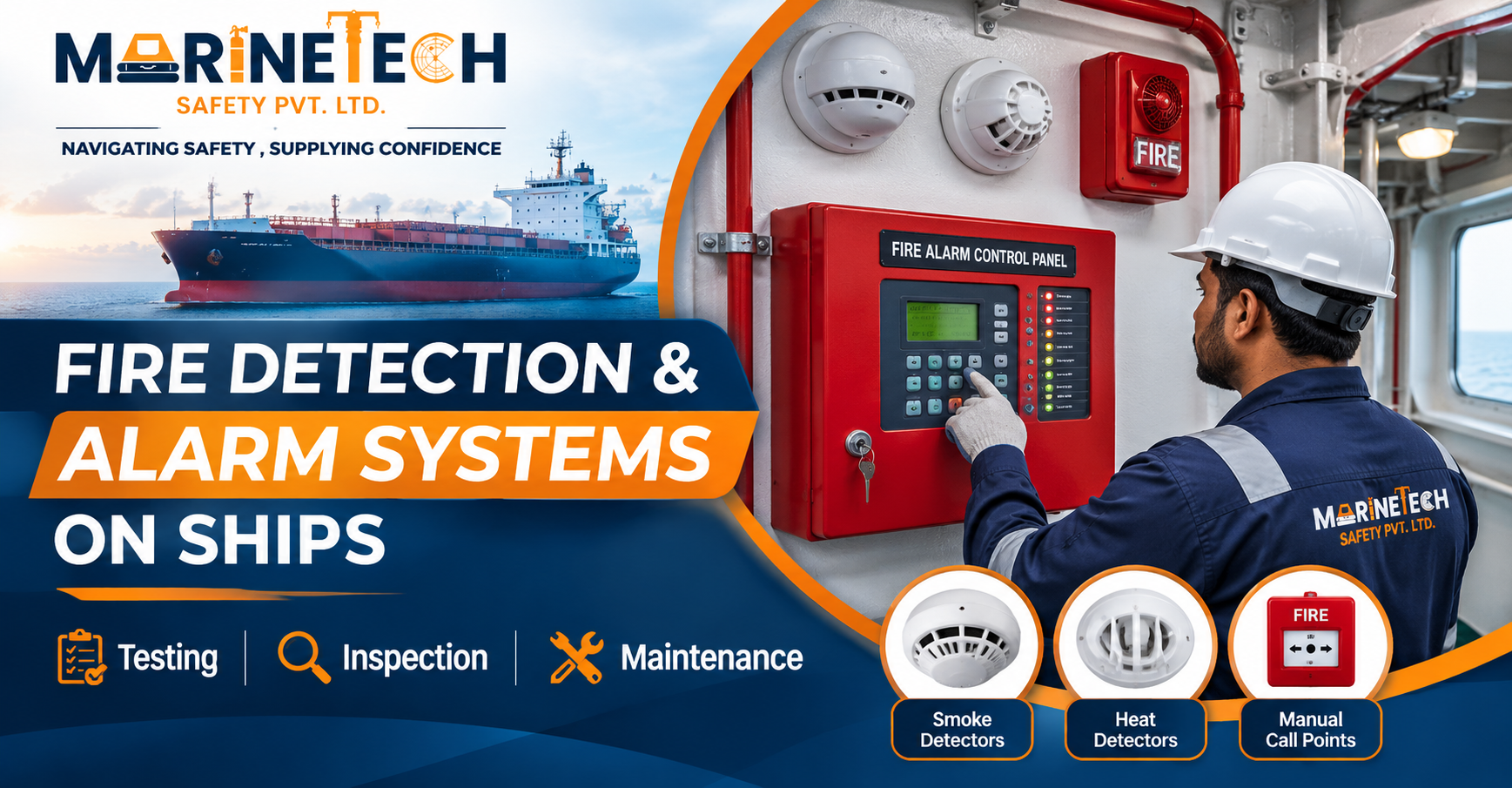
Fire Detection and Alarm Systems on Ships: Testing, Inspection and Maintenance
Fire is one of the most serious safety hazards onboard
commercial vessels. Unlike fires on land, shipboard fires can become extremely
dangerous because of confined spaces, limited escape routes, flammable
materials, machinery, electrical installations and the distance from
shore-based emergency assistance.
A properly installed and maintained fire detection and
alarm system on ships plays a critical role in identifying fire at an early
stage, alerting the crew and supporting an effective emergency response.
Modern marine fire detection systems use smoke detectors,
heat detectors, flame detectors, manual call points and central fire alarm
control panels to identify potential fire incidents and provide immediate
warnings to the crew.
However, installing a fire alarm system is not enough.
Regular testing, inspection and preventive maintenance are essential to ensure
that every detector, alarm circuit, control panel and associated component
functions correctly when required.
For shipowners, technical superintendents, fleet managers
and vessel operators, maintaining these systems is also an important part of
compliance with SOLAS Chapter II-2 and the International Code for Fire Safety
Systems (FSS Code).
Marinetech Safety Pvt. Ltd. provides marine fire
fighting appliances inspection, servicing, maintenance and supply solutions for
vessels operating across India. Our services support vessel operators in
maintaining reliable fire safety equipment and operational readiness.
1. What Is a Fire Detection and Alarm System on Ships?
A marine fire detection and alarm system is an integrated
safety arrangement designed to detect signs of fire, generate warning signals
and notify the responsible crew members.
The primary purpose is to identify a fire before it spreads,
allowing the crew to investigate, isolate affected areas and initiate
firefighting procedures.
A typical shipboard fire detection and alarm system consists
of:
- Smoke
detectors
- Heat
detectors
- Flame
detectors, where applicable
- Manual
fire alarm call points
- Fire
alarm control and indicating panels
- Audible
and visual alarm devices
- Power
supply and backup arrangements
- Detection
circuits, cables and monitoring devices
Depending on the vessel's design, type, construction date
and applicable statutory requirements, fire detection systems may be installed
in machinery spaces, accommodation spaces, service spaces, control stations,
cargo spaces and other protected areas.
The system must be suitable for the environment in which it
operates, including temperature variations, vibration, humidity, dust and other
marine conditions.
2. Types of Fire Detectors Used on Ships
Different types of detectors are used depending on the
nature of the space and the fire risks involved.
A. Smoke Detectors
Smoke detectors identify smoke particles generated during
the early stages of combustion.
They are commonly used in accommodation spaces, corridors,
control rooms and other suitable enclosed spaces.
Inspection points:
- Check
the detector body for physical damage.
- Ensure
the detector is free from dust and contamination.
- Verify
that the detector is correctly connected.
- Test
its response using an approved smoke or aerosol test method.
- Confirm
that the correct alarm indication appears on the control panel.
B. Heat Detectors
Heat detectors respond to an increase in temperature or a
predetermined temperature threshold.
They are suitable for locations where smoke detectors may
generate unwanted alarms because of normal operating conditions.
Typical applications include selected machinery areas,
galleys and other spaces where heat detection is appropriate.
Inspection points:
- Check
the detector for corrosion and physical damage.
- Verify
its installation and connections.
- Test
its response using an appropriate calibrated heat-testing device.
- Confirm
alarm activation at the correct control panel.
C. Flame Detectors
Flame detectors identify radiation associated with flames,
depending on the detector technology.
They may be used in specific high-risk areas where rapid
flame detection is required and the equipment is suitable for the operating
environment.
Inspection points:
- Inspect
the detector lens and housing.
- Check
for obstructions in its field of view.
- Verify
wiring and electrical connections.
- Perform
functional testing using the manufacturer's approved test procedure.
D. Manual Call Points
Manual call points allow crew members to activate the fire
alarm system manually when they discover a fire.
They should be accessible, clearly identified and maintained
in operational condition.
Inspection points:
- Check
accessibility and identification.
- Inspect
the housing and operating mechanism.
- Test
activation using the approved test key or procedure.
- Verify
correct alarm indication at the control panel.
3. SOLAS Requirements for Fire Detection and Alarm Systems on Ships
International maritime fire safety requirements are
primarily governed by SOLAS Chapter II-2, which addresses fire protection, fire
detection and fire extinction.
Two important regulations are:
SOLAS Chapter II-2, Regulation 7 – Detection and Alarm
Regulation 7 establishes requirements for fixed fire
detection and fire alarm systems.
Its purpose is to detect a fire in the space of origin and
provide an alarm that supports safe escape and firefighting operations.
Important requirements include:
- Fixed
fire detection and alarm installations must be suitable for the nature of
the protected space.
- Manually
operated call points must be positioned to provide accessible means of
notification.
- Required
systems must be of an approved type and comply with the applicable Fire
Safety Systems Code requirements.
- Systems
must undergo initial functional testing under varying ventilation
conditions after installation.
- Periodic
testing must verify that detectors respond to suitable simulated fire
conditions, such as heat, smoke or aerosol particles, as appropriate to
the detector design.
SOLAS Chapter II-2, Regulation 14 – Operational Readiness and Maintenance
Regulation 14 requires fire protection systems, firefighting
systems and appliances to remain ready for use.
It also requires proper testing, inspection and maintenance.
The onboard maintenance plan must include fixed fire
detection and fire alarm systems, where installed, and must be available for
inspection by the Administration.
Maintenance and inspection should follow applicable IMO
guidelines, including MSC.1/Circ.1432 as amended by MSC.1/Circ.1516, together
with manufacturer instructions and applicable flag and class requirements.
For further information about marine firefighting
equipment inspection and maintenance, visit the Marinetech
Fire Fighting Appliances Service Page.
4. Fire Detection and Alarm System Testing on Ships
Regular fire alarm system testing is necessary to verify
that the complete detection and alarm arrangement operates as intended.
Testing should be conducted according to the vessel's
approved maintenance plan, applicable statutory requirements, manufacturer
instructions and classification society requirements.
The following activities are important parts of marine fire
alarm testing.
4.1 Control Panel Functional Testing
The fire alarm control panel is the central monitoring point
of the system.
During inspection, technicians should:
- Check
the control panel for physical damage.
- Verify
the normal power supply.
- Check
the backup power supply and battery condition.
- Operate
the lamp or indicator test facility.
- Verify
fault, alarm and isolation indications.
- Check
system event records where available.
- Confirm
that audible and visual indications operate correctly.
4.2 Smoke Detector Testing
Smoke detectors should be tested using suitable approved
smoke or aerosol test equipment.
The technician should verify that the detector responds
correctly and that the corresponding alarm indication appears on the control
panel.
The location and identity of the activated detector should
be checked against the vessel's fire detection arrangement.
4.3 Heat Detector Testing
Heat detectors should be tested using appropriate
heat-testing equipment in accordance with the detector manufacturer's
instructions.
The technician should confirm that the detector activates at
the specified response conditions and that the correct alarm is received at the
control panel.
4.4 Manual Call Point Testing
Manual call points should be operated using the approved
testing method.
The following should be verified:
- Correct
alarm activation.
- Correct
zone or detector identification.
- Audible
and visual alarm operation.
- Correct
reset and restoration procedure.
4.5 Alarm Sounder and Visual Indicator Testing
Audible and visual alarm devices must be checked to ensure
that the alarm is effectively communicated to the intended areas.
The inspection should verify that sounders, bells, beacons
and other alarm indicators function correctly.
4.6 Detection Circuit and Fault Monitoring
Detection circuits should be examined for wiring damage, loose
connections, earth faults, open circuits and short circuits.
Where applicable, fault monitoring and isolation
arrangements should be checked to confirm that a single fault does not
compromise more of the system than permitted by the applicable design
requirements.
4.7 System Integration Testing
Where the fire detection system is connected to other safety
arrangements, the relevant interfaces should be checked according to the
approved system design.
These may include:
- Fire
doors and their control arrangements.
- Ventilation
shutdown systems.
- Smoke
control arrangements.
- Machinery
shutdown or other fire safety interfaces.
- Fixed
fire-extinguishing system release interfaces, where applicable.
Any test that could activate a fixed extinguishing system or
shut down essential machinery must be carefully planned and conducted under an
approved safe test procedure.
5. Inspection and Maintenance Checklist for Marine Fire Alarm Systems
A systematic inspection helps identify potential problems
before they affect the operational reliability of the system.
The following checklist can be used as a general reference
for shipboard inspections.
|
Inspection Item |
What to Check |
|
Fire alarm control panel |
Display, indicators, alarm and fault status |
|
Smoke detectors |
Cleanliness, physical condition and response |
|
Heat detectors |
Physical condition and functional response |
|
Flame detectors |
Lens condition, alignment and response |
|
Manual call points |
Accessibility and activation |
|
Alarm sounders |
Audible operation |
|
Visual alarms |
Beacon and indicator operation |
|
Wiring and circuits |
Damage, loose connections and faults |
|
Power supply |
Main and backup supply condition |
|
Batteries |
Condition, charging and capacity as applicable |
|
System interfaces |
Correct operation of connected safety functions |
|
Documentation |
Test records, maintenance reports and defect closure |
Important Maintenance Intervals
The IMO MSC.1/Circ.1432 guidelines, as amended, establish a
structured approach to onboard fire protection maintenance.
For fixed fire detection and alarm systems, the guidelines
include:
- Weekly:
Verify that fire detection and fire alarm control panel indicators
function using the lamp or indicator test switch.
- Monthly:
Test a sample of detectors and manual call points so that all devices are
tested within five years. The Administration determines the sample size
for very large systems.
- Annually:
Test all fire detection systems for proper operation, as appropriate, and
visually inspect accessible detectors so that all detectors are inspected
within one year.
These are guideline-based maintenance actions. The vessel's
flag Administration, approved maintenance plan, equipment manufacturer's
instructions and any applicable additional requirements must also be followed.
6. Common Problems Found During Fire Alarm System Inspection
Marine fire detection systems operate in demanding
environments. Regular exposure to vibration, heat, humidity, dust and corrosion
can affect their performance.
Some common problems identified during inspection include:
1. Dirty or Contaminated Detectors
Dust, oil vapour and other contaminants can interfere with
detector operation and cause false alarms or reduced sensitivity.
2. Faulty Wiring and Electrical Connections
Loose terminals, damaged cables, insulation deterioration
and short circuits can create system faults.
3. Weak Backup Batteries
A defective or poorly maintained backup battery may affect
the system's ability to operate during a main power failure.
4. Incorrect Detector Placement or Obstruction
Equipment, modifications or stored materials may obstruct
detectors or affect their ability to identify fire conditions.
5. Faulty Manual Call Points
Damaged mechanisms or poor electrical connections can
prevent manual alarm activation.
6. Frequent False Alarms
Repeated unwanted alarms may indicate contamination,
unsuitable detector selection, environmental interference or a technical fault.
7. Unresolved System Isolation
Leaving detectors or zones isolated without proper control
can reduce the effectiveness of the overall fire detection arrangement.
Every identified defect should be recorded, investigated and
rectified. Isolations must be controlled, documented and restored after the
relevant work is completed.
7. Why Professional Fire Detection System Servicing Is Important
Professional inspection and maintenance help ensure that
fire detection systems remain dependable throughout the vessel's operation.
Key benefits include:
- Early
fire detection: Helps identify potential fires before they spread.
- Crew
safety: Provides timely warnings and supports emergency response.
- Regulatory
compliance: Helps maintain compliance with applicable SOLAS, FSS Code,
flag and class requirements.
- Reduced
false alarms: Identifies contamination, installation problems and
technical faults.
- Operational
reliability: Helps reduce the risk of unexpected equipment failure.
- Proper
documentation: Provides inspection reports and maintenance records for
technical management and surveys.
Fire detection systems should be serviced by competent
personnel familiar with the installed equipment and the applicable marine
requirements.
For complete marine firefighting equipment inspection,
servicing and maintenance, explore Marinetech
Safety Pvt. Ltd.'s Fire Fighting Appliances Services.
8. Marinetech Safety Pvt. Ltd. – Marine Fire Fighting Equipment Inspection and Servicing in India
Marinetech Safety Pvt. Ltd. is an India-based marine safety
equipment service and supply company providing solutions to shipowners, ship
managers, vessel operators and the maritime industry.
With experience in marine safety equipment servicing,
inspection, maintenance and supply, Marinetech supports vessels calling at
major Indian ports.
Our objective is to help maintain the operational readiness
of critical marine safety equipment through professional servicing, technical
expertise and quality equipment supply.
Our Fire Fighting Appliances Services
Marinetech provides inspection, testing, servicing and
maintenance solutions for a wide range of marine firefighting equipment,
including:
- Fire
detection and alarm systems.
- Portable
fire extinguishers.
- Fixed
CO2 fire-extinguishing systems.
- Foam
firefighting systems.
- Water
mist systems.
- Wet
chemical systems.
- Self-Contained
Breathing Apparatus (SCBA).
- Emergency
Escape Breathing Devices (EEBD).
- Breathing
air analysis.
- Fire
hoses and nozzles.
- Clean
agent systems, including applicable Novec and FM-200 installations.
- Firefighter's
outfits and associated safety equipment.
Class and Manufacturer Approvals
Marinetech's published service information identifies
approvals and recognition from leading classification societies, including:
- ABS
- Bureau
Veritas (BV)
- DNV
- RINA
- ClassNK
- Indian
Register of Shipping (IRS)
- Directorate
General of Shipping (DGS)
- Lloyd's
Register
- Korean
Register
- China
Classification Society (CCS)
The applicable approval scope depends on the equipment,
manufacturer, service activity and vessel requirements. Customers should
confirm the relevant approval before arranging a particular service.
Our Technical Capabilities
Marinetech's FFA service operations are supported by:
- More
than 10 years of company experience.
- More
than 40 qualified engineers and technicians.
- Dedicated
marine equipment service stations.
- Specialised
inspection and testing equipment.
- Technical
support for marine fire safety systems.
- Equipment
supply and servicing coordination.
Our service capabilities help vessel operators address
equipment maintenance requirements and prepare for applicable statutory and
classification surveys.
Marine Fire Fighting Equipment Services Across India
Marinetech supports marine customers operating at major
Indian maritime locations, including:
- Mumbai
and JNPT
- Mundra
and Kandla
- Surat
and Hazira
- Dahej
and Sikka
- Jamnagar
and Vadinar
- Visakhapatnam
- Chennai
- Other
Indian ports, subject to service requirements and arrangements.
Whether you require fire detection system testing, fire
extinguisher servicing, SCBA inspection, fixed firefighting system maintenance
or marine safety equipment supply, Marinetech can assist with your vessel's
requirements.
Explore our complete range of Fire
Fighting Appliances Inspection, Servicing and Maintenance Solutions in India.
9. Why Choose Marinetech for Marine Fire Safety Services?
Selecting an experienced marine safety equipment service provider
is important for maintaining equipment reliability and supporting statutory
compliance.
Marinetech Safety Pvt. Ltd. focuses on:
- Marine-specific
technical expertise.
- Experienced
service engineers and technicians.
- Classification
society and manufacturer approval coverage for applicable services.
- Dedicated
marine equipment inspection and servicing facilities.
- Comprehensive
fire safety equipment servicing and supply.
- Support
for vessels calling at major Indian ports.
- Service
documentation and technical support.
Our commitment is to help shipowners and vessel operators
maintain reliable marine safety equipment and a safer working environment
onboard.
Keep your vessel prepared. Keep your crew protected.
Choose professional marine fire safety services.
Contact Marinetech Safety Pvt. Ltd.
Website: https://marinetechss.com/
Fire Fighting Appliances Services: https://marinetechss.com/services/fire-fighting-appliances
Email: info@marinetechss.com
Phone: +91 72270 38216 | +91 79774 30002
Corporate Office: Mumbai, Maharashtra, India
Tagline: NAVIGATING SAFETY, SUPPLYING CONFIDENCE
Frequently Asked Questions (FAQs)
1. What is a fire detection and alarm system on a ship?
A fire detection and alarm system is an integrated safety
arrangement that detects smoke, heat or flames and activates alarms to alert
the crew. It generally consists of detectors, manual call points, control
panels and audible or visual alarm devices.
2. What are the SOLAS requirements for fire detection
systems on ships?
SOLAS Chapter II-2 Regulation 7 establishes requirements for
fixed fire detection and alarm systems, including their suitability,
installation and testing. Regulation 14 requires fire detection and alarm
systems to be maintained in operational condition and included in the onboard
maintenance plan.
3. How often should marine fire detection systems be
tested?
Testing intervals depend on the applicable IMO guidelines,
flag Administration, vessel maintenance plan and manufacturer instructions.
MSC.1/Circ.1432, as amended, includes weekly control panel indicator checks,
monthly sampling of detectors and manual call points, and annual system testing
and detector inspections.
4. What types of fire detectors are used on ships?
Common types include smoke detectors, heat detectors and
flame detectors. The selection depends on the protected space, fire risk,
environmental conditions and applicable regulatory requirements.
5. Who can inspect and service fire detection systems on
ships?
Inspection and maintenance should be performed by competent
personnel with appropriate knowledge of the installed system, manufacturer
procedures and applicable marine regulations. Specialised servicing should be
assigned to suitably trained service technicians.
6. What are the common faults found in marine fire alarm
systems?
Common faults include dirty detectors, faulty wiring, weak
batteries, damaged manual call points, circuit faults, false alarms and
isolated detectors. These issues should be investigated and rectified promptly.
7. Does Marinetech Safety Pvt. Ltd. provide fire
detection and alarm system servicing in India?
Yes. Marinetech Safety Pvt. Ltd. offers marine fire
detection and alarm system testing and maintenance as part of its firefighting
appliances service portfolio, along with inspection and servicing of fire
extinguishers, SCBA, EEBD and fixed fire suppression systems.
8. How can I arrange marine fire fighting equipment
inspection with Marinetech?
You can contact Marinetech Safety Pvt. Ltd. through info@marinetechss.com or call +91 72270
38216 to discuss your vessel's equipment, service requirements, location and
scheduling.
Related Blogs from Marinetech Safety Pvt. Ltd.
Continue reading our marine safety and fire protection
guides:
- Fire
Fighting Equipment on Ships: What SOLAS Requires and What Marinetech
Supplies
- SOLAS
Chapter III: Liferaft Requirements for Merchant Ships
- Liferaft
Servicing in India 2026: Complete Guide for Ship Owners
Need professional marine firefighting equipment
servicing?
Contact
Marinetech Safety Pvt. Ltd. for inspection, testing, maintenance and supply
of marine fire safety equipment.