Blog Post
Why Cargo Gear Load Testing Is Mandatory Under SOLAS and ILO Regulations
Posted By: Harsh Bamnolia
Posted On : 10-Aug-2026
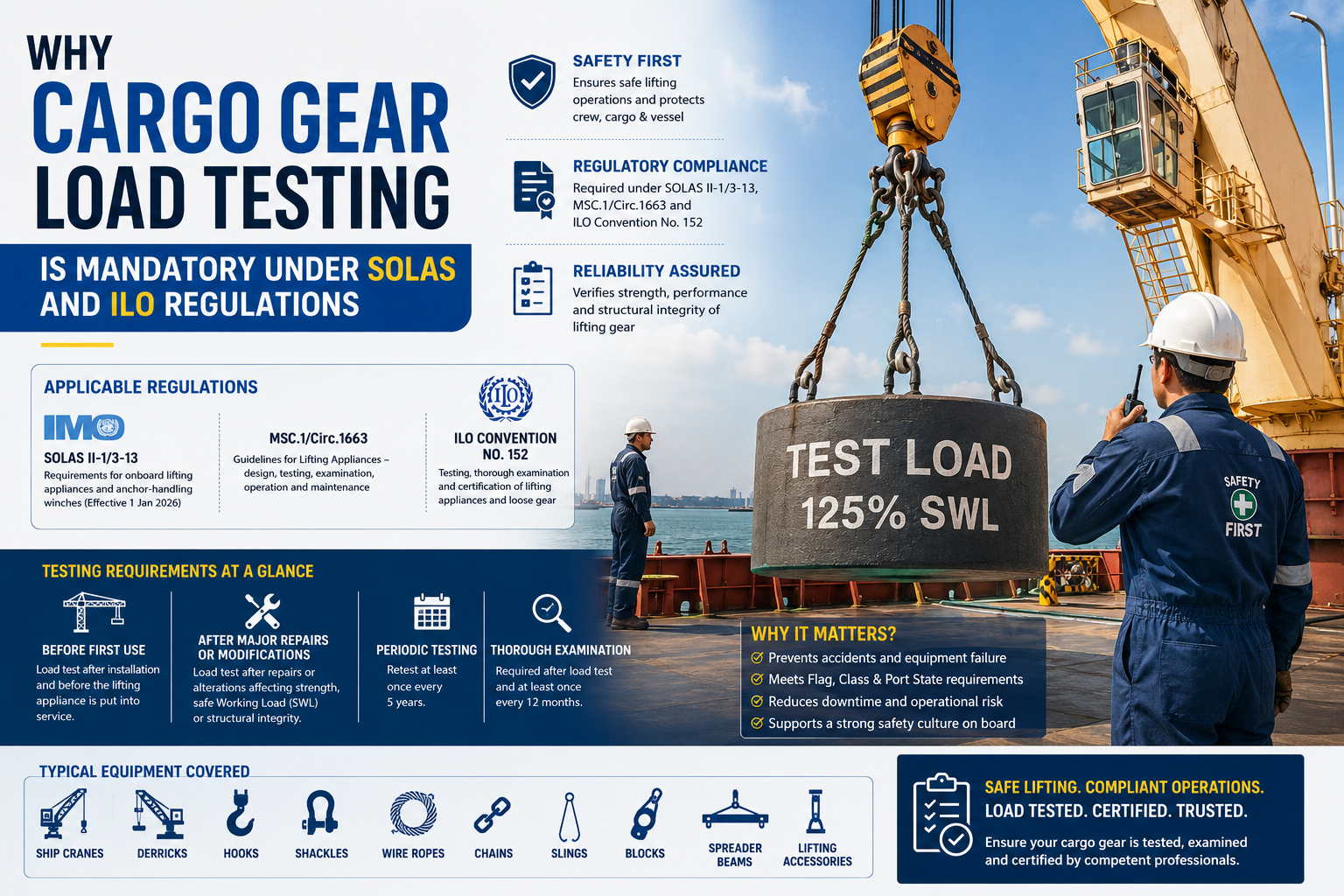
Why Cargo Gear Load Testing Is Mandatory Under SOLAS and ILO Regulations
Cargo handling operations are among
the most critical activities carried out on board ships. Cranes, derricks,
lifting appliances, hooks, shackles, wire ropes, chains, spreaders and other
loose gear are routinely exposed to heavy loads and demanding operating
conditions.
A failure of cargo gear can result
in serious injury, loss of life, cargo damage, structural damage and vessel
downtime. For this reason, international maritime regulations require
lifting appliances and associated gear to be properly tested, examined,
inspected and maintained.
In 2026, cargo gear compliance has
become even more important with the entry into force of SOLAS Chapter II-1
Regulation 3-13, which establishes requirements for onboard lifting
appliances and anchor-handling winches. IMO's supporting MSC.1/Circ.1663 –
Guidelines for Lifting Appliances provides guidance on design, testing,
examination, operation and maintenance.
At the same time, ILO Convention
No. 152 contains established requirements covering testing, examination,
inspection and certification of lifting appliances and loose gear used in ship
and dock work.
What Is Cargo Gear Load Testing?
Cargo gear load testing is a
controlled test performed to verify that a lifting appliance or lifting gear
can safely withstand its specified Safe Working Load (SWL) and the
applicable test load.
The objective is not simply to
place weight on a crane or lifting appliance. A proper cargo gear load test is
part of a wider safety assessment involving:
- Verification of Safe Working Load (SWL)
- Examination of the lifting appliance
- Inspection of structural components
- Checking wire ropes and terminations
- Examination of hooks, shackles and blocks
- Testing of brakes and operational functions
- Verification of load-bearing components
- Application of the prescribed test load
- Thorough examination after testing
- Documentation and certification
The test should be performed under
the supervision or acceptance of an appropriately recognized competent
person, Administration or Recognized Organization (RO), as applicable.
Why Is Cargo Gear Load Testing Mandatory?
Cargo gear is designed to lift
heavy loads, but its condition can deteriorate due to:
- Corrosion
- Metal fatigue
- Excessive loading
- Wire-rope deterioration
- Cracks in structural components
- Deformation
- Wear and tear
- Brake failure
- Poor maintenance
- Incorrect repairs
- Environmental exposure
- Unauthorized modifications
A lifting appliance may appear
satisfactory during a visual inspection but still have structural or mechanical
weaknesses.
Load testing provides an
additional level of confidence that the equipment remains capable of safely
performing its intended lifting function.
This is particularly important for
shipboard cranes and lifting appliances because failures can occur over
personnel, cargo holds, decks, quaysides or other working areas.
SOLAS Requirements for CargoGear Load Testing
A major regulatory development took
effect on 1 January 2026.
The IMO introduced SOLAS Chapter
II-1 Regulation 3-13, addressing the application, design, construction,
operation, inspection, testing and maintenance of onboard lifting appliances
and anchor-handling winches. The associated IMO Guidelines for Lifting
Appliances are contained in MSC.1/Circ.1663.
Key requirements include:
1. Load testing before first use
For applicable new lifting
appliances, load testing is required after installation and before the
appliance is placed into service for the first time.
This verifies that the installed
lifting appliance and its supporting arrangements can safely perform their
intended function.
2. Testing after major repairs or modifications
Load testing is also required
following repairs, modifications or alterations of a major character that could
affect:
- Safe Working Load
- Strength
- Stability
- Service life
- Primary load-bearing structure
- Functionality or structural integrity
The IMO guidelines specifically
identify these types of changes as major alterations requiring attention.
3. Periodic retesting
Under MSC.1/Circ.1663, applicable
lifting appliances should be retested at least once every five years.
4. Thorough examination
A thorough examination is required
following load testing and periodically thereafter. ABS summarizes the
SOLAS/IMO regime as requiring thorough examinations after load tests and
annually.
What About Existing Cargo Gear?
The 2026 SOLAS requirements are
particularly important for vessels with existing lifting appliances.
For lifting appliances installed
before 1 January 2026, the applicable equipment is required to be
tested, thoroughly examined, permanently marked and supported by documentary
evidence no later than the vessel's first renewal survey on or after 1
January 2026, subject to the applicable SOLAS provisions and
Administration/RO requirements.
This means shipowners and managers
should review their existing cargo gear records rather than assuming that
previously issued certificates automatically satisfy the new SOLAS
requirements.
Where existing equipment does not
have acceptable certification or supporting documentation, additional testing
and examination may be required.
ILO Convention No. 152 and Cargo Gear Testing
The ILO Occupational Safety and
Health (Dock Work) Convention, 1979 (No. 152) specifically addresses the
safe use of lifting appliances and loose gear.
Article 21 requires lifting
appliances and loose gear to be properly designed, maintained and used safely,
and prohibits loading beyond the safe working load except for authorized
testing under the direction of a competent person.
ILO Article 22 – Testing
ILO Convention No. 152 requires:
- Testing before an appliance or loose gear is put
into use for the first time
- Testing after substantial alteration or repair
affecting safety
- Retesting shipboard lifting appliances at least
once every five years
- Thorough examination and certification after
testing
ILO Article 23 – Thorough Examination
In addition to testing, lifting
appliances and loose gear are required to undergo periodic thorough
examination at least once every 12 months under the Convention.
ILO Article 25 – Records and Register
Records are also an important part
of compliance.
The ILO Convention requires
authenticated records showing the:
- Safe Working Load
- Dates of testing
- Test results
- Thorough examination results
- Inspection results
A register of lifting appliances
and loose gear should also be maintained in the prescribed form.
SOLAS vs ILO: What Is the Difference?
SOLAS and ILO requirements should
not simply be treated as two interchangeable certificates.
They address safety from related
but different regulatory perspectives.
|
Requirement |
SOLAS / IMO |
ILO Convention No. 152 |
|
Lifting appliance safety |
Yes |
Yes |
|
Load testing |
Yes |
Yes |
|
Thorough examination |
Yes |
Yes |
|
Periodic testing |
At least 5 years under
MSC.1/Circ.1663 |
At least 5 years for shipboard
lifting appliances |
|
Annual thorough examination |
Yes under IMO guidance |
Yes |
|
Loose gear |
Covered |
Covered |
|
Certification/records |
Required |
Required |
|
Competent person |
Applicable |
Required |
|
Safe Working Load |
Required |
Required |
The exact applicability can depend
on the vessel, equipment, flag Administration, Recognized Organization,
national legislation and the specific regulatory instrument being applied.
Therefore, shipowners should
verify requirements with the vessel's Flag Administration and Recognized
Organization rather than relying on a generic testing interval alone.
What Cargo Gear Should Be Tested?
Cargo gear load testing may apply
to various shipboard lifting appliances and associated lifting equipment,
depending on the applicable regulations.
Typical equipment includes:
Ship Cranes
- Provision cranes
- Deck cranes
- Cargo cranes
- Stores cranes
- Engine-room cranes
- Hose-handling cranes
- Offshore cranes where applicable
Derricks and Lifting Appliances
- Cargo derricks
- Lifting beams
- Monorail systems
- Workshop lifting appliances
- Machinery lifting arrangements
Loose Gear
- Hooks
- Shackles
- Swivels
- Blocks
- Chains
- Slings
- Wire-rope slings
- Master links
- Spreader beams
- Lifting accessories
ILO Convention No. 152 defines a
lifting appliance broadly and also specifically covers loose gear used to
attach loads to lifting appliances.
Cargo Gear Load Test: Typical Test Loads
MSC.1/Circ.1663 provides minimum
test-load guidance for lifting appliances intended for use in port or sheltered
waters.
The test load is based on the
equipment's SWL:
|
Safe Working Load |
Minimum Test Load |
|
SWL = 20 tonnes |
1.25 × SWL |
|
20 t < SWL = 50 t |
SWL + 5 tonnes |
|
SWL > 50 tonnes |
1.10 × SWL |
For lifting appliances intended for
open-sea operations, applicable dynamic loads must be considered and the test
load should be established to the satisfaction of the Administration or
recognized classification society, as applicable.
Example
Suppose a ship crane has an SWL of 20
tonnes.
The minimum test load under the
table would be:
20 × 1.25 = 25 tonnes
Therefore, the applicable minimum
test load would be 25 tonnes, subject to the requirements and acceptance
of the Administration/RO.
How Is Cargo Gear Load Testing Carried Out?
A professional cargo gear load test
should follow a controlled procedure.
Step 1: Review Documentation
The service team verifies:
- Crane details
- SWL
- Manufacturer information
- Previous test certificates
- Previous examination reports
- Repair history
- Relevant drawings
- Class/Flag requirements
Step 2: Visual and Structural Inspection
The lifting appliance is examined
for:
- Cracks
- Corrosion
- Deformation
- Loose fasteners
- Structural damage
- Abnormal wear
- Weld defects
- Damaged components
Step 3: Wire Rope Inspection
Wire ropes are checked for:
- Broken wires
- Corrosion
- Kinking
- Crushing
- Bird-caging
- Diameter reduction
- Poor termination
- Lubrication condition
Step 4: Loose Gear Inspection
Hooks, shackles, chains, blocks and
slings are examined for wear, deformation, cracks and identification markings.
Step 5: Load Test
The prescribed test load is applied
using an appropriate and controlled testing arrangement.
The equipment is monitored during
the test for abnormal movement, deformation, brake slippage or other unsafe
conditions.
Step 6: Operational Test
The lifting appliance may be
checked for functions such as:
- Hoisting
- Lowering
- Slewing
- Luffing
- Brake operation
- Emergency functions
- Limit switches
- Control systems
Step 7: Post-Test Examination
After completion of the load test,
the lifting appliance undergoes the required thorough examination.
Step 8: Certification
Upon satisfactory completion, the
applicable test and examination documentation is issued by the competent
person/RO or other authority as required.
Why Thorough Examination Is Just as Important as Load Testing
Load testing alone does not prove
that every component of cargo gear is in good condition.
For example, a crane may
successfully lift a test load while still having:
- Corroded structural members
- Excessively worn sheaves
- Damaged wire ropes
- Cracked hooks
- Deteriorated bearings
- Brake problems
- Loose structural connections
This is why load testing and
thorough examination should be considered complementary safety controls.
The ILO describes thorough
examination as a detailed visual examination by a competent person,
supplemented where necessary by other suitable methods to reach a reliable
conclusion regarding safety.
What Happens If Cargo GearTesting Is Overdue?
Using cargo gear without valid
testing and examination records can create serious operational and compliance
risks.
Potential consequences include:
- Unsafe lifting operations
- Injury or fatality
- Cargo damage
- Crane failure
- Vessel delays
- Port restrictions
- Class/Flag observations
- Inspection deficiencies
- Detention risk where applicable
- Insurance complications
- Increased liability for owners and operators
ILO Convention No. 152 states that
lifting appliances or loose gear should not be used where the competent
authority is not satisfied that the required testing, examination or inspection
has been carried out or where the equipment is considered unsafe.
Importance of Competent Cargo Gear Testing
Cargo gear testing should not be
treated as simply attaching a test weight to a crane.
A competent person should have the
necessary knowledge and experience to assess the equipment and perform the
required duties.
ILO Convention No. 152 requires
competent persons to be recognized or accepted by the competent authority,
while the SOLAS/IMO regime places testing and examination under the applicable
Administration/RO framework.
For shipowners and managers,
choosing a service provider with appropriate technical capability, equipment,
trained personnel and acceptance by the relevant authority is therefore
critical.
Cargo Gear Testing Documentation
After testing, the vessel should
maintain appropriate documentation.
Depending on the applicable
regulatory framework, records can include:
- Cargo Gear Test Certificate
- Thorough Examination Certificate
- Register of Lifting Appliances and Loose Gear
- SWL information
- Test load
- Test date
- Next due date
- Equipment identification
- Defects identified
- Repairs completed
- Competent person's details
- Class/RO or Flag endorsement where applicable
ILO guidance emphasizes maintaining
records and certificates as evidence of the safe condition of lifting
appliances and loose gear.
Cargo Gear Load Testing and Planned Maintenance
Cargo gear testing should form part
of the vessel's Planned Maintenance System (PMS).
Ship managers should maintain a
tracking system for:
Equipment ? SWL ? Last Test ?
Last Examination ? Certificate ? Next Due Date
This helps prevent:
- Expired certificates
- Missed five-year tests
- Missed annual examinations
- Unrecorded repairs
- Missing loose-gear certificates
The IMO's lifting-appliance
guidelines are intended to support a systematic approach to operation,
inspection, testing and maintenance.
Why Shipowners Should Not Wait
Until the Survey
Cargo gear testing should be
planned well before a class, Flag or port inspection.
Waiting until the last moment can
create problems such as:
- Limited availability of testing equipment
- Difficulty arranging competent personnel
- Port operation restrictions
- Vessel schedule delays
- Missing historical documentation
- Additional repair requirements discovered during
inspection
A proactive cargo gear inspection
and testing program allows defects to be identified and corrected before they
become an operational or compliance problem.
Cargo Gear Load Testing Servicesin India
For shipowners, ship managers,
technical superintendents and vessel operators, cargo gear load testing is an
important part of maintaining safe lifting operations.
Marinetech Safety Pvt. Ltd.
provides marine safety and cargo gear-related inspection and testing services
for shipboard lifting equipment.
Cargo gear services can include
inspection and testing of:
- Ship cranes
- Cargo cranes
- Deck cranes
- Derricks
- Hooks
- Shackles
- Wire ropes
- Slings
- Lifting accessories
- Loose gear
Testing requirements are assessed
according to the applicable SOLAS requirements, IMO MSC.1/Circ.1663, ILO
requirements, Flag Administration requirements and Class/RO requirements.
For vessels operating from Indian
ports such as Mundra, Hazira, Surat, Mumbai, Sikka, Jamnagar, Kandla, Vizag,
Chennai and Paradip, advance planning of cargo gear testing can help reduce
operational delays and maintain appropriate certification records.
Cargo Gear Load Testing Checklist for Shipowners
Before arranging cargo gear
testing, verify:
Equipment identification
available
Safe Working Load clearly marked
Previous certificate available
Previous test date checked
Annual examination status checked
Wire rope condition checked
Hooks and shackles inspected
Loose gear certificates available
Structural condition inspected
Brake operation checked
Test load requirement confirmed
Flag/Class/RO requirements confirmed
Competent person arranged
Test equipment available
Certificate and register updated after completion
Frequently Asked Questions
1. Is cargo gear load testingmandatory on ships?
Yes, applicable shipboard lifting
appliances are subject to testing and examination requirements under the
relevant regulatory framework. Since 1 January 2026, SOLAS II-1/3-13 and
IMO MSC.1/Circ.1663 provide specific requirements for applicable onboard
lifting appliances.
2. How often should a ship crane be load tested?
Under MSC.1/Circ.1663, applicable
lifting appliances should be retested at least once every five years,
with additional testing after installation and after major repairs or
modifications as applicable.
3. Is annual cargo gear inspection required?
Yes. Annual thorough examination
requirements apply under the applicable SOLAS/IMO and ILO framework. ILO
Convention No. 152 specifically requires thorough examination at least once
every 12 months.
4. What is SWL in cargo gear?
SWL means Safe Working Load.
It is the maximum load that a lifting appliance or item of loose gear is
certified to lift under specified operating conditions.
5. What is the difference between load testing and thorough examination?
Load testing verifies the lifting
appliance's ability to withstand the prescribed test load. Thorough examination
is a detailed assessment of the equipment and its condition. Both provide
different but complementary safety assurances.
6. What cargo gear requires certification?
Depending on the applicable
requirements, lifting appliances and associated loose gear such as hooks,
shackles, slings, chains, blocks and other lifting accessories may require
testing, examination and documentary evidence.
7. Does SOLAS replace ILO cargo gear requirements?
Not necessarily. The applicable
requirements depend on the vessel, Flag Administration, equipment and
regulatory framework. Owners should verify the specific requirements with their
Flag Administration and Recognized Organization. ABS, for example, notes that
SOLAS certification does not automatically replace applicable cargo-gear
certification requirements under other instruments.
8. Can cargo gear be used if the certificate has expired?
Equipment should not be used where
the applicable testing, examination or certification requirements have not been
satisfied. The vessel's Master, company, Flag and RO requirements should be
followed before putting the equipment back into service.
Conclusion
Cargo gear load testing is not
merely a paperwork requirement. It is a critical safety measure designed to
verify that lifting appliances and associated gear remain capable of safely
performing their intended function.
With SOLAS II-1/3-13 entering
into force on 1 January 2026, shipowners and managers need to pay
particular attention to lifting-appliance testing, thorough examination,
periodic retesting, loose-gear certification and proper documentation.
The combination of SOLAS, IMO
MSC.1/Circ.1663 and ILO Convention No. 152 provides an important framework
for safer cargo-handling operations and better control of lifting-equipment
risks.
Regular cargo gear load testing can
help protect crew, shore personnel, cargo, vessel structures and business
operations—while supporting compliance with applicable maritime safety
requirements.
If your vessel's cargo gear
test, five-year load test or annual examination is approaching, arrange the
inspection and testing in advance and confirm the applicable Flag/Class/RO
requirements before the vessel's operation or survey.
Related Blogs
1. IMO MSC.1/Circ.1318/Rev.1 Explained: Complete Guide to Fixed
CO2Fire Extinguishing System Inspection (2026)
fire fighting equipment, ship fire
fighting system, IMO MSC.1/Circ.1318/Rev.1, Fixed CO2 System, Fixed CO2 Fire
Extinguishing System, CO2 System Inspection, CO2 System Maintenance, CO2 Fire
Suppression System, Marine Fire Safety, Marine Safety, SOLAS Compliance, SOLAS
Chapter II-2
2. Marine Navigation & Communication Equipment Supplier in
India: Complete Guide for Ship Managers
AIS transponder supplier India,
ECDIS supplier India, VHF radio ship India, Inmarsat terminal supplier India,
navcom equipment India, marine radar supplier India
3.Life Saving Equipment for Ships: What SOLAS Requires & What
Marinetech Supplies
life saving equipment ship India,
LSE supplier India, lifejacket supplier India, immersion suit supplier India,
EPIRB supplier India, SART supplier India, SOLAS life saving equipment India
4. Fire Fighting Equipment on Ships: What SOLAS Requires &
What Marinetech Supplies
fire fighting equipment ship India,
SOLAS fire fighting equipment requirements, marine fire fighting equipment
supplier India, fireman outfit supplier India, SCBA supplier India, fire
extinguisher ship India
5.Fire Fighting Appliances Service in India 2026: Complete Guide
fire fighting appliances service
India 2026, LSA FFA inspection India, fire fighting equipment service ship
India, marine fire safety India, SOLAS fire fighting requirements, DG Shipping
approved fire fighting service India