Blog Post
SOLAS Chapter III: Complete Guide to Life-Saving Appliances on Ships
Posted By: Harsh Bamnolia
Posted On : 13-Oct-2026
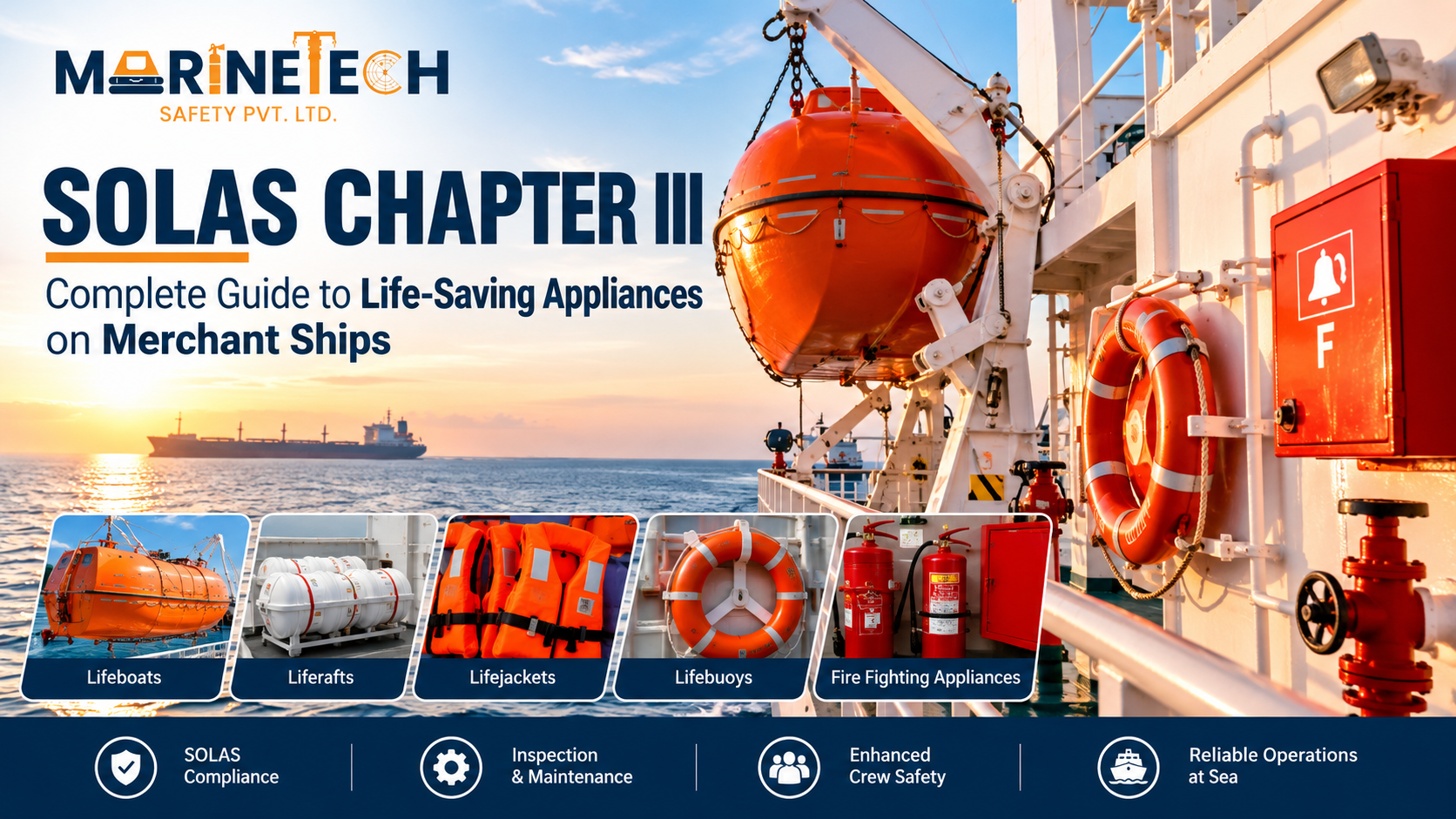
SOLAS Chapter III: Complete Guide to Life-Saving Appliances on Merchant Ships
Introduction
Safety at sea is one of the most
important responsibilities of every shipowner, ship manager, vessel operator
and crew member. Merchant ships operate in challenging environments where fire,
collision, flooding, machinery failure and severe weather can create
life-threatening emergencies. In such situations, properly maintained
life-saving appliances (LSA) are essential for protecting crew members and passengers.
The International Convention for
the Safety of Life at Sea (SOLAS), developed by the International Maritime
Organization (IMO), establishes international minimum standards for the safety
of ships. SOLAS Chapter III — Life-Saving Appliances and Arrangements
covers the requirements for lifejackets, lifeboats, liferafts, rescue boats,
lifebuoys, launching arrangements, emergency instructions and other essential
survival equipment.
For vessels operating on
international voyages, compliance involves more than carrying the required
equipment. Appliances must be approved where applicable, correctly installed,
accessible, maintained and ready for immediate use.
Marinetech Safety Pvt. Ltd. is an
India-based marine safety equipment servicing and supply company supporting
shipowners, technical managers and vessel operators with marine safety
services, inspection, maintenance and equipment supplies. Alongside life-saving
appliances, maintaining reliable firefighting equipment is another essential
part of a vessel's safety management programme.
In this guide, we explain the major
SOLAS Chapter III requirements, the different types of life-saving appliances
on merchant ships, inspection and maintenance considerations, and how
professional marine safety servicing can support vessel readiness.
1. What Is SOLAS Chapter III?
SOLAS Chapter III establishes
requirements for life-saving appliances and arrangements on ships. Its purpose
is to ensure that appropriate equipment is available to help people survive and
escape safely during an emergency at sea.
The chapter addresses the
application and approval of equipment, personal life-saving appliances,
survival craft, launching and recovery arrangements, emergency training,
drills, operational readiness and maintenance.
The International Life-Saving
Appliance (LSA) Code provides detailed technical requirements for the
design, performance, testing and construction of the appliances covered by
SOLAS.
The exact requirements applicable
to a vessel depend on factors such as its type, size, construction date,
voyage, flag Administration and applicable exemptions or special provisions.
Important SOLAS Chapter III
areas
- Personal life-saving appliances, including
lifejackets and lifebuoys.
- Survival craft, including lifeboats and liferafts.
- Rescue boats and associated launching arrangements.
- Embarkation, launching and recovery equipment.
- Line-throwing appliances and visual distress
signals.
- Muster lists, operating instructions and emergency
training.
- Operational readiness, inspections and maintenance.
Shipowners should consult the
applicable consolidated SOLAS text, LSA Code, Flag State requirements and
vessel-specific safety equipment documentation when determining compliance.
2. Why Are Life-Saving Appliances Important on Merchant Ships?
Life-saving appliances provide the
means to abandon a vessel, remain afloat, signal for assistance and support
survival until rescue arrives.
Their importance extends beyond
statutory compliance.
Emergency evacuation:
Lifeboats and liferafts provide designated survival craft when remaining on
board is no longer safe.
Personal protection:
Lifejackets and immersion suits, where required, help protect individuals
against drowning and exposure to cold water.
Man-overboard response:
Lifebuoys and associated lights or other approved equipment help identify and
support the recovery of a person who has fallen into the sea.
Survival support: Survival
craft carry equipment intended to help occupants remain safe while awaiting
rescue.
Inspection readiness: Proper
maintenance, records and equipment identification help demonstrate compliance
during applicable surveys and port State control inspections.
A missing, expired, damaged or
inaccessible appliance can compromise the entire emergency response
arrangement. For this reason, every item should be included in the vessel's
planned maintenance and inspection programme.
3. Types of Life-Saving Appliances Required on Merchant Ships
3.1 Lifeboats
Lifeboats are survival craft
designed to carry people away from a vessel in an emergency. Depending on the
ship and applicable requirements, lifeboats may include totally enclosed,
partially enclosed or free-fall arrangements.
Typical lifeboat equipment and
systems include:
- Lifeboat hull and buoyancy arrangements.
- Engine, fuel and propulsion components.
- Steering and control arrangements.
- Communication and signalling equipment.
- Survival equipment and emergency supplies.
- Launching, embarkation and recovery arrangements.
Lifeboat readiness depends on the
condition of the craft as well as its associated launching appliance, release
mechanism and other safety-critical components.
Inspections and servicing should be
carried out in accordance with applicable SOLAS requirements, manufacturer
instructions, the Flag Administration and relevant approved service
arrangements.
Related reading: Lifeboat
Servicing as per SOLAS Requirements: Inspection, Maintenance and Compliance
Guide.
3.2 Inflatable and Rigid Liferafts
Liferafts provide an alternative
survival platform when a vessel must be abandoned. They are available in
inflatable and rigid configurations, with the type and capacity determined by
the vessel's approved arrangements.
Important liferaft checks include:
- Correct capacity and approved configuration.
- Container condition and identification markings.
- Securing arrangements and accessibility.
- Painter arrangements and launching instructions.
- Hydrostatic release unit (HRU), where fitted.
- Expiry dates and service documentation.
- Required survival equipment and approved equipment
pack.
Inflatable liferafts must be
serviced at the intervals and by the facilities or service providers required
under the applicable regulations and approval arrangements. HRUs and other
components must be maintained or replaced in accordance with their applicable
requirements and manufacturer instructions.
A liferaft that is correctly stowed
but cannot be released or deployed as intended may not provide effective
emergency protection.
Related reading: SOLAS
Chapter III: Liferaft Requirements for Merchant Ships.
3.3 Lifejackets
Lifejackets are personal flotation
appliances intended to help keep a person afloat and support survival in the
water.
Ship operators should verify that:
- The required number and types are available.
- Lifejackets are correctly distributed and
accessible.
- Required lights, whistles and other fittings are
present.
- Straps, buckles, reflective material and fabric are
in acceptable condition.
- Any applicable servicing, replacement and
inspection requirements are met.
Crew members should know where
lifejackets are located and how to put them on correctly. Instructions should
be available at appropriate locations in accordance with the vessel's approved
arrangements.
3.4 Lifebuoys
Lifebuoys are used to assist a
person who has fallen overboard. Depending on the vessel's arrangements, they
may be fitted with lifebuoy self-igniting lights, smoke signals or other
approved equipment.
Routine checks should cover:
- Correct positioning and accessibility.
- Condition of the buoy and markings.
- Availability and condition of the required buoyant
lifeline.
- Condition and expiry of associated lights and smoke
signals, where applicable.
- Correct mounting and release arrangements.
Lifebuoys should never be
obstructed by cargo, temporary equipment or unauthorised modifications.
3.5 Immersion Suits and Thermal Protective Aids
Immersion suits and thermal
protective aids help reduce exposure-related risks in cold-water emergencies.
Their carriage and specifications depend on applicable SOLAS requirements and
the vessel's operating conditions.
Inspection should address material
deterioration, seams, zips, closures, reflective elements, markings and
accessories, as applicable. Any required testing and servicing should follow
the relevant manufacturer's instructions and regulatory requirements.
3.6 Rescue Boats
Rescue boats are intended to assist
in recovering persons from the water, assembling survival craft and supporting
other rescue operations.
Checks should include the boat's
hull, engine, fuel, steering, equipment, launching arrangement and recovery
system. Where applicable, associated davits, winches, falls and release
mechanisms should be included in the vessel's maintenance programme.
3.7 Visual Distress Signals
Approved visual signals help a
vessel or survival craft communicate distress and attract attention during an
emergency. These may include parachute flares, hand flares and buoyant smoke
signals.
The required type and quantity
depend on the approved equipment arrangements. Crew members should verify
expiry dates, safe stowage, accessibility and the condition of containers.
Expired or damaged pyrotechnics
must be handled and disposed of through appropriate procedures in accordance
with applicable regulations and manufacturer instructions.
3.8 Line-Throwing Appliances
Line-throwing appliances are used
to establish a line between vessels or between a vessel and shore in
appropriate emergency situations.
Checks should include the
appliance's condition, required projectiles and lines, expiry or service dates
where applicable, safe stowage and operating instructions.
3.9 Launching and Embarkation Appliances
Lifeboats and other survival craft
are only effective when people can embark and launch them safely.
Associated arrangements may include
davits, winches, falls, release mechanisms, embarkation ladders, embarkation
stations and marine evacuation systems, as applicable to the ship.
These systems must be maintained
and tested in accordance with the applicable requirements. Testing or
maintenance involving loads and release mechanisms must be undertaken by
competent personnel using approved procedures and appropriate safety precautions.
4. SOLAS Chapter III: Operational Readiness and Maintenance
SOLAS Regulation III/20 addresses
operational readiness, maintenance and inspections. Regulation III/36 addresses
instructions for onboard maintenance.
The fundamental requirement is that
life-saving appliances remain in working order and ready for immediate use,
subject to the applicable provisions.
A practical shipboard maintenance
programme should cover the following activities.
Daily and routine readiness
checks
Responsible crew members should
carry out the checks required by the vessel's procedures, including verifying
that equipment is accessible, correctly stowed and free from obvious damage or
obstruction.
Weekly and monthly inspections
The applicable SOLAS requirements
specify particular weekly and monthly checks for relevant equipment and
systems. The vessel's safety management system should identify the responsible
personnel, required inspection scope and records.
Periodic servicing and testing
Liferafts, lifeboats, launching
appliances, breathing apparatus and other equipment may require different
servicing, testing or examination intervals. These intervals must not be
assumed to be identical across all equipment categories.
Always verify the applicable SOLAS
provision, current amendments, manufacturer's instructions, service approval
requirements and Flag State directions.
Recordkeeping
Inspection and servicing records
should be maintained as applicable. These may include:
- Equipment identification and location.
- Inspection or service date.
- Findings and defects identified.
- Repairs, replacements and tests performed.
- Next due date, where applicable.
- Service reports, certificates and supporting
documentation.
- Corrective actions and closure records.
Clear records help ship managers
plan maintenance and demonstrate the vessel's compliance status.
5. Common Life-Saving Appliance Deficiencies Found During Inspections
Poorly maintained equipment can
create safety risks and lead to deficiencies during statutory surveys or port
State control inspections.
Common issues include:
- Expired liferaft service dates or HRUs.
- Damaged lifejackets or missing accessories.
- Inaccessible or incorrectly secured survival craft.
- Defects in lifeboat launching or recovery
arrangements.
- Missing or expired distress signals.
- Incomplete maintenance and servicing records.
- Obstructed embarkation stations or emergency escape
routes.
- Crew unfamiliarity with operating instructions and
emergency procedures.
- Defective lights, batteries or other associated
equipment.
- Unresolved defects recorded during previous
inspections.
The best way to address these
issues is through planned maintenance, timely servicing, crew familiarisation
and a structured review of the vessel's safety equipment inventory.
6. How Life-Saving Appliances and Fire-Fighting Appliances Work Together
Life-saving appliances and
fire-fighting appliances perform different but complementary functions.
LSA helps people escape, evacuate,
survive and be recovered during an emergency. Fire-fighting appliances (FFA)
help prevent, detect, contain and extinguish fires.
On a merchant ship, a fire can
quickly threaten accommodation spaces, machinery rooms, cargo areas and escape
routes. Effective firefighting may prevent the need to abandon the vessel,
while properly maintained survival craft and personal protective equipment
provide essential protection if evacuation becomes necessary.
SOLAS Chapter III addresses
life-saving appliances and arrangements, while SOLAS Chapter II-2 addresses
fire protection, fire detection and fire extinction.
The ship's safety programme should
therefore consider both systems together.
Fire-safety equipment may include:
- Portable and semi-portable fire extinguishers.
- Fire hoses, nozzles and hydrant equipment.
- Self-contained breathing apparatus (SCBA).
- Emergency escape breathing devices (EEBD).
- Fire detection and alarm systems.
- Fixed CO2, foam and other approved fire suppression
systems.
- Firefighter's outfits and associated equipment.
Each system has specific
inspection, testing, servicing and documentation requirements.
For professional inspection,
maintenance, servicing and supply of marine firefighting equipment, explore Marinetech
Safety Pvt. Ltd.'s Fire Fighting Appliances Service.
This service page provides
information about firefighting appliance servicing, including fire
extinguishers, SCBA sets, fixed fire suppression systems, fire hoses and
nozzles, fire detection systems and EEBDs.
7. Marine Safety Equipment Servicing in India: How Marinetech Safety Pvt. Ltd. Supports Shipowners
Marinetech Safety Pvt. Ltd. is an
India-based company providing marine safety equipment services and supplies for
shipowners, ship managers, technical superintendents and vessel operators.
Its service offering covers
life-saving and firefighting equipment as well as other marine technical
services.
Depending on the equipment and
applicable approvals, services include inspection, maintenance, testing,
servicing and certification support, alongside the supply of marine safety
equipment.
Life-saving appliance support
For relevant equipment and approved
service arrangements, ship operators can seek support with liferaft servicing,
lifeboat servicing, associated safety equipment and other life-saving appliance
requirements.
Fire-fighting appliance service
Marinetech provides firefighting
equipment servicing, including inspection, maintenance and testing of relevant
equipment and systems. Its service scope includes fire extinguishers, SCBA,
fixed fire suppression systems, fire hoses and nozzles, fire detection and
alarm systems, and EEBDs.
Explore the dedicated service page:
Fire
Fighting Appliances Service in India.
Marine safety equipment supply
Vessels may also require
replacement equipment, accessories, consumables and approved components to
maintain their onboard safety arrangements. The correct product specification,
type approval, compatibility and acceptance by the vessel's Flag Administration
must be verified before purchase.
Support across Indian maritime
locations
Marinetech's service network and
operating coverage include key maritime locations such as Mumbai, Mundra,
Surat, Vizag and Chennai, with service arrangements depending on the equipment
and operational requirements.
Shipowners should contact the
company to confirm service availability, scheduling, applicable approvals and
documentation for their specific vessel and port call.
8. How to Prepare a Merchant Ship for an LSA Inspection
Before a scheduled survey or
inspection, ship managers and chief officers can use the following checklist as
a starting point.
- Review the vessel's approved safety equipment list
and applicable certificates.
- Confirm that the required appliances are onboard in
the correct quantities and locations.
- Check liferaft, HRU and relevant equipment service
or expiry dates.
- Verify the condition and accessibility of
lifeboats, liferafts and lifejackets.
- Review the condition of launching and recovery
arrangements.
- Check required visual distress signals and other
time-limited equipment.
- Verify that onboard inspection and maintenance
records are complete.
- Review outstanding defects and confirm that
corrective actions have been closed.
- Confirm that crew members understand muster lists,
emergency instructions and operating procedures.
- Arrange required servicing and testing with an
appropriately approved service provider.
This checklist does not replace the
vessel's official inspection requirements. The final scope should be determined
from the applicable regulations, approved equipment list, Flag State
instructions and vessel-specific documentation.
9. Benefits of Professional Marine Safety Equipment Servicing
Professional servicing helps ship
operators maintain reliable equipment, identify defects before an emergency and
organise maintenance documentation.
Key benefits include:
Improved emergency readiness:
Inspection and testing help identify equipment that may not perform as
intended.
Better maintenance planning:
Tracking service dates and defects reduces the risk of overdue maintenance.
Documented compliance:
Proper reports and certificates, where applicable, support statutory and
operational reviews.
Equipment reliability:
Appropriate maintenance helps protect the condition and function of
safety-critical equipment.
Coordinated LSA and FFA
management: Managing both life-saving and firefighting equipment as part of
an integrated safety programme helps address the full emergency response chain.
Equipment should always be serviced
by personnel and facilities meeting the applicable approval and competency
requirements.
10. Why Choose Marinetech Safety Pvt. Ltd.?
For shipowners and technical
managers seeking marine safety equipment services and supplies in India,
Marinetech Safety Pvt. Ltd. offers a range of services relevant to onboard
safety and statutory maintenance.
The company supports marine
equipment inspection, servicing and supply, with a service portfolio covering
life-saving appliances, firefighting equipment, lifeboats, liferafts,
navigation and communication systems, calibration and other marine technical requirements.
When selecting a service provider,
ship operators should confirm:
- Relevant equipment and manufacturer approvals.
- Acceptance by the vessel's Flag Administration or
classification society where required.
- Technician competency and appropriate service
facilities.
- Scope of inspection, testing and maintenance.
- Availability of reports, certificates and traceable
records.
- Service scheduling that fits the vessel's port call
and operational requirements.
For more information about the
company and its service portfolio, visit the Marinetech
Safety Pvt. Ltd. official website.
Conclusion
SOLAS Chapter III is a fundamental
part of maritime safety because it establishes requirements for life-saving
appliances and arrangements on merchant ships. Lifeboats, liferafts,
lifejackets, lifebuoys, rescue boats, distress signals and associated launching
arrangements must be suitable for the vessel, correctly maintained and ready
for use.
Shipowners and technical managers
should combine routine onboard inspections, planned maintenance, periodic
professional servicing, crew familiarisation and accurate documentation to
support effective emergency preparedness.
Fire safety is equally important.
Life-saving appliances and firefighting systems work together to protect people
and support a coordinated response when an emergency occurs.
Marinetech Safety Pvt. Ltd.
supports marine operators with marine safety equipment services and supplies in
India, including firefighting appliance inspection, maintenance and servicing.
Need professional firefighting
equipment servicing for your vessel?
Visit the Marinetech
Safety Pvt. Ltd. Fire Fighting Appliances Service page to explore the
service scope and discuss your vessel's requirements.
Website: https://marinetechss.com/
Email: info@marinetechss.com
Phone: +91 72270 38216 | +91 79
7743 0002
Contact the team to discuss
equipment requirements, service scheduling and availability at your vessel's
Indian port of call.
Frequently Asked Questions
1. What is SOLAS Chapter III?
SOLAS Chapter III covers
life-saving appliances and arrangements on ships. It addresses personal
life-saving appliances, survival craft, launching arrangements, emergency
instructions, drills, maintenance and operational readiness.
2. What is the LSA Code?
The International Life-Saving
Appliance (LSA) Code establishes detailed technical requirements for
life-saving appliances covered by SOLAS, including relevant construction,
performance and testing provisions.
3. Which life-saving appliances are required on merchant ships?
Depending on the vessel type and
applicable regulations, these can include lifeboats, liferafts, lifejackets,
lifebuoys, rescue boats, immersion suits, visual distress signals,
line-throwing appliances and associated launching arrangements.
4. How often should life-saving appliances be inspected?
The inspection and servicing
schedule varies by equipment type and applicable regulation. SOLAS specifies
particular weekly and monthly checks, while liferafts, lifeboats, launching
appliances and other equipment have additional requirements. The vessel's
maintenance plan, manufacturer instructions and Flag State requirements should
be consulted.
5. Is liferaft servicing mandatory under SOLAS?
SOLAS includes requirements for the
operational readiness, maintenance and inspection of life-saving appliances,
including arrangements for servicing inflatable liferafts. The applicable
servicing intervals and facility requirements must be verified against the
current regulations and relevant approval arrangements.
6. What is the difference between LSA and FFA?
LSA means Life-Saving Appliances,
which help people evacuate and survive an emergency. FFA means Fire-Fighting
Appliances, which help prevent, detect, contain and extinguish fires. Both are
essential parts of a ship's safety arrangements.
7. What firefighting equipment does Marinetech Safety Pvt. Ltd. service?
Marinetech's firefighting appliance
service scope includes fire extinguishers, SCBA sets, fixed fire suppression
systems, fire hoses and nozzles, fire detection and alarm systems, EEBDs and
other relevant equipment. The applicable service scope and approvals should be
confirmed for the specific equipment.
8. Where can I arrange marine firefighting equipment servicing in India?
Shipowners and technical managers
can contact Marinetech Safety Pvt. Ltd. to discuss firefighting equipment
servicing and supply requirements. The company supports key maritime locations
including Mumbai, Mundra, Surat, Vizag and Chennai, subject to service scope,
scheduling and applicable approvals.
For details, visit the Fire Fighting Appliances Service page.