Blog Post
Marine Instrument Calibration for Ships in India: What You Need to Know in 2026
Posted By: Harsh Bamnolia
Posted On : 25-Jun-2026
Marine Instrument Calibration for Ships in India: What You Need to Know in 2026
Calibration is the process of verifying that a measuring instrument produces results within an acceptable margin of its true value, and adjusting it where it does not. On a ship, an uncalibrated instrument is not merely inaccurate — it is potentially dangerous. A pressure gauge that reads lower than actual pressure, a gas detector that responds late to a flammable atmosphere, an oily water separator monitor that fails to detect an oil concentration above 15 ppm — these are instruments whose inaccuracy can directly contribute to casualties, environmental violations, and criminal prosecution of the master and officers.
Marine instrument calibration in India sits at the intersection of SOLAS requirements, MARPOL compliance, class society rules, and manufacturer maintenance requirements. It covers a wider range of equipment than most ship managers realise — from the gas detectors in enclosed spaces to the navigational instruments on the bridge, from the 15 ppm bilge alarm to the pressure gauges on fire suppression systems. Understanding exactly what must be calibrated, how often, to what standard, and what documentation must be produced is a compliance requirement that is too often treated as an afterthought until a PSC officer or class surveyor raises it.
This guide covers the marine instrument calibration requirements that apply to SOLAS vessels calling at Indian ports, what the calibration process involves, and how Marinetech provides certified calibration services across India's major ports.
Why Calibration Is a SOLAS and MARPOL Requirement, Not Just Good Practice
Instrument calibration requirements on ships arise from multiple overlapping regulatory sources — SOLAS, MARPOL, the FSS Code, class society rules, and manufacturer specifications. Understanding which regulation requires which instrument's calibration is important because it determines the calibration interval, the standard the calibration must meet, and the consequences of non-compliance.
SOLAS Chapter V requires navigational instruments to be maintained in an efficient working state. While SOLAS does not universally prescribe specific calibration intervals for all navigational instruments, the obligation to maintain them effectively implies regular calibration as part of the planned maintenance system. Where a manufacturer specifies a calibration interval as part of the instrument's maintenance requirements, failure to calibrate at that interval is a failure to maintain the instrument effectively under SOLAS.
MARPOL Annex I — which governs oil pollution prevention — specifically requires that the 15 ppm bilge alarm on the oily water separator be operational and properly calibrated. SOLAS Regulation V/7 describes the requirement for atmosphere testing instruments for enclosed spaces, including instruments for measuring oxygen, flammable gases, hydrogen sulphide, and carbon monoxide. These instruments are subject to calibration requirements under the applicable IMO guidelines and the Merchant Shipping (Prevention of Pollution by Oil) Rules in India. IRClass
Class society rules — which may be more specific than the conventions themselves — typically require calibration records for safety-critical instruments as part of the planned maintenance system review during annual and renewal surveys. An instrument with no calibration record, or one where the last calibration predates the manufacturer's specified interval, is a finding at class survey.
Which Instruments Must Be Calibrated on a SOLAS Vessel
The range of instruments requiring calibration on a commercial vessel is broader than most ship managers initially assume. The following covers the primary categories.
Gas Detection Instruments
Gas detectors are among the most safety-critical instruments on any vessel — particularly on tankers, chemical carriers, and vessels with enclosed spaces that crew must enter. The instruments covered include fixed gas detection systems in pump rooms, cargo spaces, and machinery spaces, portable gas detectors used for enclosed space entry, and oxygen analysers used to verify atmosphere before entry.
Each of these instruments must be calibrated using certified reference gas mixtures at intervals specified by the manufacturer — typically every 3 to 6 months for portable detectors used in high-frequency enclosed space entry operations, and annually as a minimum for fixed detection systems. Calibration records must be maintained on board and must identify the instrument by serial number, the calibration gas used, the calibration date, and the technician who conducted the calibration.
PSC officers conducting detailed inspections following enclosed space incidents pay specific attention to gas detector calibration records. An instrument used for enclosed space entry that cannot produce a calibration record within the manufacturer's specified interval is a serious deficiency — and in the context of an actual enclosed space fatality, an uncalibrated gas detector is a critical piece of evidence in the casualty investigation.
15 PPM Bilge Alarm and OWS Monitor
The oily water separator's 15 ppm oil content meter and alarm system must be maintained in a properly calibrated state under MARPOL Annex I. The 15 ppm alarm must activate before discharge exceeds 15 ppm oil content, and the monitoring system must produce an accurate continuous reading during OWS operation.
The calibration of the 15 ppm monitoring system involves verification against a certified reference standard and adjustment where the instrument's response has drifted from its calibration points. Calibration intervals are set by the manufacturer — typically annually as a minimum, with some equipment requiring more frequent verification. The calibration record must be available on board and must be consistent with the OWS operation log entries in the Oil Record Book.
An OWS monitor that has not been calibrated within the manufacturer's interval is a MARPOL deficiency. Combined with Oil Record Book entries showing regular overboard discharge operations, an uncalibrated OWS monitor creates a significant legal exposure for the vessel and its officers — because it calls into question whether any of the reported discharge operations actually met the 15 ppm standard.
Pressure Gauges on Safety-Critical Systems
Pressure gauges are fitted across a vessel's systems — fuel oil, lubricating oil, cooling water, compressed air, firefighting systems, CO2 fixed suppression systems, and more. On safety-critical systems — particularly fire suppression systems where the cylinder pressure determines whether the system has sufficient agent to suppress a fire — an inaccurate pressure gauge can conceal a deficiency that would otherwise trigger maintenance action.
CO2 fixed suppression system cylinders are required to be weighed at the annual FFA inspection to verify their charge. The pressure gauges on these cylinders are not a substitute for weighing — they can read correctly even when the cylinder is underweight due to slow seepage of liquid CO2. However, pressure gauges on other systems — hydraulic systems, breathing air systems for SCBA, compressed air systems for starting engines and operating safety valves — must be calibrated to ensure the readings they display are accurate enough for safe operational decisions.
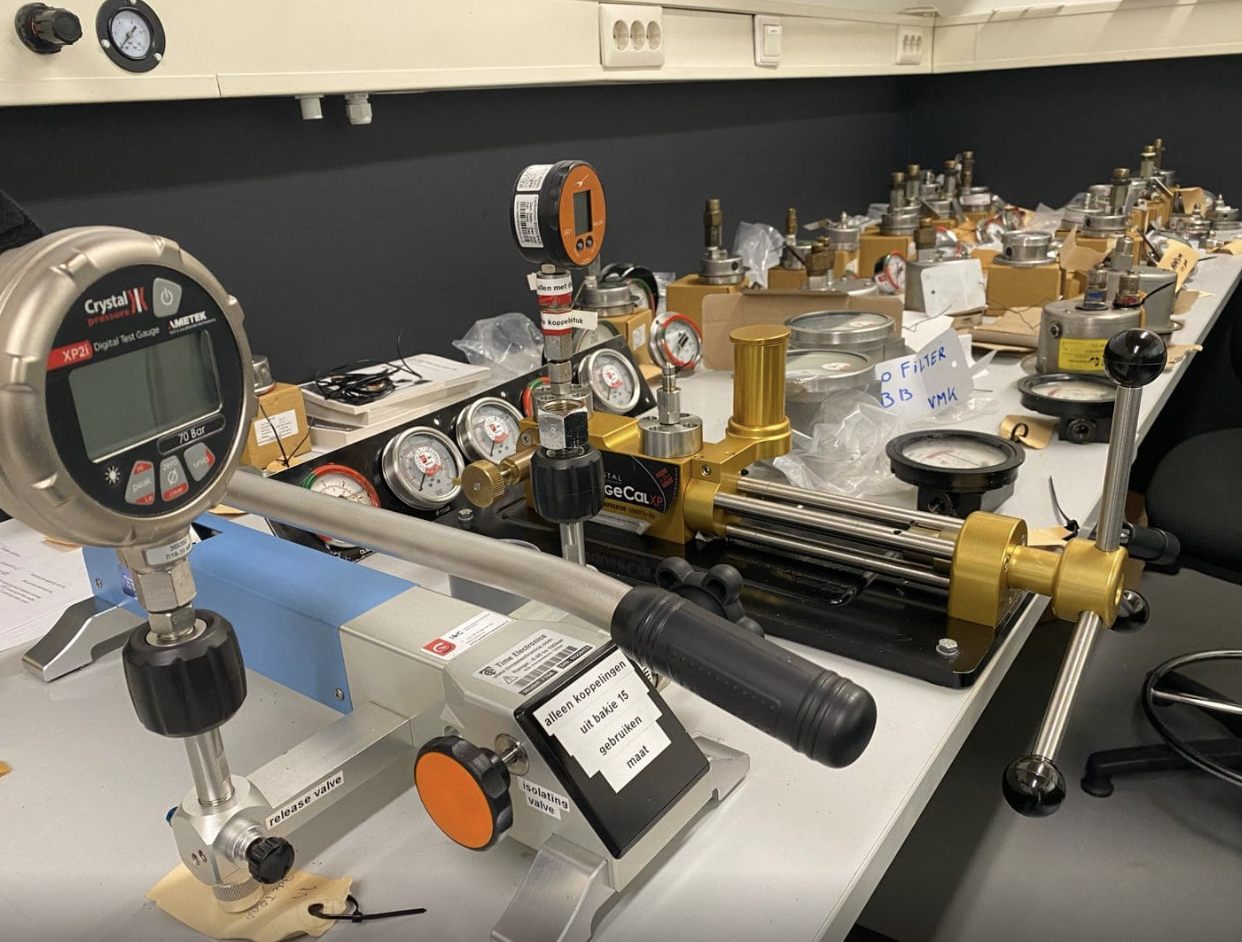
Calibration of pressure gauges uses a dead-weight tester or a precision reference gauge to verify the instrument's reading at multiple pressure points. Where the instrument's reading is outside acceptable tolerance at any test point, it is adjusted, repaired, or replaced. Calibration records identify the gauge by tag number and location, the calibration method, the reference standard used, the result at each test point, and the next calibration due date.
Navigational Instruments
The magnetic compass — required on all SOLAS vessels as the primary non-electronic direction-finding instrument — must be adjusted periodically and a deviation card produced that accounts for the compass error at various headings. The adjustment and deviation card preparation is a form of calibration, and the deviation card must be current, posted at the compass, and available for PSC inspection. An outdated deviation card is a common bridge inspection finding.
Gyrocompasses require periodic service and performance verification — not calibration in the conventional sense, but a functional assessment that confirms the gyro is maintaining a stable reference and that its error is within acceptable limits. ECDIS systems require periodic functional testing and software updates as part of their type approval maintenance requirements. Speed logs require periodic verification against GPS-derived speed over ground where conditions permit.
These navigational instrument requirements are best addressed through the planned maintenance system rather than as standalone calibration services — but they must appear in the PMS with defined intervals and completion records, and those records must be available at class survey and PSC inspection.
Temperature Monitoring Instruments
Temperature instruments on refrigerated cargo systems, engine cooling systems, and exhaust systems require periodic calibration verification. On refrigerated container vessels and reefer ships where cargo temperature records are a legal and commercial requirement — potentially involving food safety certification or pharmaceutical cold chain compliance — the calibration of temperature monitoring systems is particularly critical. Calibration records for these instruments must be traceable to national or international temperature standards.
Flow Meters and Level Gauges
Flow meters used in fuel oil transfer, ballast water treatment monitoring, and cargo measurement applications require periodic calibration to ensure the volumes recorded in operational logs are accurate. Level gauges on tanks used for cargo measurement, fuel accounting, or ballast water record-keeping must be verified against physical soundings at intervals sufficient to confirm accuracy.
What a Marine Instrument Calibration Service Involves
When Marinetech's calibration engineers conduct an instrument calibration service on board, the process follows a systematic approach designed to produce calibration records that meet class society and PSC requirements.
The service begins with a calibration schedule review — identifying all instruments on board that require calibration, confirming the applicable intervals and standards for each, and checking the last calibration date against those intervals. Instruments approaching or overdue for calibration are prioritised.
Each instrument is then calibrated against a reference standard that is itself traceable to national or international standards — typically the National Physical Laboratory (NPL) in India or an internationally recognised metrology authority. Traceability of the reference standard is a fundamental requirement of a calibration record that will satisfy a class surveyor or PSC officer — calibration against an unverified reference standard does not produce a valid calibration certificate.
The calibration result for each instrument is recorded — the as-found condition before calibration, the adjustments made, and the as-left condition after calibration. Where an instrument cannot be adjusted to within acceptable tolerance, it is condemned and a replacement recommendation is made. A calibration certificate is produced for each instrument, identifying the instrument by tag number and serial number, the standard used, the calibration date, the results, and the next calibration due date.
Calibration Services Marinetech Provides in India
Marinetech Safety & Shipping Corporation provides certified marine instrument calibration services across all major Indian ports. Our calibration engineers carry portable calibration equipment with traceable reference standards, enabling on-board calibration of gas detectors, pressure gauges, temperature instruments, and OWS monitoring systems without requiring the instrument to be removed from the vessel.
For gas detectors specifically — the most time-sensitive calibration requirement given the enclosed space entry risk — Marinetech carries certified reference gas mixtures for oxygen, flammable gas (LEL), hydrogen sulphide, and carbon monoxide calibration, covering the full range of gases commonly measured in enclosed space operations. View our calibration services.
Calibration services at major Indian ports can be combined with LSA, FFA, GMDSS, and VDR services in a single Marinetech port call, producing a consolidated compliance service record for class survey review. Contact us to discuss a combined service plan.
Frequently Asked Questions
Which instruments are most commonly found deficient during PSC inspections in India?
Gas detection instruments — particularly portable gas detectors used for enclosed space entry — are the most commonly cited calibration deficiency at Indian ports. The most frequent finding is a detector that has not been calibrated within the manufacturer's specified interval, combined with enclosed space entry records showing the detector was used for entries during that period.
What does "traceable calibration" mean and why does it matter?
Traceable calibration means the reference standard used to calibrate the instrument has itself been calibrated against a recognised national or international standard — creating a documented chain of comparisons back to a primary standard. Traceability is required for a calibration certificate to be accepted at class survey and PSC inspection. Calibration against an unverified reference — a workshop gauge of unknown accuracy, for example — does not produce a traceable calibration record and is not acceptable.
How often must portable gas detectors be calibrated?
Most manufacturers specify calibration every 3 to 6 months for portable gas detectors in regular operational use. Some high-frequency environments — vessels where enclosed space entry is conducted daily — may require more frequent calibration. The manufacturer's specified interval in the instrument's operation manual is the minimum requirement. Where the class society or flag state specifies a shorter interval, that takes precedence.
Does the 15 ppm OWS monitor need to be calibrated even if the OWS is not regularly used?
Yes. The calibration interval is based on time, not frequency of use. An OWS monitor that has not been used for 6 months still requires calibration if the manufacturer's interval has elapsed. More importantly, an OWS monitor on a vessel that claims to be using it regularly but cannot produce calibration records is a significant red flag during a MARPOL inspection.
Can Marinetech calibrate instruments while the vessel is in port without removing them?
Yes. Marinetech's engineers carry portable calibration equipment suitable for on-board calibration of most common marine instruments — gas detectors, pressure gauges, temperature instruments, and OWS monitors can all be calibrated in place without disrupting the vessel's operation. For instruments that require workshop calibration, we can advise on the removal, calibration, and reinstallation process.
Does Marinetech provide calibration records in the format required by class societies?
Yes. Our calibration certificates are produced in a format that meets the documentation requirements of all major class societies — ABS, DNV GL, Bureau Veritas, Lloyd's Register, IRS, NKK, RINA, CCS, and Korean Register. Each certificate identifies the reference standard with its traceability information, producing a calibration record that satisfies both class survey and PSC inspection requirements.
Book Marine Instrument Calibration in India
Contact Marinetech Safety & Shipping Corporation to schedule calibration services at any major Indian port. Provide the vessel name, port and expected arrival date, and a list of instruments requiring calibration and we confirm availability and cost estimate within 24 hours.
Services email: info@marinetechss.com
Phone: +91-8866475732 | +91-72270 38216
Get a Free Quote for Marine Instrument Calibration
Related reading: How to Prepare for a PSC Inspection: Checklist 2026 | Fire Fighting Appliances Service in India 2026 | Top 10 PSC Deficiencies That Lead to Ship Detention | Flag State Surveys & ISM/ISPS Audits for Ships in India