Blog Post
Marine Fire Extinguisher Servicing Before Safety Survey | Marinetech Safety
Posted By: Harsh Bamnolia
Posted On : 27-Aug-2026
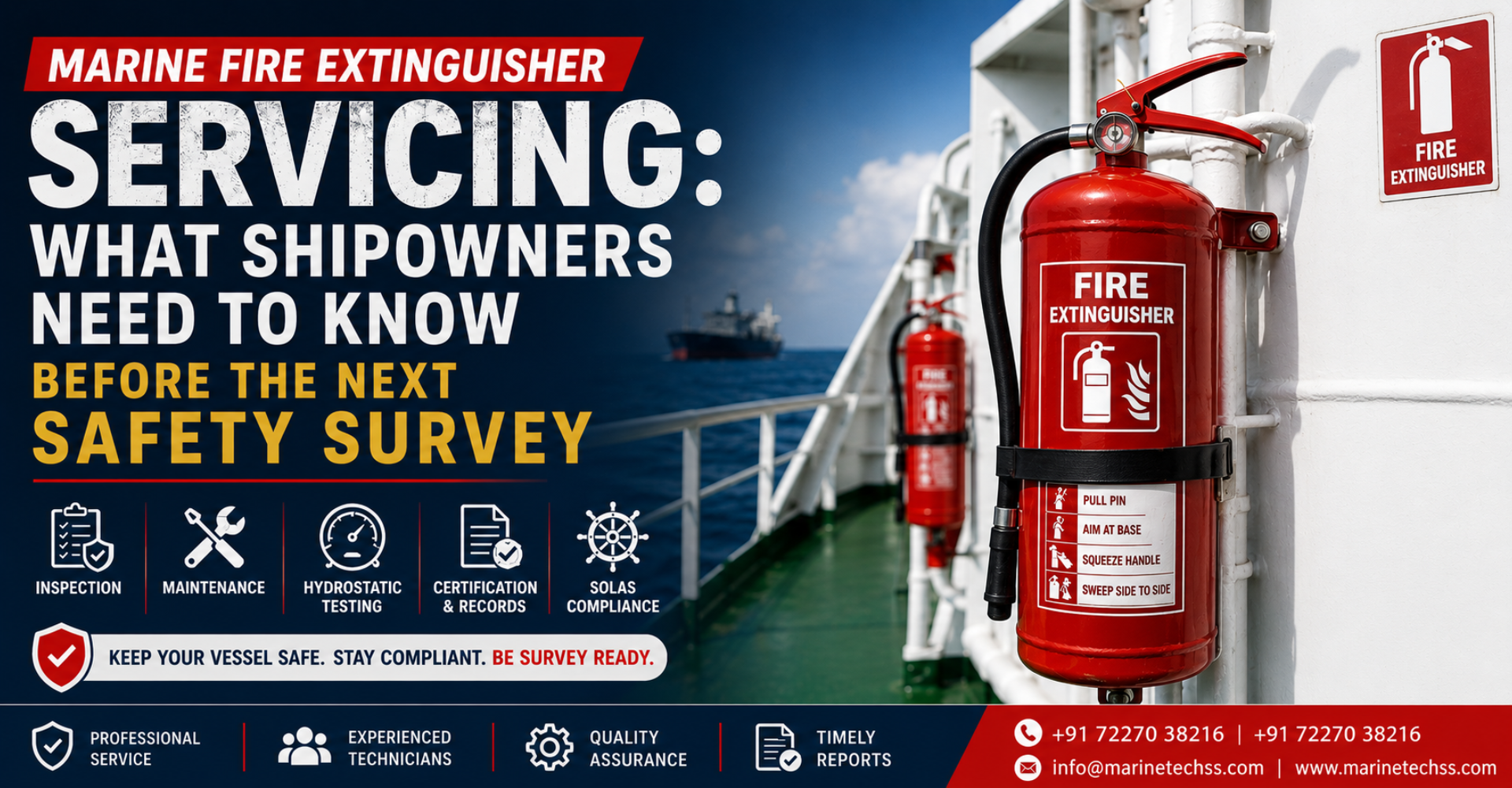
For a shipowner or ship manager, preparing for a scheduled
safety survey is not simply about checking whether firefighting equipment is
physically present onboard. The equipment must also be properly maintained,
accessible, correctly identified, operational and supported by appropriate
inspection and maintenance records.
Portable fire extinguishers are among the most frequently
used pieces of firefighting equipment onboard a vessel. A defective
extinguisher, missing service record, damaged cylinder, incorrect pressure or
overdue maintenance can become a safety concern during a survey.
The International Maritime Organization (IMO) requires ships
to maintain firefighting systems and appliances in good working order and
readily available for immediate use. Portable fire extinguishers are
specifically included within the ship's maintenance programme. (IMO)
For shipowners preparing for an upcoming survey, marine
fire extinguisher servicing should therefore be treated as part of the vessel's
planned safety maintenance—not as a last-minute compliance exercise.
Why Marine Fire Extinguisher Servicing Matters Before a Safety Survey
Fire onboard a vessel can develop rapidly, and the crew may
have only a short period to control an incident before it becomes a major
emergency.
SOLAS Chapter II-2 establishes requirements related to fire
protection, fire detection and fire extinction, including the ready
availability of fire-extinguishing appliances. (International
Maritime Organization)
A marine fire extinguisher can only perform its intended
function when:
- The
correct extinguisher type is available for the intended fire risk.
- The
cylinder and components are in satisfactory condition.
- The
extinguishing medium is suitable and within its service requirements.
- Operating
mechanisms function correctly.
- Pressure
is within the required range where applicable.
- The
extinguisher is properly mounted and accessible.
- Inspection
and maintenance records are available.
- Required
testing and servicing have been completed.
IMO's guidelines also emphasize periodic inspection and
maintenance in accordance with the manufacturer's instructions, together with
maintaining records of inspections and maintenance. (IMO)
This makes proper servicing important for both crew
safety and survey readiness.
What Should Shipowners Check Before Fire Extinguisher Servicing?
Before arranging a service visit, shipowners and technical
managers should review the condition and documentation of the vessel's portable
extinguishers.
1. Check the Physical Condition of Extinguishers
The first step is a visual inspection.
Look for:
- Corrosion
on the cylinder
- Dents
or physical damage
- Damaged
hoses
- Blocked
or damaged nozzles
- Missing
safety pins
- Damaged
handles or operating mechanisms
- Leakage
- Damaged
pressure gauges
- Missing
identification labels
- Incorrect
or unreadable markings
- Damaged
mounting brackets
Marine environments expose firefighting equipment to salt,
humidity, vibration and temperature variations. Even when an extinguisher
appears externally acceptable, internal components may still require
professional inspection.
2. Verify the Correct Extinguisher Type
Different areas of a vessel present different fire hazards.
Depending on the vessel and space, extinguishers may
include:
- CO2
fire extinguishers
- Dry
Powder fire extinguishers
- Foam
fire extinguishers
- Water
fire extinguishers
- Wet
Chemical extinguishers
- Other
approved extinguishing agents or systems
The extinguisher type, capacity, location and suitability
should be checked against the vessel's approved arrangements and applicable
requirements.
Simply having "enough extinguishers" is not
sufficient if the wrong type is installed for a particular fire risk.
3. Check Pressure and Operating Condition
For applicable portable extinguishers, pressure indication
is an important part of routine inspection.
A technician should assess whether:
- The
pressure indication is within the acceptable range.
- The
gauge is functioning correctly.
- There
is evidence of leakage.
- The
operating mechanism is intact.
- The
hose and nozzle are unobstructed.
- The
extinguisher has signs of previous discharge or tampering.
An extinguisher that appears normal but has lost pressure
may not perform when required.
4. Inspect the Extinguishing Agent
Servicing should not be limited to checking the outside of
the cylinder.
Depending on the extinguisher type, professional servicing
may involve examination of the extinguishing agent, cylinder, valve assembly,
hose, operating mechanism and other components.
For dry powder extinguishers, for example, the condition of
the powder is important. Moisture contamination or deterioration can affect
discharge performance.
For foam extinguishers, the condition and suitability of the
foam compound should be considered according to the applicable equipment and
manufacturer's requirements.
For CO2 extinguishers, cylinder condition, weight and
associated components require particular attention.
5. Check Hydrostatic Testing Requirements
Hydrostatic testing is an important part of maintaining
pressure-containing fire extinguisher cylinders.
The applicable test interval and procedure depend on the
extinguisher design, cylinder, manufacturer, flag requirements, class
requirements and applicable regulations.
Shipowners should therefore avoid relying on a generic
testing interval for every extinguisher.
A competent service provider should verify the equipment's
identification and applicable testing requirements before carrying out pressure
testing.
Important: Hydrostatic testing should only be carried
out using appropriate equipment and procedures by competent personnel.
6. Review Fire Extinguisher Service Records
One of the most important areas to check before a survey is
documentation.
IMO guidance states that records of inspections should be
maintained and should identify the date of inspection, type of maintenance
carried out and whether a pressure test was performed. (IMO)
Shipowners and ship managers should therefore maintain
appropriate records covering:
- Date
of inspection
- Equipment
identification
- Extinguisher
type
- Maintenance
performed
- Recharging,
where applicable
- Pressure
testing, where applicable
- Replacement
of components
- Technician/service
details
- Certification
or service documentation
- Next
due date
Good documentation helps demonstrate that firefighting
equipment is being managed through a planned maintenance system rather than
being serviced only when a survey approaches.
7. Check Accessibility and Mounting
A properly serviced extinguisher is of little value if the
crew cannot quickly access it.
Before a survey, check that extinguishers are:
- Clearly
visible
- Correctly
located
- Properly
secured
- Easily
accessible
- Free
from obstruction
- Protected
from unnecessary environmental exposure
- Identified
according to the vessel's fire control arrangements
IMO requirements emphasize the ready availability of
fire-extinguishing appliances. (International
Maritime Organization)
Common Fire Extinguisher Problems Found During Vessel Inspections
Some problems are simple to identify but are often
overlooked during routine shipboard checks.
Common examples include:
Corroded Cylinders
Saltwater exposure and humidity can contribute to external
corrosion. Severe corrosion may compromise cylinder integrity and require
further assessment.
Damaged Hoses or Nozzles
Cracked hoses, blocked nozzles or damaged discharge
components can affect the extinguisher's ability to deliver the extinguishing
agent effectively.
Missing Safety Seals or Pins
Missing or damaged safety components may indicate that an
extinguisher has been operated, tampered with or improperly maintained.
Incorrect Pressure
An extinguisher with insufficient or excessive pressure may
require professional inspection.
Expired or Missing Service Identification
An extinguisher without clear service identification or
supporting records can create uncertainty during a survey.
Poor Accessibility
Equipment blocked by stores, cargo, machinery or other
objects can become difficult to access during an emergency.
Incomplete Maintenance Records
Even when equipment appears physically satisfactory, missing
documentation can make it difficult to demonstrate that the required
maintenance has been completed.
What Happens During Professional Marine Fire Extinguisher Servicing?
The exact procedure depends on the extinguisher type and
applicable requirements, but professional servicing can include:
- Equipment
identification and inventory verification
- Visual
examination
- Cylinder
condition assessment
- Inspection
of valves and operating mechanisms
- Hose
and nozzle inspection
- Pressure
assessment
- Extinguishing-agent
assessment
- Recharging
where required
- Replacement
of defective components
- Hydrostatic
testing where applicable
- Reassembly
- Final
inspection
- Identification/service
marking
- Documentation
and certification
The objective is to return the equipment to a condition in
which it is safe, functional, identifiable and ready for use.
Marine Fire Extinguisher Servicing Should Be Part of a Larger Firefighting Equipment Maintenance Programme
Shipowners should avoid looking at portable extinguishers in
isolation.
A vessel's firefighting safety programme can include
multiple systems and appliances, depending on the vessel's type and approved
arrangements.
These may include:
- Portable
fire extinguishers
- Fire
hoses and nozzles
- Fire
hydrants
- Fire
pumps
- Fixed
CO2 systems
- Foam
systems
- Water
mist systems
- SCBA
sets
- EEBDs
- Firefighter's
outfits
- Fire
detection and alarm systems
- Other
fixed and portable firefighting equipment
IMO's maintenance requirements include portable fire
extinguishers as part of the wider fire protection and firefighting equipment
maintenance programme. (IMO)
This is why shipowners may benefit from working with a
marine safety service provider capable of handling multiple firefighting and
lifesaving equipment requirements.
Why Choose a Marine Specialist Instead of a General Fire Extinguisher Service Company?
A shipboard fire extinguisher is not simply another
industrial extinguisher.
Marine equipment operates within a regulated environment
involving:
- SOLAS
requirements
- IMO
guidelines
- Flag
State requirements
- Classification
society requirements
- Manufacturer
requirements
- Vessel-specific
approved arrangements
- Survey
and inspection requirements
A marine-focused service provider understands that servicing
must consider the vessel's operational environment and documentation
requirements.
For shipowners, fleet managers and technical
superintendents, this can make coordination easier—particularly when multiple
lifesaving and firefighting appliances need to be serviced during a port call.
Marinetech Safety Pvt. Ltd. – Marine Firefighting & Lifesaving Equipment Service in India
Marinetech Safety Pvt. Ltd. is an India-based marine
safety equipment servicing and supply company providing services for
shipowners, ship managers and vessels operating in Indian ports and beyond.
Our marine safety services cover a wide range of lifesaving
and firefighting equipment.
For complete details of our firefighting and lifesaving
equipment servicing capabilities, visit our [Lifesaving and Firefighting
Appliances Service] page.
The service scope includes equipment such as:
- Fire
extinguishers
- Lifejackets
- EEBD
- SCBA
sets and cylinders
- Fixed
CO2 systems
- Foam
systems
- Wet
chemical systems
- Water
mist systems
- Clean
agent systems
- Firefighting
appliances
- Immersion
and protective suits
- Other
marine safety equipment
Marinetech Safety Pvt. Ltd. also provides supply of
materials related to safety systems onboard vessels. (marinetechss.com)
The company operates as a marine servicing and supply
provider with capabilities covering firefighting, lifesaving, GMDSS, navigation
communication, calibration, lifeboat servicing, BWMS, VDR and other marine
technical services. (marinetechss.com)
Marine Fire Extinguisher Service for Indian Ports
For shipowners and ship managers calling Indian ports,
timely service availability can be important because firefighting equipment
maintenance may need to be coordinated with vessel schedules and port calls.
Marinetech Safety Pvt. Ltd. provides marine safety equipment
services on a pan-India basis, supporting vessels and operators requiring
inspection, servicing and maintenance of firefighting and lifesaving equipment.
This can be particularly useful for vessels calling ports
and maritime locations such as:
- Mumbai
- Nhava
Sheva / JNPT
- Mundra
- Kandla
- Hazira
- Surat
- Sikka
- Jamnagar
- Chennai
- Visakhapatnam
- Paradip
- Other
Indian ports
For shipowners requiring broader equipment support,
combining fire extinguisher servicing with other lifesaving and firefighting
appliances service can reduce the need to coordinate multiple specialist
vendors.
How Shipowners Can Prepare 30 Days Before a Safety Survey
A proactive approach can significantly reduce last-minute
deficiencies.
30 Days Before Survey
Review:
- Fire
extinguisher inventory
- Service
due dates
- Hydrostatic
test status
- Cylinder
condition
- Pressure
condition
- Service
records
- Fire
control plan
- Equipment
accessibility
- Spare
extinguishing agent requirements
- Other
firefighting equipment due for service
15 Days Before Survey
Arrange professional inspection of equipment approaching its
service or test due date.
Resolve:
- Corrosion
- Leakage
- Damaged
hoses
- Damaged
gauges
- Missing
pins
- Missing
labels
- Defective
components
- Documentation
gaps
7 Days Before Survey
Conduct a final onboard verification.
Confirm that:
- All
extinguishers are in their designated locations.
- Access
is clear.
- Identification
is visible.
- Service
markings are available.
- Records
are updated.
- Deficiencies
identified during the service have been closed.
Questions Shipowners Should Ask a Marine Fire Extinguisher Service Provider
Before appointing a service company, ask:
1. Do you provide marine-specific fire extinguisher servicing?
Marine servicing should consider applicable shipboard
requirements rather than treating the equipment like general commercial fire
extinguishers.
2. Can you handle different extinguisher types?
Ask whether the provider can service the extinguisher types
installed on your vessel.
3. Can you perform required testing?
Confirm whether the provider has appropriate facilities and
equipment for applicable pressure/hydrostatic testing.
4. Do you provide service documentation?
Proper documentation is important for demonstrating
maintenance history during inspections and surveys.
5. Can you service other firefighting appliances?
A provider capable of handling multiple firefighting
appliances can simplify service coordination during port calls.
6. Do you have relevant approvals or class/manufacturer recognition?
Where required, confirm the service provider's applicable
approvals, authorizations and competence for the equipment being serviced.
Marine Fire Extinguisher Servicing Is About Readiness, Not Just Compliance
The purpose of servicing a fire extinguisher is not simply
to place a new service sticker on the cylinder.
The real objective is to ensure that when a crew member
reaches for the extinguisher during an emergency, the equipment is:
Available ? Accessible ? Correct ? Functional ? Properly
Maintained ? Properly Documented
A survey may identify deficiencies, but the greater concern
is what happens when a real fire occurs onboard.
Regular maintenance therefore protects more than
compliance—it protects crew, vessel, cargo, environment and business
continuity.
Final Takeaway for Shipowners
Before the next safety survey, do not wait until the
surveyor arrives to discover that your fire extinguishers have overdue
servicing, damaged components, inadequate documentation or testing requirements
that have not been addressed.
Make marine fire extinguisher inspection and servicing part
of the vessel's planned maintenance programme.
If you are looking for a marine service provider in India
for fire extinguishers and lifesaving & firefighting appliances,
Marinetech Safety Pvt. Ltd. can support vessel owners and ship managers with
inspection, maintenance, servicing and related marine safety equipment
requirements.
Explore our [Lifesaving and Firefighting Appliances
Service] for details of our marine firefighting equipment servicing
capabilities.
Frequently Asked Questions
1) How often should marine fire extinguishers be serviced?
Marine fire extinguishers should be inspected and maintained
at intervals consistent with applicable IMO/flag/class requirements and the
manufacturer's instructions. IMO guidance states that the interval between
periodic inspections and maintenance should not exceed the period between
safety equipment surveys. (IMO)
2) What types of marine fire extinguishers can be serviced?
Depending on the service provider's capabilities and
equipment, marine servicing may cover CO2, dry powder, foam, water, wet
chemical and other approved extinguisher types.
3) Is hydrostatic testing required for marine fire extinguishers?
Pressure-containing cylinders may require periodic
hydrostatic or pressure testing according to the applicable requirements for
the particular cylinder and extinguisher. The exact requirement should be
verified against the manufacturer, flag, class and applicable regulations.
4) What records should be maintained after fire extinguisher servicing?
Records should identify the inspection date, maintenance
performed and whether pressure testing was carried out. (IMO)
5) Can fire extinguisher servicing be combined with other marine safety services?
Yes. Shipowners can coordinate portable extinguisher
servicing with other firefighting and lifesaving equipment inspections, subject
to the vessel's service requirements and the service provider's capabilities.
Related Marine Safety Services
Looking for more than portable fire extinguisher servicing?
Marinetech Safety Pvt. Ltd. provides a range of marine
safety equipment services, including:
- Lifesaving
& Firefighting Appliances Service
- Lifeboat,
Rescue Boat & Davit Service
- Liferaft
Service
- GMDSS
Radio Survey
- Calibration
Services
- Cargo
Gear Load Testing
- VDR/SVDR
Services
- BWMS
Service
- Electronic
& Navigation Communication Services
For vessel owners and ship managers, using one
marine-focused service provider for multiple safety equipment requirements can
simplify maintenance planning and port-call coordination.
Request Marine Fire Extinguisher Servicing
Marinetech Safety Pvt. Ltd.
Phone: +91-8866475732 | +91-72270 38216
Email: info@marinetechss.com
Request a Free Quote for marine fire extinguisher
servicing, firefighting appliance inspection and other marine safety equipment
services.
Related Blogs
1. Cargo Gear Load Testing Service in Mundra – Complete Guide for Ship Owners & Managers
Read the Mundra Cargo Gear Load Testing Guide
2. Cargo Gear Load Testing in India: Requirements, Process & How Marinetech Helps
Learn about cargo gear testing requirements, inspection procedures and cargo gear services across Indian ports.
Read the Cargo Gear Load Testing India Guide
3. Why Cargo Gear Load Testing Is Mandatory Under SOLAS and ILO Regulations
Understand the regulatory framework surrounding cargo gear inspection, load testing and thorough examination.
Read the SOLAS & ILO Cargo Gear Guide
This guide covers cargo gear testing, ship cranes, derricks, loose lifting gear, inspection procedures and testing preparation for vessels calling Mundra.