Blog Post
GMDSS Radio Survey & Inspection Service in Chennai – Complete Guide for Ship Owners & Managers
Posted By: Harsh Bamnolia
Posted On : 29-Aug-2026
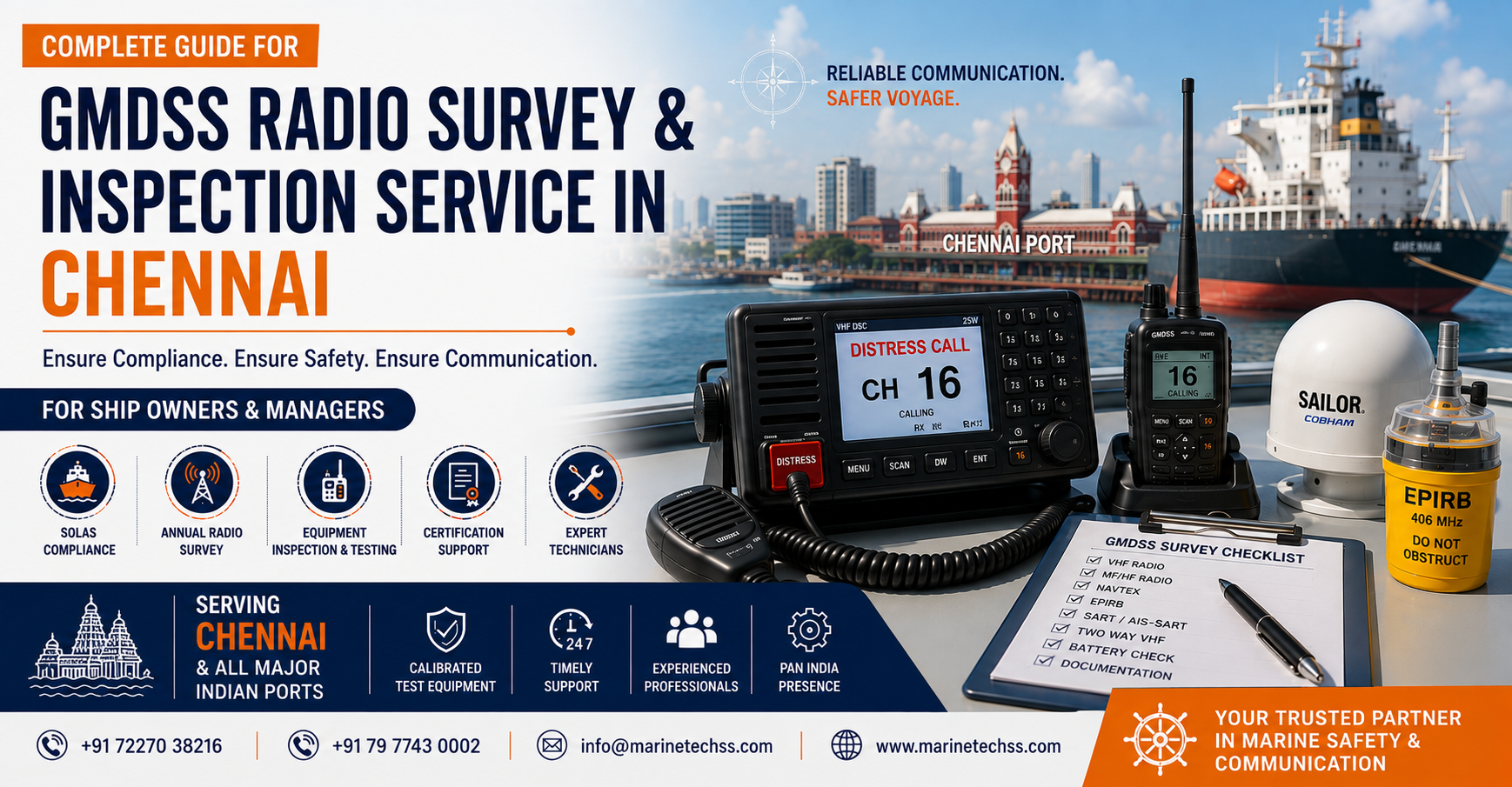
Reliable radio communication is a
fundamental part of maritime safety.
When a vessel experiences an
emergency, the ability to transmit a distress alert, communicate with rescue
authorities and receive maritime safety information can be critical to protecting
the crew, passengers and vessel.
The Global Maritime Distress and
Safety System (GMDSS) provides the international framework for maritime
distress and safety communications. Its carriage and operational requirements
are incorporated into SOLAS Chapter IV – Radiocommunications. IMO states
that applicable passenger ships and cargo ships of 300 gross tonnage and
upwards on international voyages are required to carry specified
radiocommunication equipment, including equipment such as EPIRBs and SARTs. (International
Maritime Organization)
For ship owners, ship managers and
technical superintendents whose vessels call at Chennai and other South
Indian ports, keeping GMDSS equipment operational and properly documented
is an important part of vessel compliance and emergency preparedness.
This makes professional GMDSS
Radio Survey & Inspection Service in Chennai an important requirement
for vessels approaching their statutory radio survey, certification or
maintenance schedule.
In this guide, we explain GMDSS
radio survey requirements, equipment commonly inspected, survey preparation,
common deficiencies and how Marinetech Safety Pvt. Ltd. can support ship
owners and managers with GMDSS inspection and technical services.
What Is a GMDSS Radio Survey?
A GMDSS radio survey is an
inspection and testing process used to verify that a vessel's required radio
communication and distress-alerting equipment is operational and complies with
the applicable statutory requirements.
The survey may involve inspection
and testing of:
- VHF radio and DSC
- MF/HF radio
- NAVTEX
- EPIRB
- SART or AIS-SART
- Two-way VHF equipment
- Satellite communication equipment, where applicable
- GMDSS batteries
- Emergency power arrangements
- Antennas and cables
- Equipment identification and programming
- Radio documentation
- Maintenance records
For Indian vessels covered by the
current rules, DGMA states that a valid Cargo Ship Safety Radio Certificate or
applicable passenger-ship certificate is issued following a satisfactory radio
survey. DGMA also states that annual radio surveys are required to maintain
validity. (Directorate General of Shipping)
GMDSS Radio Survey Requirements in Chennai
The Indian GMDSS framework is
administered by the Directorate General of Maritime Administration (DGMA).
Under the current Merchant
Shipping (Distress and Safety Radio Communication) Rules, 2025, DGMA states
that radio surveys are conducted by DGMA Nautical Surveyors and by Recognised Organisations
authorised by DGMA.
Importantly for vessels operating
in Chennai, DGMA specifically lists Chennai among the locations where
Nautical Surveyors conduct radio surveys. (Directorate General of Shipping)
The applicable regime includes:
- Initial radio surveys
- Annual radio surveys
- Renewal surveys
- Intermediate surveys, where applicable
- Radio certification
- Record of Equipment (Form R)
- Equipment testing
- EPIRB annual testing
- SART functional testing
- GMDSS emergency power verification
DGMA also states that the vessel's Record
of Equipment (Form R) must remain current and accurately reflect the actual
GMDSS installation onboard. (Directorate General of Shipping)
SOLAS Chapter IV and GMDSS
The international foundation for
GMDSS is SOLAS Chapter IV – Radiocommunications.
IMO explains that Chapter IV
incorporates the GMDSS and establishes requirements relating to
radiocommunication services and shipborne radiocommunication equipment. (International
Maritime Organization)
The GMDSS modernization amendments
entered into force on 1 January 2024, introducing updated requirements
and allowing the use of modern communication technologies while removing
obsolete requirements. (International Maritime Organization)
Therefore, ship managers should
ensure that their GMDSS inspection programme considers both:
- Applicable SOLAS requirements
- Current Indian flag-state requirements
- Applicable IMO performance standards
- Vessel trading area
- Equipment type and installation
- Flag and class requirements
- Manufacturer requirements
What Equipment Is Checked During a GMDSS Radio Survey?
The exact GMDSS equipment
arrangement depends on the vessel's size, type, trading area and applicable requirements.
However, a professional GMDSS
inspection may include the following.
1. VHF Radio and DSC
VHF is a critical shipboard
communication system.
Inspection and testing may include:
- Transmit function
- Receive function
- DSC functionality
- Channel operation
- MMSI programming
- Call sign information
- Antenna condition
- Cabling
- Power supply
- Control units
- Emergency power
Particular attention should be paid
to the correct programming of vessel identification information.
2. MF/HF Radio
Where required by the vessel's sea
area and equipment configuration, MF/HF radio equipment forms an important part
of long-range maritime communication.
Inspection can include:
- Transmitter performance
- Receiver performance
- DSC operation
- Frequency settings
- Antenna condition
- Earthing
- Cabling
- Power supply
- Control equipment
3. EPIRB Inspection
The Emergency
Position-Indicating Radio Beacon (EPIRB) is one of the most important
distress-alerting devices onboard a vessel.
During inspection, attention may be
given to:
- Physical condition
- Battery expiry
- Self-test
- Activation arrangement
- Hydrostatic release unit
- MMSI programming
- Identification information
- Registration details
- Installation
- Associated documentation
India operates within the
COSPAS-SARSAT system, with DGMA noting that 406 MHz EPIRB alerts are processed
through India's system and forwarded to the Indian Coast Guard MRCC for
search-and-rescue response. (Directorate General of Shipping)
4. SART / AIS-SART Inspection
Search and Rescue Transponders help
rescuers locate a vessel or survival craft during an emergency.
Inspection may include:
- Physical condition
- Battery expiry
- Self-test
- Operational condition
- Mounting
- Storage
- Identification
- Documentation
5. NAVTEX
NAVTEX provides maritime safety
information to vessels within applicable coverage areas.
Inspection may include:
- Reception
- Display or printer operation
- Antenna
- Power supply
- Configuration
- Message reception
Modernized GMDSS requirements also
recognize newer digital maritime safety information technologies, including
NAVDAT. (Directorate General of Shipping)
6. Two-Way VHF Radiotelephones
Portable two-way VHF radios are
important for emergency and survival-craft communication.
The inspection may include:
- Transmit and receive performance
- Battery condition
- Battery expiry
- Charging arrangement
- Physical condition
- Storage
- Required quantity
7. Satellite / Recognised Mobile Satellite Service Equipment
Depending on the vessel's sea area
and approved installation, satellite communication equipment may form part of
the GMDSS arrangement.
The modernized GMDSS framework
allows recognised mobile satellite services and reflects the industry's move
toward modern communication systems. (International Maritime Organization)
GMDSS Sea Areas and Their Impact on Equipment
The vessel's trading area is
important because GMDSS equipment requirements depend on the sea area in which
the vessel operates.
The principal sea areas are:
Sea Area A1
An area within the radiotelephone
coverage of at least one VHF coast station where continuous DSC alerting is
available.
Sea Area A2
An area outside A1 but within the
coverage of at least one MF coast station where continuous DSC alerting is
available.
Sea Area A3
An area outside A1 and A2 within
the coverage of a recognised mobile satellite service.
Sea Area A4
Areas outside A1, A2 and A3.
The equipment carried onboard must
correspond to the vessel's applicable operating area and statutory
requirements.
For this reason, ship managers
should reassess the GMDSS arrangement whenever a vessel's trading area changes.
What Does a GMDSS Radio Surveyor Check?
A professional GMDSS survey should
not be limited to switching equipment on and off.
The inspection should consider the
complete communication and distress-alerting arrangement.
Equipment Condition
The physical condition of radios,
antennas, control units, cables and associated equipment is reviewed.
Functional Performance
Required equipment is tested to
verify that it performs its intended functions.
Emergency Power
The GMDSS installation must have
appropriate power arrangements. DGMA states that the complete GMDSS
installation is to be supplied by two independent sources of electrical energy,
with applicable emergency-source capacity requirements depending on the sea
area. (Directorate General of Shipping)
Identification and Programming
MMSI and other
vessel-identification information should be correct.
Batteries
Battery condition, expiry dates,
charging and capacity should be reviewed as applicable.
Documentation
Certificates, test reports,
maintenance records and the Record of Equipment should correspond with the
actual installation.
Common GMDSS Deficiencies Found During Inspection
Ship owners and managers should pay
particular attention to common problems such as:
- Expired EPIRB batteries
- Expired SART batteries
- Expired portable VHF batteries
- Incorrect MMSI programming
- Incorrect vessel identification
- Damaged antennas
- Loose or corroded connections
- Defective DSC
- MF/HF radio faults
- NAVTEX reception problems
- Defective battery chargers
- Incorrect equipment records
- Missing test certificates
- Incomplete radio log entries
- Outdated maintenance records
- Equipment not matching Form R
Many of these issues can be
identified and corrected during a planned pre-survey inspection.
Marinetech Safety Pvt. Ltd. – GMDSS Radio Survey Service in Chennai
Marinetech Safety Pvt. Ltd.
is an India-based marine safety equipment service and supply company supporting
ship owners, ship managers, vessel operators and maritime organisations.
Our GMDSS Radio
Survey & Inspection Service covers inspection, testing and
certification support for essential GMDSS equipment.
Marinetech's published service
information includes inspection and testing of:
- VHF radios
- MF/HF radios
- NAVTEX
- EPIRB
- SART
- GMDSS equipment
- Associated communication systems
The company's service page also
describes annual GMDSS surveys, certification support and emergency repair
services. (marinetechss.com)
Marinetech states that its GMDSS
service uses calibrated testing tools and signal analysers and provides
documentation such as checklists, defect reports and certificates aligned with
applicable Flag State and IMO requirements. (marinetechss.com)
GMDSS Radio Survey & Inspection Service in Chennai
For vessels calling at Chennai,
Marinetech Safety Pvt. Ltd. can support ship owners and managers with GMDSS
inspection and technical requirements.
Our service scope can include:
- GMDSS radio survey support
- VHF inspection and testing
- MF/HF radio inspection
- NAVTEX testing
- EPIRB inspection
- SART inspection
- Two-way VHF inspection
- GMDSS battery checks
- Equipment troubleshooting
- Technical repair support
- Documentation review
- Test certificate support
- Statutory survey preparation
For more information, visit the
dedicated GMDSS
Radio Survey & Inspection Service page.
What Happens If GMDSS Equipment Fails During a Survey?
If a required piece of equipment
fails a test, the cause should be identified and appropriate corrective action
taken.
Depending on the problem,
corrective action may involve:
- Troubleshooting
- Battery replacement
- Equipment programming
- Antenna repair
- Cable replacement
- Component replacement
- Manufacturer-supported servicing
- Equipment replacement
- Retesting
For ship managers, having access to
technical repair support can help reduce the time required to resolve
deficiencies.
GMDSS Radio Survey in Chennai – Frequently Asked Questions
1. What is a GMDSS radio survey?
A GMDSS radio survey is an
inspection and testing process used to verify that a vessel's required GMDSS
communication and distress-alerting equipment is operational and compliant with
applicable requirements.
2. How often is a GMDSS radio survey required in India?
Under the current Indian
radio-communication framework, DGMA states that an annual radio survey is
required to maintain the validity of the applicable radio certification.
Initial, renewal and intermediate surveys apply according to the vessel's
certification regime, size and trading area. (Directorate General of Shipping)
3. Is GMDSS radio survey available in Chennai?
Yes. DGMA specifically identifies
Chennai as one of the locations where its Nautical Surveyors conduct radio
surveys. (Directorate General of Shipping)
4. What GMDSS equipment is inspected?
Depending on the vessel and trading
area, equipment may include VHF DSC, MF/HF, NAVTEX, EPIRB, SART/AIS-SART,
two-way VHF and applicable satellite/RMSS equipment.
5. Can Marinetech provide GMDSS survey support in Chennai?
Marinetech Safety Pvt. Ltd.
provides GMDSS radio survey and inspection services in India, including
inspection and testing of VHF, MF/HF, NAVTEX, EPIRB and SART equipment. Contact
Marinetech to confirm the applicable service and survey arrangements for your
vessel. (marinetechss.com)
6. What documents should be available for a GMDSS survey?
Ship managers should prepare the
applicable radio certificate, Record of Equipment/Form R, previous survey
reports, equipment test certificates, battery information, radio log,
maintenance records and vessel identification information.
7. Is GMDSS servicing the same as a radio survey?
No. A survey verifies the
installation and equipment against applicable statutory requirements, while
servicing involves technical maintenance, repair, testing, programming or
replacement of equipment.
8. What should I do if my EPIRB battery is expired?
The battery should be replaced in
accordance with the equipment manufacturer's requirements and applicable
regulatory procedures, followed by the required testing and documentation.
9. Why is pre-survey GMDSS inspection useful?
A pre-survey inspection can
identify equipment faults, expired batteries, programming errors and
documentation gaps before the statutory survey.
10. Where can ship owners arrange GMDSS inspection services in Chennai?
Ship owners and managers can
contact Marinetech Safety Pvt. Ltd. to discuss GMDSS radio survey, inspection,
testing and technical support requirements for vessels calling at Chennai.
Book GMDSS Radio Survey & Inspection Service in Chennai
If your vessel is calling at Chennai
and requires GMDSS radio survey, inspection, testing, servicing or technical
support, Marinetech Safety Pvt. Ltd. can assist with your marine communication
equipment requirements.
View GMDSS Radio
Survey & Inspection Service
Contact our team with your:
- Vessel name
- Flag
- Port
- Survey due date
- GMDSS equipment configuration
- Required service
We can help you plan the
appropriate technical support for your vessel.
Marinetech Safety Pvt. Ltd.
Phone: +91 72270 38216 | +91
79 7743 0002
Email: info@marinetechss.com
Request a Free Quote
Related Blogs
- IMO
MSC.1/Circ.1318/Rev.1 Explained – Understanding IMO
requirements and their importance for marine safety equipment.
- GMDSS
Radio Survey in India: Complete Guide for Ship Owners & Officers –
Detailed information about GMDSS surveys, equipment and compliance.
- Marine
Navigation & Communication Equipment Supplier in India –
Guide for ship managers sourcing marine navigation and communication
equipment.