Blog Post
Visual Distress Signals: Types and How They Save Lives
Posted By: Harsh Bamnolia
Posted On : 30-Apr-2024
What are Visual Distress Signals?
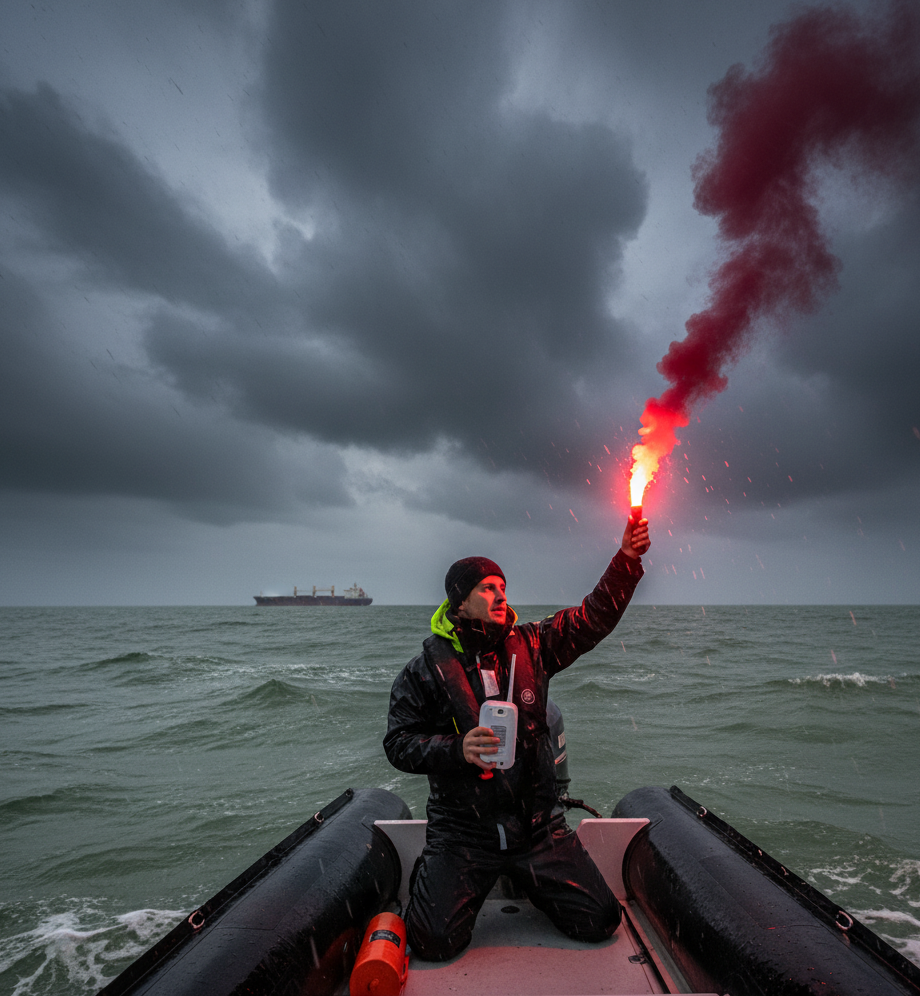
Visual distress signals are tools designed to attract attention and communicate a need for immediate assistance during a maritime emergency. Unlike radio or satellite communication, visual signals work purely through sight, bright lights, distinct colors or reflected sunlight, making them a critical backup when other communication methods fail or aren't enough on their own.
How Do Visual Distress Signals Help?
1. Immediate Attention
Visual distress signals are built to attract attention fast, using bright, often flashing lights and distinct colors that stand out clearly against the sea and sky, helping rescuers locate the source of distress from long distances.
2. Universal Recognition
Guidelines from the International Maritime Organization (IMO) and other maritime authorities standardize visual distress signals, ensuring they're recognized by mariners worldwide regardless of nationality or language.
3. Day and Night Visibility
Different signal types suit different conditions, flares and rockets are highly visible at night, while smoke signals are most effective during daylight, giving vessels signaling options around the clock.
4. Enhanced Safety as a Communication Backup
Visual signals provide a reliable way to call for help when other methods, such as radios or mobile phones, fail. For e.g., during an onboard electric failure.
5. Preventing Collisions
Visual distress signals aren't only for calling for rescue. A vessel adrift due to engine failure can use flares or lights to alert nearby ships of its presence, helping reduce the risk of a collision.
6. Regulatory Compliance
Maritime regulations require vessels to carry specific types and quantities of visual distress signals. Compliance ensures a vessel is properly prepared for emergencies and helps avoid penalties during inspection.
Types of Visual Distress Signals
Handheld Flares
Portable, easy-to-use devices for signaling nearby vessels or aircraft at close range.
Parachute Rockets
Fired to significant heights for long-range visibility, making them well-suited to open-water emergencies where nearby help may be far away.
Smoke Signals
Produce dense, colored smoke visible during daylight hours, helping pinpoint a vessel's exact location for approaching rescuers.
Signaling Mirrors
A simple but effective tool that uses reflected sunlight to create a bright flash visible from a distance, requiring no power source or expiration date, making it a reliable backup option.
Visual Distress Signals at a Glance
| Type | Best Used | Visibility Range |
| Handheld Flares | Day or night, close range | Nearby vessels/aircraft |
| Parachute Rockets | Day or night, long range | Open water, distant vessels |
| Smoke signals | Daytime | Location marking near vessel |
| Signal Mirrors | Daytime (requires sunlight) | Long range, line of sight |
Frequently Asked Questions (FAQs)
Q. What are visual distress signals used for?
A. Visual distress signals are used to attract attention and communicate a need for immediate assistance during a maritime emergency, serving as a reliable backup when radio or other communication methods aren't available or sufficient.
Q. What are the main types of visual distress signals?
A. The main types include handheld flares, parachute rockets, smoke signals, and signal mirrors, each suited to different visibility conditions and signaling ranges.
Q. What is a signal mirror and how does it work?
A. A signal mirror is a simple device that reflects sunlight to create a bright, attention-grabbing flash visible from a distance, offering a reliable, power-free backup signaling option during daylight hours.
Q. Which visual distress signals work best at night?
A. Handheld flares and parachute rockets are most effective at night, as they emit their own bright light rather than relying on reflected or daylight-dependent visibility.
Conclusion
Visual distress signals remain one of the most dependable tools for calling attention during a maritime emergency, offering options suited to day, night and situations where other communication methods fail. Understanding the different types and keeping a compliant set onboard, is a fundamental part of maritime safety preparedness. Visit Marinetech Safety Pvt. Ltd. to explore our full range of certified signaling equipment.
Supply Email: supply@marinetechss.com
Phone: +91 8866475732 | +91 7227038216
Related Reading: Understanding the Critical Role of Distress Signals in Maritime Safety