Blog Post
SOLAS Requirements for Fire Extinguishers on Cargo Ships
Posted By: Harsh Bamnolia
Posted On : 09-Nov-2026
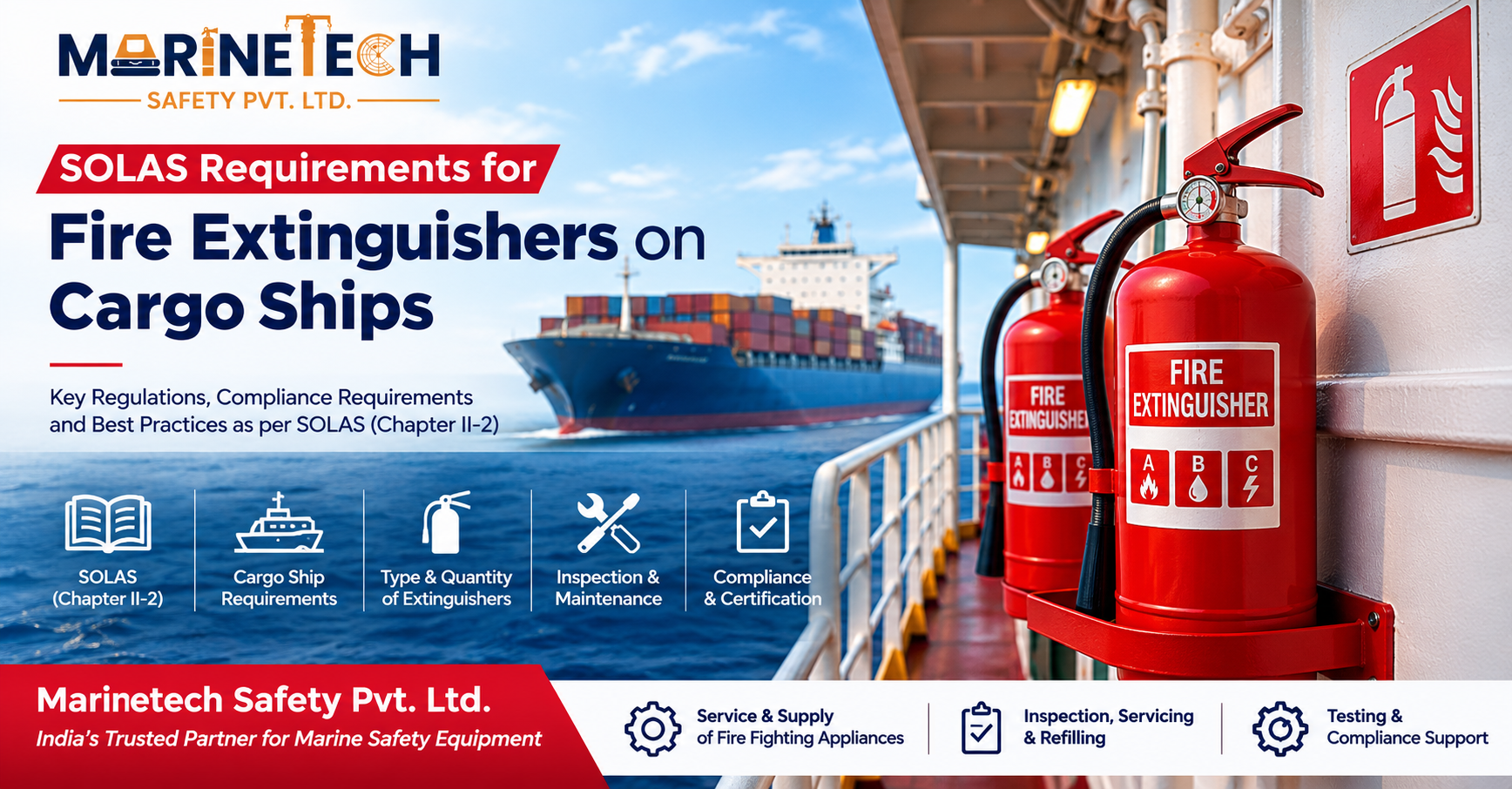
SOLAS Requirements for Fire Extinguishers on Cargo Ships: Complete Guide to Marine Fire Safety and Compliance
Fire safety is one of the most critical aspects of maritime
operations. A fire onboard a cargo ship can threaten crew lives, damage valuable
cargo, disrupt vessel operations and cause significant environmental damage.
Since ships operate far from shore-based emergency services, properly
installed, inspected and maintained firefighting equipment is essential.
The International Convention for the Safety of Life at Sea
(SOLAS) establishes international requirements for fire protection, fire
detection and fire extinction onboard ships. Under SOLAS Chapter II-2,
cargo ships must carry appropriate firefighting equipment, including portable
fire extinguishers, fire hoses, fire detection systems and fixed
fire-extinguishing arrangements, depending on the vessel's type and
configuration.
For shipowners, technical superintendents, ship managers and
marine operators, understanding the SOLAS requirements for fire extinguishers
on cargo ships is essential to maintaining statutory compliance and ensuring
onboard safety.
In this guide, we explain the important SOLAS regulations,
portable fire extinguisher requirements, equipment locations, inspection
procedures and maintenance considerations for cargo ships.
1. What Are the SOLAS Requirements for Fire Extinguishers on Cargo Ships?
The primary regulatory reference for shipboard fire safety
is SOLAS Chapter II-2 – Construction: Fire Protection, Fire Detection and
Fire Extinction.
Regulation II-2/10 specifically addresses firefighting
arrangements and equipment. It requires firefighting appliances to be readily
available and suitable fixed fire-extinguishing systems to be installed, taking
into account the fire risks associated with protected spaces.
The main requirements applicable to portable fire
extinguishers include:
- Portable
fire extinguishers must comply with the applicable requirements of the
International Fire Safety Systems (FSS) Code.
- Suitable
types and sufficient numbers of extinguishers must be provided in
accommodation spaces, service spaces and control stations.
- One
extinguisher intended for use in a space must be positioned near its
entrance.
- Extinguishers
must be easily visible and readily accessible.
- Their
condition and serviceability must not be affected by weather, vibration or
other external factors.
- Used
or discharged extinguishers must be immediately recharged or replaced with
an equivalent unit.
- Appropriate
spare charges or replacement extinguishers must be carried as required.
The number, type and distribution of portable fire
extinguishers depend on the vessel's construction date, gross tonnage, space
arrangement, cargo carried and applicable flag and classification requirements.
2. Minimum Number of Portable Fire Extinguishers on Cargo Ships
Under SOLAS Chapter II-2, Regulation 10.3.2.1, accommodation
spaces, service spaces and control stations must be provided with suitable
portable fire extinguishers in sufficient numbers to the satisfaction of the
Administration.
For ships of 1,000 gross tonnage and upwards, at least
five portable fire extinguishers must be provided for these spaces.
However, this requirement should not be interpreted as the
total number of extinguishers required throughout the vessel.
Additional extinguishers are required depending on machinery
spaces, workshops, cargo arrangements, special spaces and other applicable
provisions.
For example:
|
Ship Area |
Fire Extinguisher Requirement |
|
Accommodation spaces |
Suitable extinguishers in sufficient numbers |
|
Service spaces |
Suitable extinguishers according to space requirements |
|
Control stations |
Appropriate extinguishers suitable for installed equipment |
|
Machinery spaces |
Additional extinguishers according to machinery space
requirements |
|
Cargo spaces |
Requirements depend on cargo type and applicable
regulations |
|
Vehicle and Ro-Ro spaces |
Specific distribution and spacing requirements |
|
Weather deck |
Additional requirements may apply, particularly when
dangerous goods are carried |
Important: The exact number and arrangement must be
checked against SOLAS Regulation II-2/10, the FSS Code, applicable IMO unified
interpretations and the vessel's approved fire control plan.
3. Fire Extinguisher Requirements in Cargo Spaces
Cargo spaces present different fire hazards depending on the
type of cargo carried onboard.
General cargo, packaged dangerous goods, vehicles and
containerised cargo can involve different fire risks. Therefore, the required
firefighting arrangements must be assessed according to the vessel's design and
cargo operation.
A. General Cargo Spaces
Portable fire extinguisher arrangements for general cargo
spaces must be assessed against the applicable SOLAS requirements and the
unified interpretation of SOLAS Chapter II-2.
The presence of a cargo hold does not automatically mean
that an additional portable extinguisher is required in every hold.
B. Cargo Spaces Carrying Dangerous Goods
When dangerous goods are carried, additional firefighting
equipment may be required.
Under the relevant interpretation of SOLAS Chapter II-2, two
portable fire extinguishers, each with a capacity of at least 6 kg of dry
powder or equivalent, should be provided for applicable cargo spaces carrying
dangerous goods.
The precise arrangements must be checked against the
applicable provisions for the dangerous goods, cargo space and vessel
configuration.
C. Vehicle and Ro-Ro Cargo Spaces
Vehicle spaces and Ro-Ro spaces have specific portable fire
extinguisher requirements.
Under SOLAS Regulation II-2/6.2.1, portable fire
extinguishers must be provided:
- At
each deck level in each hold or compartment where vehicles are carried.
- At
intervals not exceeding 20 metres on both sides of the space.
- At
least one portable fire extinguisher must be located at each access to the
cargo space.
Additional firefighting appliances, including water-fog
applicators and portable foam applicator units, are required in applicable
vehicle, Ro-Ro and special category spaces intended for motor vehicles carrying
fuel in their tanks for their own propulsion.
These arrangements are important for controlling vehicle
fires and reducing the risk of fire spreading between cargo units.
4. Types of Fire Extinguishers Used on Cargo Ships
Different fire extinguishing agents are suitable for
different types of onboard fire hazards.
The selection of portable fire extinguishers should consider
the fire classification, potential hazards, equipment compatibility and
applicable approval requirements.
A. Dry Chemical Powder (DCP) Fire Extinguishers
DCP extinguishers are commonly used onboard vessels because
of their effectiveness against several types of fire.
Typical applications include:
- Flammable
liquid fires.
- Flammable
gas fires.
- Electrical
equipment fires, where the extinguisher is appropriately rated.
ABC powder extinguishers are also available for fires
involving ordinary combustible materials.
B. Carbon Dioxide (CO2) Fire Extinguishers
CO2 extinguishers are commonly used for electrical equipment
and flammable liquid fire risks.
Typical applications include:
- Electrical
switchboards.
- Control
panels.
- Electronic
equipment areas.
- Machinery-related
electrical hazards.
CO2 extinguishers must not be placed in accommodation spaces
under SOLAS Regulation II-2/10.3.2.3.
C. Foam Fire Extinguishers
Foam extinguishers are suitable for certain flammable liquid
fires and are commonly used in locations where liquid fuel or oil hazards
exist.
Typical applications include:
- Fuel
handling areas.
- Machinery-related
fire hazards.
- Workshops
and selected service spaces.
D. Water and Water-Based Fire Extinguishers
Water-based extinguishers are primarily suitable for
ordinary combustible materials, subject to the specific extinguisher approval
and fire classification.
They must not be used on electrical equipment or other
incompatible hazards unless specifically designed and approved for that
application.
E. Wet Chemical Fire Extinguishers
Wet chemical extinguishers are particularly suitable for
fires involving cooking oils and fats.
They are commonly associated with galley fire protection
arrangements.
The correct selection of extinguishing media is essential
because using an unsuitable extinguisher can increase the danger during a fire
emergency.
5. SOLAS Requirements for Fire Extinguisher Locations Onboard Ships
Correct positioning is just as important as the number of
extinguishers carried onboard.
SOLAS Regulation II-2/10.3.2.2 requires one portable fire
extinguisher intended for use in any space to be stowed near the entrance to
that space.
The extinguishers should be:
- Installed
in clearly visible locations.
- Easily
accessible during emergencies.
- Properly
secured using suitable mounting brackets.
- Protected
against corrosion and external damage.
- Positioned
without obstructing emergency escape routes.
- Provided
with appropriate operating instructions.
- Identified
through suitable fire safety signs.
The location and arrangement of extinguishers should also
correspond with the vessel's approved fire control plan.
Crew members must be familiar with the locations of
extinguishers and understand which equipment should be used for different types
of fire.
6. Spare Charges and Replacement Fire Extinguishers
SOLAS Chapter II-2/10.3.3 addresses the provision of spare
charges for portable fire extinguishers that can be recharged onboard.
The requirements include:
- Spare
charges for 100% of the first ten extinguishers.
- Spare
charges for 50% of the remaining extinguishers capable of being recharged
onboard.
- A
maximum requirement of 60 spare charges in total.
For extinguishers that cannot be recharged onboard,
additional portable extinguishers of the same quantity, type, capacity and
number as determined by the applicable spare-charge calculation must be
provided instead.
Instructions for recharging must be available onboard.
Only spare charges approved by the extinguisher manufacturer
should be used.
These provisions ensure that firefighting capability can be
restored promptly after extinguishers have been discharged.
7. Inspection and Maintenance of Marine Fire Extinguishers
Carrying approved extinguishers is not sufficient if they
are not maintained in proper working condition.
SOLAS Chapter II-2/14 and the relevant IMO maintenance
guidance establish the importance of maintaining firefighting equipment in good
working order and readily available for immediate use.
The maintenance plan should include portable fire
extinguishers and spare charges, where applicable.
The maintenance and inspection programme should follow MSC.1/Circ.1432,
as amended by MSC.1/Circ.1516, and other applicable requirements.
A typical marine fire extinguisher inspection programme
includes the following activities:
A. Visual Inspection
Check the following:
- Cylinder
body condition.
- Corrosion,
dents and physical damage.
- Safety
pin and tamper seal.
- Discharge
hose and nozzle.
- Operating
instructions and identification labels.
- Mounting
brackets.
- Pressure
gauge, where fitted.
B. Pressure and Weight Verification
Depending on the extinguisher design, verify:
- Operating
pressure.
- Total
weight.
- Extinguishing
agent quantity.
- Cartridge
condition.
- Signs
of leakage or pressure loss.
C. Internal Examination and Servicing
Where required by the applicable maintenance schedule and
manufacturer instructions, the extinguisher should undergo internal inspection
and servicing.
The procedure may include:
- Disassembly.
- Internal
cylinder examination.
- Inspection
of valves and operating components.
- Verification
of extinguishing media.
- Recharging
with the correct agent.
- Replacement
of defective parts.
- Reassembly
and sealing.
D. Hydrostatic Pressure Testing
Hydrostatic testing is important for verifying the
structural integrity of extinguisher cylinders.
Under IMO Resolution A.951(23), extinguishers and propellant
cartridges should be hydraulically tested in accordance with recognised
standards or manufacturer instructions at intervals not exceeding ten years.
Applicable cylinder-specific requirements, manufacturer
instructions and flag-state rules must also be considered.
E. Documentation and Records
The vessel should maintain proper inspection and maintenance
records.
Documentation may include:
- Inspection
reports.
- Servicing
certificates.
- Hydrostatic
test records.
- Recharging
details.
- Equipment
identification numbers.
- Defect
reports.
- Corrective
action records.
Proper documentation helps demonstrate compliance during
statutory surveys, classification inspections and Port State Control
examinations.
8. Important IMO Regulations and References for Marine Fire Extinguishers
Shipowners and technical managers should be familiar with
the following regulatory references:
|
Regulation / Reference |
Subject |
|
SOLAS Chapter II-2 |
Fire protection, detection and extinction |
|
SOLAS II-2/10 |
Firefighting arrangements |
|
SOLAS II-2/10.3 |
Portable fire extinguishers |
|
SOLAS II-2/10.3.2 |
Arrangement of portable fire extinguishers |
|
SOLAS II-2/10.3.3 |
Spare charges |
|
SOLAS II-2/14 |
Operational readiness and maintenance |
|
International FSS Code |
Fire safety systems and equipment requirements |
|
IMO Resolution A.951(23) |
Improved guidelines for marine portable fire extinguishers |
|
MSC.1/Circ.1275 and Corr.1 |
Unified interpretation of the number and arrangement of
portable fire extinguishers |
|
MSC.1/Circ.1432, as amended |
Maintenance and inspection of fire protection systems and appliances |
These references should be read together with the latest
applicable amendments, flag-state requirements, class rules and manufacturer
instructions.
9. Common Fire Extinguisher Deficiencies Found During Ship Inspections
During onboard inspections, fire extinguishers may be
identified as deficient due to improper maintenance, incorrect positioning or
missing documentation.
Some common deficiencies include:
- Expired
or overdue servicing.
- Missing
safety pins or broken tamper seals.
- Low
pressure or incorrect extinguisher weight.
- Corroded
or damaged extinguisher cylinders.
- Blocked
or damaged discharge hoses.
- Missing
operating instructions.
- Incorrect
extinguisher type for the protected space.
- Inaccessible
or improperly secured extinguishers.
- Missing
inspection and maintenance records.
- Overdue
hydrostatic pressure testing.
Ship operators should address such deficiencies promptly to
maintain firefighting readiness and reduce the possibility of regulatory
non-compliance.
10. Marine Fire Fighting Appliances Service in India – Marinetech Safety Pvt. Ltd.
Marinetech Safety Pvt. Ltd. is an India-based marine safety
equipment servicing and supply company providing comprehensive solutions for
shipowners, ship managers, technical superintendents and vessel operators.
The company specialises in the inspection, maintenance,
testing, servicing and supply of marine lifesaving and firefighting appliances.
With technical expertise, trained engineers and established
service infrastructure, Marinetech supports vessels requiring reliable marine
fire safety equipment services at major Indian maritime locations.
Our Marine Fire Fighting Equipment Services
Our firefighting equipment service portfolio includes:
- Portable
and wheeled fire extinguisher inspection and servicing.
- Fire
extinguisher refilling and recharging.
- Hydrostatic
pressure testing.
- Fire
hose and nozzle inspection and pressure testing.
- SCBA
sets and cylinder servicing.
- EEBD
inspection and servicing.
- Fixed
CO2 fire suppression system servicing.
- Foam
system inspection and maintenance.
- Wet
chemical fire suppression systems.
- Water
mist systems.
- Clean-agent
fire suppression systems.
- Fire
detection and alarm system inspection.
- Breathing
air analysis and foam analysis.
Why Choose Marinetech Safety Pvt. Ltd.?
Marinetech provides marine safety equipment services backed
by technical capabilities and industry approvals.
Our capabilities include:
- Approvals
from leading classification societies, including ABS, BV, DNV, RINA,
ClassNK, IRS, DGS, Lloyd's Register, Korean Register and CCS, for
applicable services.
- More
than 10 years of marine industry experience.
- 40+
qualified engineers.
- Dedicated
service stations and technical facilities.
- Manufacturer
approvals for selected marine firefighting equipment.
- Inspection,
maintenance, testing and certification support for applicable equipment.
Our objective is to help shipowners and vessel operators
maintain their firefighting appliances in reliable working condition and
support compliance with applicable maritime safety requirements.
Looking for professional marine fire extinguisher servicing in India?
Explore our complete range of Fire Fighting
Appliances Inspection, Servicing and Maintenance.
For fire extinguisher inspection, refilling, hydrostatic
testing, SCBA servicing, fixed CO2 system maintenance and other marine
firefighting services, contact the Marinetech technical team.
11. Marine Fire Extinguisher Servicing at Major Indian Ports
For vessels calling at Indian ports, timely maintenance and
inspection of firefighting equipment are important for maintaining operational
readiness.
Marinetech Safety Pvt. Ltd. supports marine safety equipment
servicing requirements across major maritime locations in India, including:
- Mumbai
- Nhava
Sheva / JNPT
- Mundra
- Kandla
- Surat
- Hazira
- Sikka
- Jamnagar
- Visakhapatnam
(Vizag)
- Chennai
- Paradip
Shipowners and technical managers can coordinate their
firefighting appliance servicing requirements according to vessel schedules and
applicable service arrangements.
12. Conclusion: Maintaining SOLAS Compliance for Fire Extinguishers on Cargo Ships
Fire extinguishers are among the most important
first-response firefighting appliances onboard cargo ships. SOLAS Chapter II-2
establishes requirements for their selection, distribution, accessibility,
maintenance and operational readiness.
Shipowners and vessel operators must ensure that all
extinguishers are suitable for their intended applications, correctly
positioned, regularly inspected and properly maintained.
Understanding SOLAS requirements, following IMO maintenance
guidelines and keeping accurate servicing records can help reduce onboard fire
risks and support compliance during statutory and Port State Control
inspections.
Marinetech Safety Pvt. Ltd. – Your Marine Fire Fighting Appliances Service Partner in India
Whether you require fire extinguisher inspection, refilling,
hydrostatic testing, fire hose testing, SCBA servicing or fixed firefighting
system maintenance, Marinetech provides marine safety equipment servicing and
supply solutions for vessels operating across India.
Contact Marinetech Safety Pvt. Ltd.
Website: https://marinetechss.com/
Fire Fighting Appliances Service: https://marinetechss.com/services/fire-fighting-appliances
Email: info@marinetechss.com
Phone: +91 72270 38216 | +91 79 7743 0002
NAVIGATING SAFETY, SUPPLYING CONFIDENCE.
Frequently Asked Questions (FAQs)
1. What are the SOLAS requirements for fire extinguishers
on cargo ships?
SOLAS Chapter II-2, Regulation 10 establishes requirements
for portable fire extinguishers, including suitable types, sufficient
quantities, correct positioning, accessibility and maintenance. The exact
arrangements depend on the vessel's type, size, spaces and applicable
regulations.
2. How many fire extinguishers are required on a cargo
ship?
Under SOLAS II-2/10.3.2.1, ships of 1,000 GT and upwards
must carry at least five portable fire extinguishers for accommodation spaces,
service spaces and control stations. Additional extinguishers are required
depending on machinery spaces, cargo arrangements and other applicable
requirements.
3. Where should fire extinguishers be located onboard
cargo ships?
Fire extinguishers should be installed in clearly visible
and easily accessible locations. Under SOLAS II-2/10.3.2.2, one extinguisher
intended for use in a space must be stowed near its entrance. Vehicle and Ro-Ro
spaces have additional distribution requirements.
4. Which types of fire extinguishers are used onboard
cargo ships?
Common types include dry chemical powder, CO2, foam,
water-based and wet chemical extinguishers. The selection depends on the fire
hazards, protected space and compatibility of the extinguishing agent.
5. What are the SOLAS requirements for spare fire
extinguisher charges?
SOLAS II-2/10.3.3 requires spare charges for 100% of the
first ten extinguishers and 50% of the remaining extinguishers capable of being
recharged onboard, subject to a maximum of 60 spare charges. Additional
replacement extinguishers are required for units that cannot be recharged
onboard.
6. How often should marine fire extinguishers be
inspected and serviced?
Fire extinguishers should be regularly inspected and
maintained according to SOLAS, applicable IMO guidance, flag-state
requirements, classification society requirements and manufacturer
instructions. The vessel's maintenance plan should establish the required
inspection and servicing schedule.
7. Is hydrostatic testing required for marine fire
extinguishers?
Yes. IMO Resolution A.951(23) provides that extinguishers
and propellant cartridges should be hydraulically tested according to
recognised standards or manufacturer instructions at intervals not exceeding
ten years. Applicable cylinder-specific requirements must also be followed.
8. Where can I get SOLAS-compliant marine fire
extinguisher servicing in India?
Marinetech Safety Pvt. Ltd. provides marine fire
extinguisher inspection, refilling, maintenance and hydrostatic testing, along
with other firefighting equipment services. The company supports vessels at
major Indian maritime locations, including Mumbai, Mundra, Surat, Jamnagar,
Vizag, Chennai and other ports. Visit https://marinetechss.com/services/fire-fighting-appliances/
for service details.