Blog Post
SOLAS Chapter V: Safety of Navigation – Complete Guide
Posted By: Harsh Bamnolia
Posted On : 16-Nov-2026
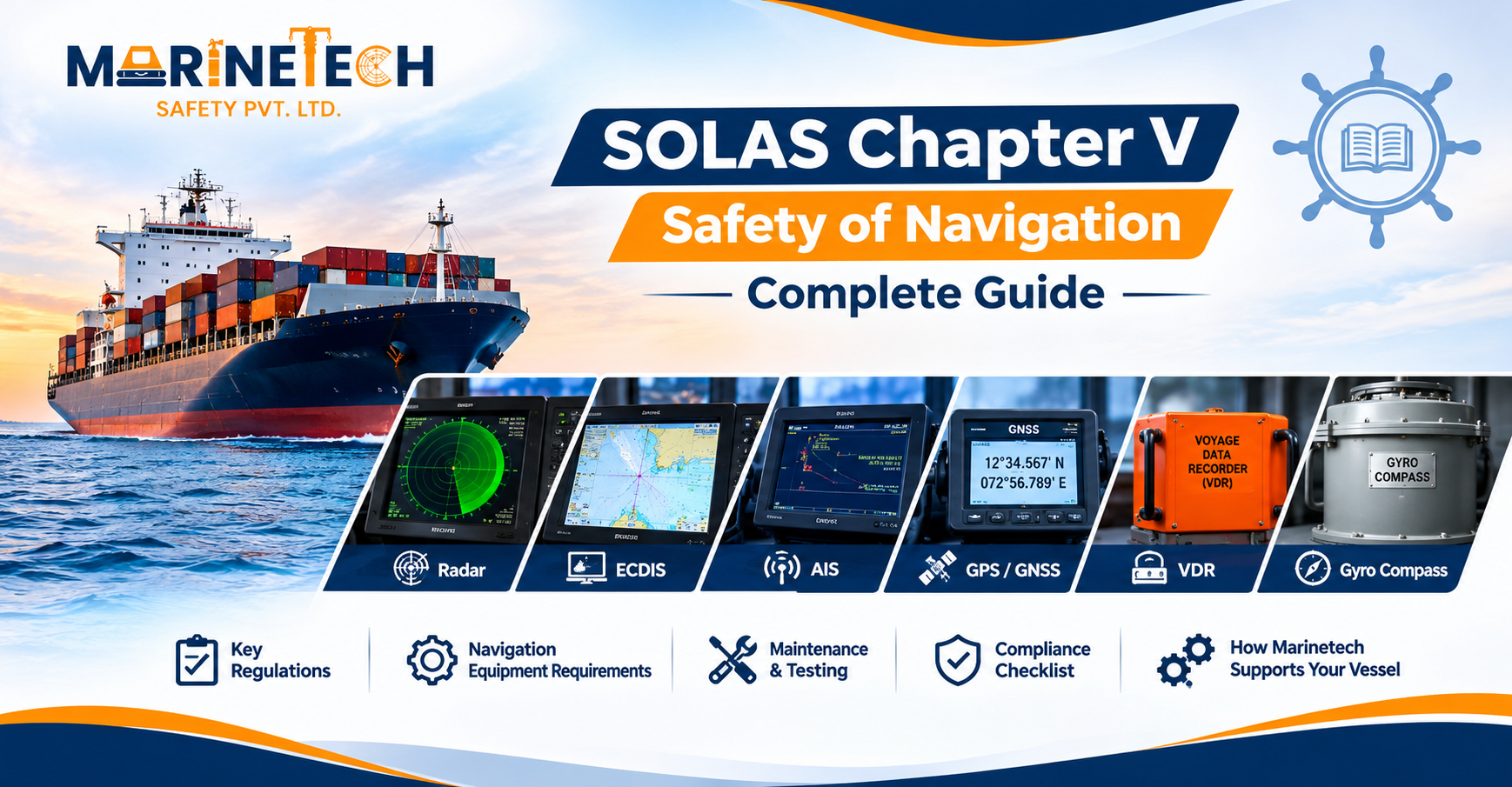
SOLAS Chapter V: Safety of Navigation – Complete Guide for Ships and Marine Navigation Equipment
Safety of navigation is one of the most important aspects of
commercial shipping. Every vessel operating at sea must have reliable navigation
equipment, competent personnel, updated navigational information and effective
procedures to prevent accidents and protect human life.
The International Convention for the Safety of Life at Sea
(SOLAS), 1974, establishes internationally recognised requirements for maritime
safety. Among its chapters, SOLAS Chapter V – Safety of Navigation plays
a particularly important role in ensuring safe ship operations.
Unlike several other SOLAS chapters that apply to specific
categories of ships or voyages, Chapter V generally applies to all ships on all
voyages, subject to specified exceptions.
SOLAS Chapter V covers navigational warnings, meteorological
information, ship routing, vessel traffic services, bridge equipment,
navigation systems, voyage data recorders, steering gear, nautical charts and
the responsibilities of the ship's master.
For shipowners, fleet managers, technical superintendents
and marine engineers, understanding these requirements is essential to
maintaining navigational safety and regulatory compliance.
At Marinetech Safety Pvt. Ltd., India, we support
shipowners and vessel operators through professional marine electronic,
navigation and communication equipment services, inspection, maintenance and
supply.
In this guide, we explain the major requirements of SOLAS
Chapter V, important navigation equipment, maintenance considerations and how
professional marine navigation servicing helps vessels maintain operational
readiness.
1. What Is SOLAS Chapter V?
SOLAS Chapter V is the section of the International
Convention for the Safety of Life at Sea that deals specifically with the
safety of navigation.
Its primary objective is to improve the safety of ships,
passengers, crew members and the marine environment through appropriate
navigation equipment, operational procedures and navigational support services.
The chapter addresses two major areas:
- Responsibilities
of governments to provide navigational safety services.
- Responsibilities
of ships, masters and operators to maintain safe navigation practices.
The revised SOLAS Chapter V entered into force on 1 July
2002 and has subsequently been amended to address developments in maritime
technology and navigational safety.
Main objectives of SOLAS Chapter V
- Improve
the safety of ships during navigation.
- Ensure
availability of appropriate navigational equipment.
- Promote
accurate voyage planning.
- Provide
navigational warnings and meteorological information.
- Improve
communication and identification of ships.
- Ensure
proper maintenance of navigational equipment.
- Establish
responsibilities for masters and ship operators.
- Reduce
the risk of collisions, groundings and other maritime accidents.
2. Applicability of SOLAS Chapter V
One of the important characteristics of SOLAS Chapter V is
its wide applicability.
Under Regulation V/1, the chapter generally applies to all
ships on all voyages, except specified categories such as warships and naval
auxiliaries used only for government non-commercial service and ships
navigating exclusively within the specified Great Lakes waters.
Certain requirements may differ according to the ship's
type, size, construction date, voyage and applicable exemptions.
Therefore, shipowners and technical managers should verify
the specific requirements applicable to their vessels with the relevant flag
administration and recognised organisation.
3. Important Regulations Under SOLAS Chapter V
SOLAS Chapter V contains regulations dealing with different
aspects of navigational safety.
The following are some of the important regulations that
shipowners, marine engineers and navigation officers should understand.
Regulation V/4 – Navigational Warnings
Ships must receive relevant information about navigational
hazards and dangers at sea.
Navigational warnings may include:
- Floating
objects and wrecks.
- Submerged
hazards.
- Changes
in navigational channels.
- Navigational
buoy failures.
- Restricted
navigation areas.
- Offshore
installations.
- Other
dangers affecting safe navigation.
Masters and navigation officers should ensure that relevant
navigational warnings are reviewed and considered during voyage planning.
Regulation V/5 – Meteorological Services and Warnings
Meteorological information plays an important role in safe
ship navigation.
Ships should receive relevant weather information,
including:
- Storm
warnings.
- Wind
speed and direction.
- Sea
conditions.
- Wave
height.
- Tropical
cyclone warnings.
- Visibility
conditions.
- Other
weather-related navigational hazards.
The bridge team should consider updated weather information
before and during the voyage.
Regulation V/10 – Ships' Routeing
Ships' routeing systems are established to improve maritime
traffic management and reduce the possibility of collisions.
These systems may include:
- Traffic
separation schemes.
- Recommended
tracks.
- Deep-water
routes.
- Precautionary
areas.
- Inshore
traffic zones.
- Areas
to be avoided.
Ships must comply with applicable routeing measures and
navigation requirements.
Regulation V/11 – Ship Reporting Systems
Certain vessels are required to participate in mandatory
ship reporting systems established by the relevant authorities.
These systems help coastal authorities monitor vessel
movements and improve maritime safety.
Regulation V/12 – Vessel Traffic Services (VTS)
Vessel Traffic Services help manage and monitor vessel
movements in designated areas.
VTS is particularly important in:
- Busy
commercial ports.
- Narrow
channels.
- Coastal
navigation areas.
- Congested
waterways.
- Areas
with complicated navigational conditions.
Vessels operating in areas covered by mandatory VTS
requirements must comply with the applicable reporting and participation
procedures.
Regulation V/14 – Ships' Manning
Ships must be sufficiently and efficiently manned from a
safety perspective.
Proper manning ensures that qualified personnel are
available to operate navigation equipment, maintain bridge watches and respond
to emergencies.
Regulation V/15 – Bridge Design and Navigation Equipment
Arrangement
This regulation addresses the principles of bridge design,
the arrangement of navigational systems and equipment, and bridge procedures.
Navigation equipment should be arranged to support effective
bridge operations and minimise human error.
Regulation V/16 – Maintenance of Equipment
Regulation V/16 addresses the maintenance of equipment.
Shipowners and operators should establish appropriate
maintenance arrangements for equipment required under SOLAS Chapter V.
Where equipment fails or becomes defective, the relevant
flag administration and classification society requirements should be followed.
Regular inspections, maintenance records and timely repairs
are important for maintaining navigational readiness.
Regulation V/17 – Electromagnetic Compatibility
Electrical and electronic navigation equipment should be
installed and operated in a manner that minimises electromagnetic interference.
This is important because interference between electronic
systems can affect the accuracy and reliability of bridge equipment.
Regulation V/18 – Approval, Surveys and Performance
Standards
Navigation systems and equipment covered by the regulation
must meet applicable approval, survey and performance-standard requirements.
Equipment should be type-approved where required and
maintained according to the applicable regulatory and manufacturer
requirements.
Regulation V/19 – Carriage Requirements for Shipborne
Navigational Systems and Equipment
Regulation V/19 is one of the most important regulations for
shipowners and marine technical managers.
It specifies the navigation systems and equipment that ships
are required to carry, depending on their type, gross tonnage, construction
date and applicable requirements.
Important equipment covered by the carriage requirements
includes:
- Magnetic
compass.
- Gyro
compass or other approved heading indication arrangements, as applicable.
- Nautical
charts and publications.
- Electronic
Chart Display and Information System (ECDIS), where required.
- Global
Navigation Satellite System (GNSS) receiver.
- Radar
equipment.
- Automatic
Radar Plotting Aid (ARPA), where applicable.
- Automatic
Identification System (AIS).
- Echo
sounder.
- Speed
and distance measuring equipment.
- Heading
and track control systems, where applicable.
- Bridge
Navigational Watch Alarm System (BNWAS), where required.
- Long-Range
Identification and Tracking (LRIT), where applicable.
The exact carriage requirements must be checked against the
vessel's statutory particulars and applicable amendments.
Regulation V/19-1 – Long-Range Identification and
Tracking (LRIT)
LRIT allows the identification and tracking of ships over
long distances.
It supports maritime security and safety by providing
relevant vessel identification and position information to authorised
authorities.
Applicable ships must comply with LRIT carriage and
performance requirements.
Regulation V/20 – Voyage Data Recorders (VDR)
Voyage Data Recorders are important safety systems installed
on applicable ships.
They record information relating to vessel operations,
including relevant navigational data and bridge audio.
Depending on the system, recorded information may include:
- Ship
position.
- Speed.
- Heading.
- Radar
information.
- AIS
information.
- Bridge
audio.
- Communication
data.
- Other
required operational information.
VDR information can assist investigators in understanding
the circumstances surrounding marine accidents, collisions and groundings.
Applicable VDR and S-VDR systems must comply with the
relevant performance standards and testing requirements, including the annual
performance testing arrangements applicable to the vessel.
For professional testing and inspection, explore our VDR Annual
Performance Test Service.
Regulation V/22 – Navigation Bridge Visibility
The navigation bridge must provide adequate visibility to
support safe navigation.
Bridge visibility requirements help officers identify other
vessels, navigational hazards and surrounding conditions.
Regulation V/24 – Use of Heading and/or Track Control
Systems
Ships using heading or track control systems must operate
them in accordance with applicable requirements and safe navigation procedures.
Officers should understand the system's limitations and
remain prepared to take manual control when necessary.
Regulation V/25 – Operation of Steering Gear
Steering gear must be operated in accordance with the
applicable requirements to ensure effective control of the vessel.
The steering system must be maintained in an operational
condition.
Regulation V/26 – Steering Gear: Testing and Drills
This regulation addresses steering gear testing and
emergency steering drills.
Applicable tests and drills must be conducted within the
prescribed periods and recorded as required.
Regulation V/27 – Nautical Charts and Nautical
Publications
Ships must carry adequate and up-to-date nautical charts and
publications necessary for the intended voyage.
This includes appropriate paper or electronic chart
arrangements, depending on the vessel's applicable requirements.
Regulation V/28 – Records of Navigational Activities and
Daily Reporting
Ships must maintain the prescribed records of navigational
activities and incidents.
These records support safe operations, accountability and
regulatory inspections.
Regulation V/33 – Distress Situations: Obligations and Procedures
The master of a ship at sea that receives information from
any source that persons are in distress at sea is bound to proceed with all
speed to their assistance, subject to the applicable provisions of the
regulation.
Regulation V/34 – Safe Navigation and Avoidance of
Dangerous Situations
The master must ensure that the intended voyage is properly
planned and that safe navigation procedures are followed.
Voyage planning should consider:
- Navigational
hazards.
- Weather
conditions.
- Tidal
information.
- Currents.
- Traffic
separation schemes.
- Restricted
areas.
- Port
approaches.
- Emergency
arrangements.
- Safe
alternative routes.
Regulation V/34-1 – Master's Discretion
The master must not be prevented by the shipowner, charterer
or company from taking or executing decisions which, in the master's
professional judgement, are necessary for the safety of life at sea and
protection of the marine environment.
4. Important Navigation Equipment Required on Ships
Modern merchant vessels depend on several electronic and
mechanical navigation systems to maintain safe navigation.
The following equipment plays an important role in
navigational safety.
1. Radar System
Radar helps officers detect other vessels, land masses,
navigational hazards and objects around the ship.
Marine radar systems generally operate in X-band and S-band
configurations.
Regular maintenance should include checking:
- Antenna
condition.
- Display
performance.
- Transmitter
operation.
- Scanner
rotation.
- Cables
and connections.
- Alarm
functions.
- Performance
and target detection.
<Add internal link: Marine Radar Inspection and
Maintenance>
2. Automatic Identification System (AIS)
AIS automatically exchanges vessel identification and
movement information with other AIS-equipped vessels and shore stations within
its communication range.
Typical AIS information includes:
- Vessel
name.
- Maritime
Mobile Service Identity (MMSI).
- Position.
- Course
over ground.
- Speed
over ground.
- Navigational
status.
- Other
static and dynamic information.
AIS supports situational awareness but should not replace
radar, visual lookout or other collision-avoidance procedures.
3. Electronic Chart Display and Information System (ECDIS)
ECDIS is an electronic navigation system that displays
official electronic navigational charts and relevant navigational information.
It supports route planning, route monitoring and navigation.
Maintenance and operational checks should cover:
- System
functionality.
- Chart
permits and updates.
- Software
status.
- Sensor
inputs.
- GPS
interface.
- Heading
information.
- Backup
arrangements.
- Alarm
functionality.
4. Global Navigation Satellite System (GNSS) / GPS
GPS and other GNSS receivers provide vessel position, speed
and timing information.
These systems are essential for modern navigation and
provide inputs to other bridge equipment.
Regular checks should verify position accuracy, antenna
condition, signal reception and correct interface connections.
5. Gyro Compass
A gyro compass provides a true-north reference and supplies
heading information to various navigation systems.
Gyro compass maintenance should include:
- Operational
performance checks.
- Heading
accuracy verification.
- Repeater
checks.
- Alarm
inspection.
- Power
supply inspection.
- Interface
verification.
6. Magnetic Compass
A magnetic compass provides an independent means of
indicating direction.
It is important to maintain the compass in proper working
condition and ensure applicable adjustment and deviation documentation is
available.
7. Echo Sounder
An echo sounder measures water depth beneath the vessel.
It is particularly useful during coastal navigation, port
approaches and operations in shallow waters.
Maintenance should include transducer inspection, display
verification, alarm checks and operational testing.
8. Voyage Data Recorder (VDR / S-VDR)
A VDR records important information about the vessel's
operation and navigational activities.
Applicable VDR systems require maintenance and annual
performance testing in accordance with the relevant IMO requirements.
9. Bridge Navigational Watch Alarm System (BNWAS)
BNWAS monitors bridge watchkeeping activity and provides
alerts if the responsible officer does not acknowledge the system within the
selected interval.
It supports bridge watchkeeping safety and helps reduce
risks associated with an unattended or ineffective bridge watch.
10. Speed Log and Autopilot
Speed logs provide vessel speed information, while autopilot
systems assist in maintaining the selected heading or track.
Both systems should be inspected and tested according to the
manufacturer's recommendations and applicable requirements.
5. Importance of Regular Marine Navigation Equipment Maintenance
Navigation equipment is critical to the safe operation of a
vessel. Equipment failure can affect the accuracy of navigational information
and increase the risk of maritime incidents.
Regular inspection and maintenance help identify problems
before they become serious operational issues.
Key benefits of navigation equipment maintenance
1. Improved navigational safety
Properly functioning equipment helps bridge officers make
informed navigational decisions.
2. Regulatory compliance
Regular servicing helps shipowners maintain equipment in
accordance with applicable SOLAS, flag state, class and manufacturer
requirements.
3. Reduced equipment failures
Preventive maintenance can identify damaged components,
loose connections, software problems and power supply issues.
4. Reduced vessel downtime
Timely repairs can help prevent unexpected equipment
breakdowns during port operations or voyages.
5. Better performance and accuracy
Testing and calibration, where applicable, help maintain the
accuracy and reliability of navigation instruments.
6. Improved inspection readiness
Proper service reports, maintenance records and certificates
help demonstrate compliance during relevant statutory and classification
inspections.
6. Common Navigation Equipment Deficiencies Found on Ships
During inspections and maintenance, vessels may experience
different types of navigation equipment problems.
Common examples include:
|
Equipment |
Common Deficiencies |
|
Radar |
Scanner faults, display problems, poor target detection |
|
AIS |
Incorrect MMSI, GPS input failure, transmission issues |
|
ECDIS |
Outdated charts, software issues, sensor interface faults |
|
GPS |
Position errors, antenna failure, signal reception
problems |
|
Gyro Compass |
Heading errors, repeater malfunction, alarm faults |
|
Magnetic Compass |
Incorrect deviation records, damaged components |
|
Echo Sounder |
Incorrect depth readings, transducer faults |
|
VDR |
Sensor input failure, recording problems, audio faults |
|
BNWAS |
Alarm failure, incorrect configuration |
|
Speed Log |
Inaccurate readings, sensor or interface failure |
Shipowners should ensure that identified deficiencies are
rectified by appropriately qualified service personnel.
7. SOLAS Chapter V Compliance Checklist for Shipowners
Before a statutory survey or port state control inspection,
shipowners and technical superintendents should review the condition of their
navigational equipment and relevant documentation.
The following checklist can help:
- Verify
that applicable navigation equipment is installed.
- Check
radar operational performance.
- Verify
AIS operation and vessel identification details.
- Check
ECDIS operation and electronic chart updates.
- Verify
GPS and GNSS position inputs.
- Check
gyro compass and heading repeaters.
- Inspect
the magnetic compass and applicable deviation records.
- Test
echo sounder operation.
- Verify
VDR and S-VDR operational condition.
- Review
applicable VDR Annual Performance Test documentation.
- Check
BNWAS functionality, where required.
- Inspect
navigation equipment power supplies.
- Review
equipment maintenance records.
- Verify
applicable type-approval and service documentation.
- Check
that nautical charts and publications are up to date.
- Review
voyage planning procedures.
- Verify
applicable steering gear testing and drill records.
Note: This checklist is intended as a general
maintenance and readiness guide. It does not replace the vessel-specific
statutory equipment list, flag requirements, class survey instructions or the
full text of SOLAS.
8. How Marinetech Safety Pvt. Ltd. Supports SOLAS Chapter V Compliance
Marinetech Safety Pvt. Ltd. is an India-based marine safety
equipment servicing and supply company supporting shipowners, ship managers,
operators and maritime organisations.
We provide a range of marine safety, electronic navigation
and communication services designed to support vessel operational readiness and
applicable regulatory requirements.
Our Electronic & Navigation Communication Service covers
various marine electronic and navigational systems installed on commercial
vessels.
Our Electronic & Navigation Communication Services
Include
Marine Navigation Equipment Servicing
- Radar
systems.
- AIS
equipment.
- ECDIS
systems.
- GPS
and GNSS equipment.
- Gyro
compass and repeaters.
- Magnetic
compass.
- Echo
sounder.
- Speed
log.
- Autopilot.
- BNWAS.
Marine Communication Equipment Servicing
- VHF
radio.
- MF/HF
radio.
- GMDSS
equipment.
- NAVTEX.
- Inmarsat-C.
- EPIRB.
- SART.
- SSAS.
- LRIT.
- Antennas
and communication accessories.
VDR and Other Marine Electronic Services
- VDR
and S-VDR Annual Performance Test.
- Navigation
system inspection.
- Marine
electronic equipment maintenance.
- Equipment
installation and integration.
- Troubleshooting
and repair.
- System
upgrades.
- Marine
electronic equipment supply.
Our objective is to help vessel operators maintain reliable
navigation and communication systems through appropriate servicing, technical
support and equipment supply.
Why Choose Marinetech Safety Pvt. Ltd.?
- India-based
marine safety and equipment servicing company.
- Experienced
marine technicians and engineers.
- Multiple
service locations supporting major Indian ports.
- Marine
navigation and communication equipment servicing.
- Marine
safety equipment supply solutions.
- Technical
support for shipowners and vessel management companies.
- Focus
on equipment reliability and applicable regulatory compliance.
For complete information about our services, visit:
Electronic
& Navigation Communication Service – Marinetech Safety Pvt. Ltd.
Shipowners and technical managers can contact our team for
marine navigation equipment inspection, maintenance, troubleshooting, repair
and supply requirements.
9. Importance of Choosing a Professional Marine
Navigation Equipment Service Provider
Marine navigation systems are interconnected, and a fault in
one system can affect the operation of other bridge equipment.
For example, a GPS input problem can affect AIS, ECDIS and
VDR data. Similarly, an incorrect gyro heading input can affect radar overlays,
autopilot and other connected navigation systems.
Therefore, navigation equipment servicing should be
performed by qualified technicians familiar with the relevant equipment,
manufacturer procedures and applicable statutory requirements.
When selecting a marine navigation service provider,
shipowners should consider:
- Technical
experience with marine electronic equipment.
- Availability
of suitable diagnostic and testing tools.
- Knowledge
of applicable IMO and SOLAS requirements.
- Manufacturer
authorisation, where required.
- Proper
service documentation.
- Availability
of spare parts and replacement equipment.
- Ability
to coordinate onboard service during port calls.
10. Conclusion
SOLAS Chapter V plays a vital role in improving the safety
of navigation for ships operating worldwide.
From navigation equipment carriage requirements and voyage
planning to navigational warnings, VDR systems and steering gear, the chapter
establishes important requirements for maintaining safe ship operations.
For shipowners, technical superintendents and vessel
operators, maintaining navigation equipment in proper working condition is
essential for safe navigation and regulatory readiness.
Regular inspection, preventive maintenance and timely
rectification of equipment deficiencies can help minimise operational risks and
improve vessel reliability.
Marinetech Safety Pvt. Ltd. supports the maritime
industry in India through marine electronic, navigation and communication
equipment servicing and supply solutions.
If your vessel requires marine navigation equipment
servicing, inspection, repair or supply, connect with our technical team.
Marinetech Safety Pvt. Ltd. – Navigating Safety,
Supplying Confidence.
Website: https://marinetechss.com/
Electronic & Navigation Communication Service: https://marinetechss.com/services/electronic-navigation-communication-service
Email: info@marinetechss.com
Phone: +91 72270 38216 | +91 79 7743 0002