Blog Post
SOLAS Chapter IV GMDSS Requirements: EPIRB, SART, VHF & Radio Equipment
Posted By: Harsh Bamnolia
Posted On : 08-Oct-2026
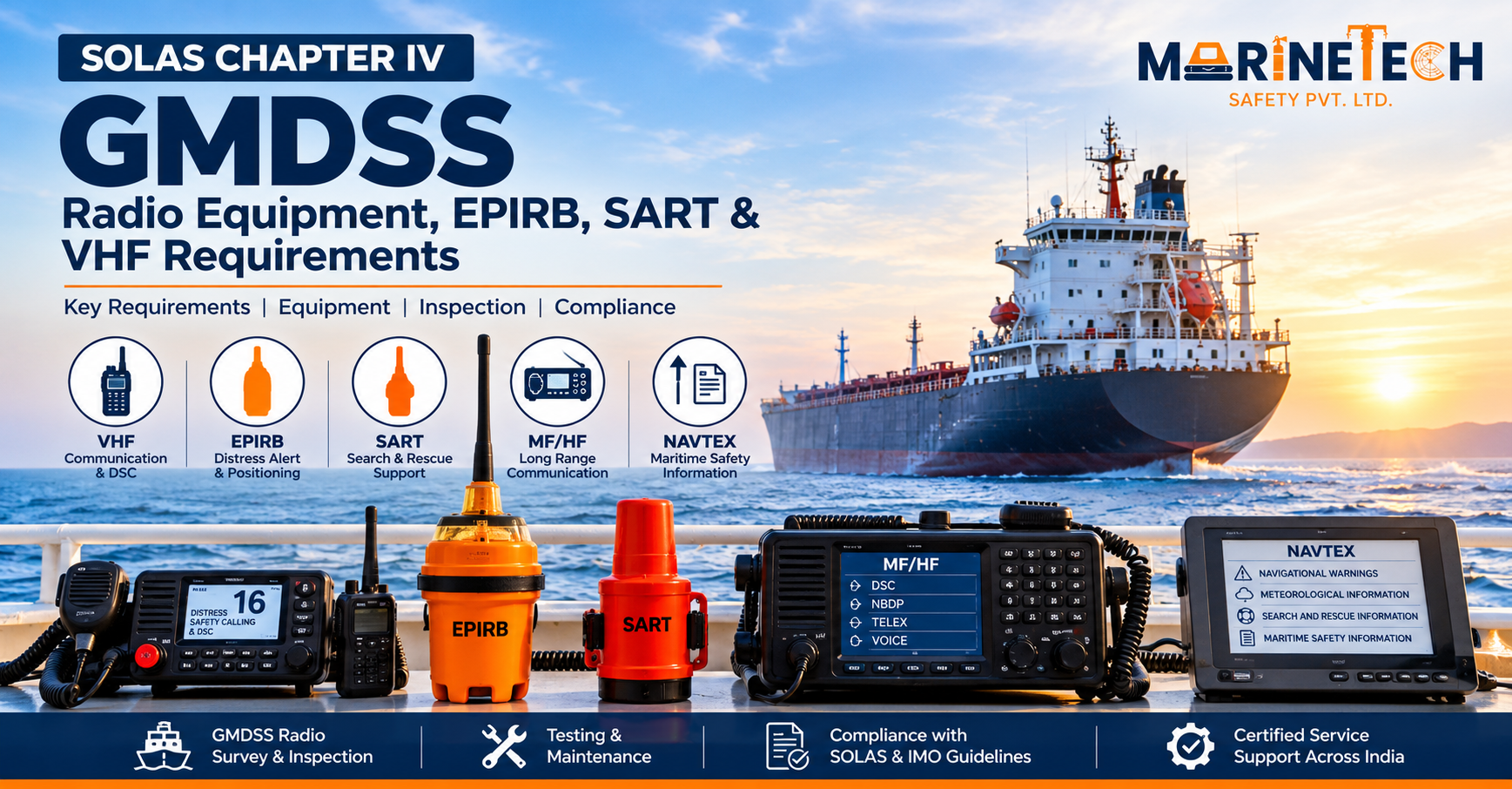
SOLAS Chapter IV GMDSS: Radio Equipment, EPIRB, SART & VHF Requirements for Ships
Reliable communication is one of
the most important elements of ship safety. During a distress situation, a
vessel must be capable of transmitting distress alerts, receiving maritime
safety information and communicating with other vessels, coast stations and
search-and-rescue authorities.
The Global Maritime Distress and
Safety System (GMDSS) provides the international framework for these
communications.
The requirements for GMDSS are
incorporated into SOLAS Chapter IV – Radiocommunications. The
International Maritime Organization (IMO) states that applicable passenger
ships and cargo ships of 300 gross tonnage and above on international
voyages are required to carry specified radiocommunication equipment,
including EPIRBs and SARTs. International
Maritime Organization
For ship owners, ship managers,
Masters, Chief Engineers and technical superintendents, understanding the
requirements for VHF, DSC, EPIRB, SART, MF/HF, NAVTEX, satellite
communication equipment and GMDSS batteries is essential for maintaining
vessel compliance and emergency readiness.
This guide explains the major SOLAS
Chapter IV GMDSS requirements, the purpose of important GMDSS equipment and
the role of a professional GMDSS Radio Survey & Inspection Service.
What Is GMDSS?
GMDSS stands for Global Maritime
Distress and Safety System.
It is an internationally recognized
communication and safety system designed to ensure that a vessel in distress
can:
- Send a distress alert to shore and/or other vessels
- Receive distress and safety information
- Communicate with rescue coordination authorities
- Communicate with nearby vessels
- Receive Maritime Safety Information (MSI)
- Support search-and-rescue operations
- Maintain communication using appropriate radio and
satellite systems
GMDSS combines different
communication technologies depending on the vessel's trading area.
These may include:
- VHF radio
- VHF DSC
- MF radio
- HF radio
- MF/HF DSC
- Satellite communication equipment
- NAVTEX
- EPIRB
- Radar SART
- AIS-SART
- Portable two-way VHF radios
- GMDSS reserve batteries
- Associated antennas, cables and power supplies
IMO guidance states that a ship
should be capable of transmitting ship-to-shore distress alerts by at least two
separate and independent means using different radiocommunication services,
subject to the applicable requirements. International
Maritime Organization
SOLAS Chapter IV – Radiocommunications
SOLAS Chapter IV establishes
requirements for radiocommunication services and shipborne radiocommunication
equipment.
The exact equipment arrangement
depends on factors including:
- Vessel type
- Gross tonnage
- International voyage requirements
- Trading area
- GMDSS sea area
- Flag-state requirements
- Applicable IMO requirements
- Recognized Organization/Class requirements
- Equipment installation and type approval
The GMDSS framework was modernized,
with amendments entering into force on 1 January 2024, allowing modern
communication technologies and removing obsolete requirements. marinetechss.com
Therefore, ship managers should
avoid relying solely on older equipment lists and should verify the vessel's
current statutory requirements.
GMDSS Sea Areas: A1, A2, A3 and A4
The GMDSS requirements are closely
connected with the sea area in which a vessel operates.
Sea Area A1
A1 is an area within the coverage
of at least one VHF coast station where continuous DSC alerting is available.
VHF DSC equipment is therefore an
important part of the GMDSS installation for vessels operating in A1.
Sea Area A2
A2 is an area outside A1 but within
the coverage of at least one MF coast station with continuous DSC alerting
capability. International
Maritime Organization
Additional MF/DSC capabilities are
therefore required.
Sea Area A3
A3 covers areas outside A1 and A2
that are within the coverage of a recognized mobile satellite service supported
by the ship's satellite earth station.
Sea Area A4
A4 is the area outside A1, A2 and
A3 and generally relates to polar regions where the applicable satellite
coverage is not available.
The required radio equipment must
therefore be evaluated against the vessel's actual trading area.
GMDSS Radio Equipment Requirements
The exact GMDSS equipment fit
varies according to the vessel and its sea area.
The following are some of the major
systems normally associated with a SOLAS GMDSS installation.
1. VHF Radio and DSC
VHF – Very High Frequency radio
is one of the primary communication systems used for short-range maritime
communication.
The GMDSS VHF installation includes
Digital Selective Calling (DSC) capability.
Important functions include:
- Distress alerting
- Urgency communication
- Safety communication
- Ship-to-ship communication
- Ship-to-shore communication
- Bridge-to-bridge communication
IMO material identifies VHF DSC on Channel
70 and radiotelephony including Channel 16 among the applicable
GMDSS arrangements. International
Maritime Organization
Why VHF testing is important
During a GMDSS radio survey, the
surveyor may verify:
- Transmitter performance
- Receiver performance
- DSC operation
- Channel operation
- Distress alert functionality
- Antenna condition
- Cabling
- Power supply
- Equipment programming
- Communication performance
Regular testing helps identify
failures before the equipment is required during an emergency.
2. EPIRB – Emergency Position
Indicating Radio Beacon
An EPIRB is a
satellite-based distress alerting device used to help search-and-rescue
authorities locate a vessel in an emergency.
A float-free EPIRB is part of the
GMDSS equipment requirements applicable to SOLAS ships. International
Maritime Organization
Depending on the installation, an
EPIRB may:
- Transmit a distress alert
- Provide vessel identification
- Provide position information
- Support search-and-rescue operations
- Automatically activate when the vessel sinks, where
a float-free arrangement is provided
IMO guidance notes that an EPIRB
can be used as one of the independent means of distress alerting when installed
appropriately or remotely activatable from the bridge. International
Maritime Organization
EPIRB inspection
A professional inspection should
consider:
- Physical condition
- Hydrostatic release arrangement
- Battery validity
- Expiry dates
- Identification coding
- Self-test operation
- Position information
- Mounting arrangement
- Float-free mechanism
- Operational documentation
EPIRB battery and release-unit
validity should be monitored as part of the vessel's planned maintenance
system.
3. SART – Search and Rescue
Transponder
A Search and Rescue Transponder
(SART) helps rescuers locate a survival craft or vessel during
search-and-rescue operations.
SOLAS GMDSS arrangements recognize Radar
SART or AIS-SART as locating devices. International
Maritime Organization
The equipment can be particularly
important after abandonment when the survival craft needs to be located by
rescue units.
SART inspection should consider:
- Physical condition
- Battery expiry
- Self-test
- Activation
- Operational status
- Mounting/stowage
- Identification markings
- Manufacturer's service requirements
The SART should be readily
accessible and maintained in accordance with applicable statutory and
manufacturer requirements.
4. MF/HF Radio and DSC
For vessels operating in areas
requiring medium- or high-frequency communication, MF/HF equipment forms an
important part of the GMDSS installation.
MF/HF systems can provide:
- Long-range distress communication
- DSC distress alerting
- Safety communications
- Urgency communications
- General maritime communication
IMO GMDSS equipment guidance
identifies MF DSC at 2187.5 kHz and HF DSC frequencies where HF
equipment is required. International
Maritime Organization
During an inspection, technicians
may check:
- Transmitter output
- Receiver sensitivity
- DSC operation
- Distress functions
- Antenna system
- Insulators
- Earthing
- Cabling
- Power supply
- Control units
- Printer or display functions where applicable
5. NAVTEX and Maritime Safety
Information
NAVTEX is used for receiving
maritime safety information and navigational warnings.
Depending on the vessel's equipment
arrangement and applicable requirements, GMDSS installations may include
equipment capable of receiving:
- Navigational warnings
- Meteorological warnings
- Weather forecasts
- Search-and-rescue information
- Other maritime safety information
The receiver should be operational
and correctly configured for the vessel's trading area.
6. Portable GMDSS VHF Equipment
Portable two-way VHF equipment is
used for emergency communication, particularly in survival craft and during
search-and-rescue situations.
The equipment should be:
- Readily accessible
- Properly stowed
- Operational
- Supported by valid batteries
- Maintained according to manufacturer instructions
- Available for emergency use
Battery condition is particularly
important because portable equipment may be required after loss of the vessel's
main electrical supply.
7. GMDSS Reserve Power and
Batteries
GMDSS equipment must remain
available when the vessel's main electrical supply is unavailable.
Therefore, reserve power
arrangements and GMDSS batteries are important parts of GMDSS maintenance.
Inspection may include:
- Battery condition
- Capacity
- Charging system
- Connections
- Terminals
- Battery room/installation condition
- Battery expiry or replacement requirements
- Emergency power availability
- Load testing where applicable
- Records and documentation
The GMDSS installation should be
evaluated as a complete system rather than treating individual radios as
isolated equipment.
GMDSS Radio Survey Checklist for Ship Managers
Before arranging a GMDSS radio
survey, ship managers can review the following checklist.
Equipment
- VHF operational
- VHF DSC tested
- MF/HF operational where applicable
- DSC tested
- NAVTEX operational
- EPIRB tested
- SART/AIS-SART tested
- Portable VHF radios operational
- Satellite equipment operational where applicable
Power Supply
- GMDSS batteries checked
- Battery expiry dates checked
- Charging system operational
- Emergency power available
- Battery connections checked
Installation
- Antennas inspected
- Coaxial cables checked
- Connectors checked
- Earthing checked
- Equipment securely mounted
- Bridge controls accessible
Documentation
- Radio licence available
- Safety Radio Certificate available
- Equipment certificates available
- Previous survey records available
- Maintenance records updated
- Battery records updated
- Radio log maintained
A vessel-specific checklist should
always be prepared according to the vessel's statutory certificate, trading
area and applicable Flag State/Class requirements.
Common GMDSS Deficiencies Found During Inspection
Some of the issues that can result
in delays or deficiencies include:
1. Expired batteries
EPIRB, SART, portable VHF and GMDSS
battery expiry dates should be monitored.
2. Faulty DSC
A radio may appear operational
while its DSC function is not working correctly.
3. Damaged antennas or cables
Corrosion, water ingress, damaged
connectors and deteriorated coaxial cables can affect radio performance.
4. Incorrect equipment
programming
MMSI, call sign, vessel
identification and other configuration parameters should be checked.
5. Incomplete documentation
Missing test records, certificates
or maintenance records can complicate statutory inspections.
6. Poor equipment accessibility
Emergency equipment must be
properly located and readily available for use.
7. Battery charging problems
A GMDSS battery that cannot
maintain the required condition can compromise emergency communication
capability.
GMDSS Radio Survey Service by Marinetech Safety Pvt. Ltd.
Marinetech Safety Pvt. Ltd.
is an India-based marine safety equipment service and supply company supporting
ship owners, ship managers, vessel operators and maritime organizations.
The company's GMDSS service covers
inspection and testing of important communication and distress equipment,
including:
- VHF
- VHF DSC
- MF/HF radio
- NAVTEX
- EPIRB
- SART
- GMDSS equipment
- Associated communication systems
Marinetech's published GMDSS
service information also covers annual GMDSS radio surveys, certification
support, calibrated testing equipment, signal analysis, defect reporting and
emergency repair support. marinetechss.com
For a dedicated service page, see:
[GMDSS Radio Survey &
Inspection Service in India – Marinetech Safety Pvt. Ltd.] GMDSS
Radio Survey & Inspection Service
This should be your primary
internal backlink from this article.
Other natural internal-link
placements can use anchors such as:
- GMDSS Radio Survey Service in India
- GMDSS Radio Survey & Inspection
- Marine Radio Survey Services
- GMDSS Equipment Inspection
- GMDSS Radio Testing Services
Avoid using the exact same anchor
text for every internal link.
GMDSS Services Across Indian Ports
For vessel operators, accessibility
of a service provider is important because ships may have short port stays and
statutory surveys can be time-sensitive.
Marinetech supports marine service
requirements across major Indian maritime locations, including:
- Mumbai
- Mundra
- Surat
- Sikka
- Jamnagar
- Chennai
- Vizag
- Other Indian ports subject to service availability
The company's website also provides
information about its wider marine safety service and supply portfolio. marinetechss.com
Marinetech's broader services
include marine safety equipment servicing, lifesaving appliance service,
firefighting appliance service, lifeboat and rescue boat service, calibration,
VDR performance testing, cargo gear load testing, BWMS service and electronic/navigation
communication services.
Related GMDSS & Marine Safety Articles
Readers interested in GMDSS
compliance can also explore these related resources from Marinetech Safety Pvt.
Ltd.:
1. What Is a GMDSS Radio Survey?
Requirements, Procedure & Inspection Checklist for Ships
A detailed guide covering GMDSS
survey procedures, equipment testing and inspection preparation.
2. GMDSS Radio Survey &
Inspection Service in Mumbai
A location-focused guide for ship
owners and managers requiring GMDSS radio survey support in Mumbai.
GMDSS
Radio Survey & Inspection Service in Mumbai
3. GMDSS Radio Survey &
Inspection Service in Chennai
A guide covering GMDSS equipment
inspection and radio survey requirements for vessels calling Chennai.
GMDSS
Radio Survey & Inspection Service in Chennai
4. How to Prepare a Vessel for
Panama Flag Survey & Inspection
Includes a section on preparing
GMDSS and radio equipment before Flag State inspection.
How
to Prepare a Vessel for Panama Flag Survey
5. Marine Navigation &
Communication Equipment Supplier in India
Useful for ship managers looking
for navigation and communication equipment supply.
Marine
Navigation & Communication Equipment Supplier in India
Frequently Asked Questions – SOLAS Chapter IV GMDSS
1. What is SOLAS Chapter IV?
SOLAS Chapter IV is the Radiocommunications
chapter of the International Convention for the Safety of Life at Sea. It
incorporates the GMDSS framework and establishes requirements concerning
shipborne radiocommunication equipment and services. International
Maritime Organization
2. What GMDSS equipment is
required on a ship?
The exact equipment depends on the
vessel, voyage and GMDSS sea area. Common equipment includes VHF/DSC, MF/HF
where applicable, satellite communication equipment, NAVTEX or other MSI
reception equipment, EPIRB, SART/AIS-SART, portable GMDSS VHF radios and GMDSS
reserve power.
3. What is the purpose of an
EPIRB?
An EPIRB is an Emergency Position
Indicating Radio Beacon used to transmit a distress alert and assist
search-and-rescue authorities in locating a vessel or survival craft.
4. What is a SART used for?
A SART, or Search and Rescue
Transponder, is used to assist rescuers in locating a vessel or survival craft
during a search-and-rescue operation.
5. What is VHF DSC in GMDSS?
VHF DSC, or Digital Selective
Calling, is a digital communication and distress-alerting function associated
with the GMDSS VHF installation. Channel 70 is used for DSC, while VHF Channel
16 is used for radiotelephony distress, safety and calling functions. International
Maritime Organization
6. How often should GMDSS
equipment be inspected?
The required survey and maintenance
schedule depends on the applicable statutory, Flag State, Class and
manufacturer requirements. Ship managers should follow the vessel's Safety
Radio Certificate and applicable statutory survey programme rather than relying
on a generic interval.
7. What is checked during a
GMDSS radio survey?
A GMDSS radio survey may include
VHF/DSC, MF/HF, NAVTEX, EPIRB, SART/AIS-SART, portable VHF, satellite equipment
where applicable, batteries, antennas, power supplies, documentation, equipment
identification and maintenance records.
8. Where can I get GMDSS Radio
Survey services in India?
Marinetech Safety Pvt. Ltd.
provides GMDSS Radio Survey & Inspection Services in India,
including inspection and testing of VHF, MF/HF, NAVTEX, EPIRB, SART and other
applicable GMDSS equipment. marinetechss.com
Conclusion
GMDSS is an essential component of
modern maritime safety communication. Compliance with SOLAS Chapter IV
requires ship owners and managers to ensure that the vessel's applicable radio
equipment remains operational, properly maintained and supported by appropriate
documentation.
VHF/DSC, MF/HF, EPIRB, SART,
NAVTEX, portable VHF equipment, satellite communication systems and GMDSS
reserve power all have important roles within the overall emergency
communication arrangement.
Regular inspection and professional
testing can help identify equipment problems before they become critical during
an emergency or statutory survey.
For professional GMDSS Radio
Survey & Inspection Services in India, ship owners and managers can
contact Marinetech Safety Pvt. Ltd.
Request
GMDSS Radio Survey Service from Marinetech Safety Pvt. Ltd.
Marinetech Safety Pvt. Ltd.
Marine Safety Equipment Service & Supply
Mumbai | Mundra | Surat | Sikka | Jamnagar | Chennai | Vizag