Blog Post
Marine Fire Hose & Nozzle Inspection Guide for Ships
Posted By: Harsh Bamnolia
Posted On : 05-Nov-2026
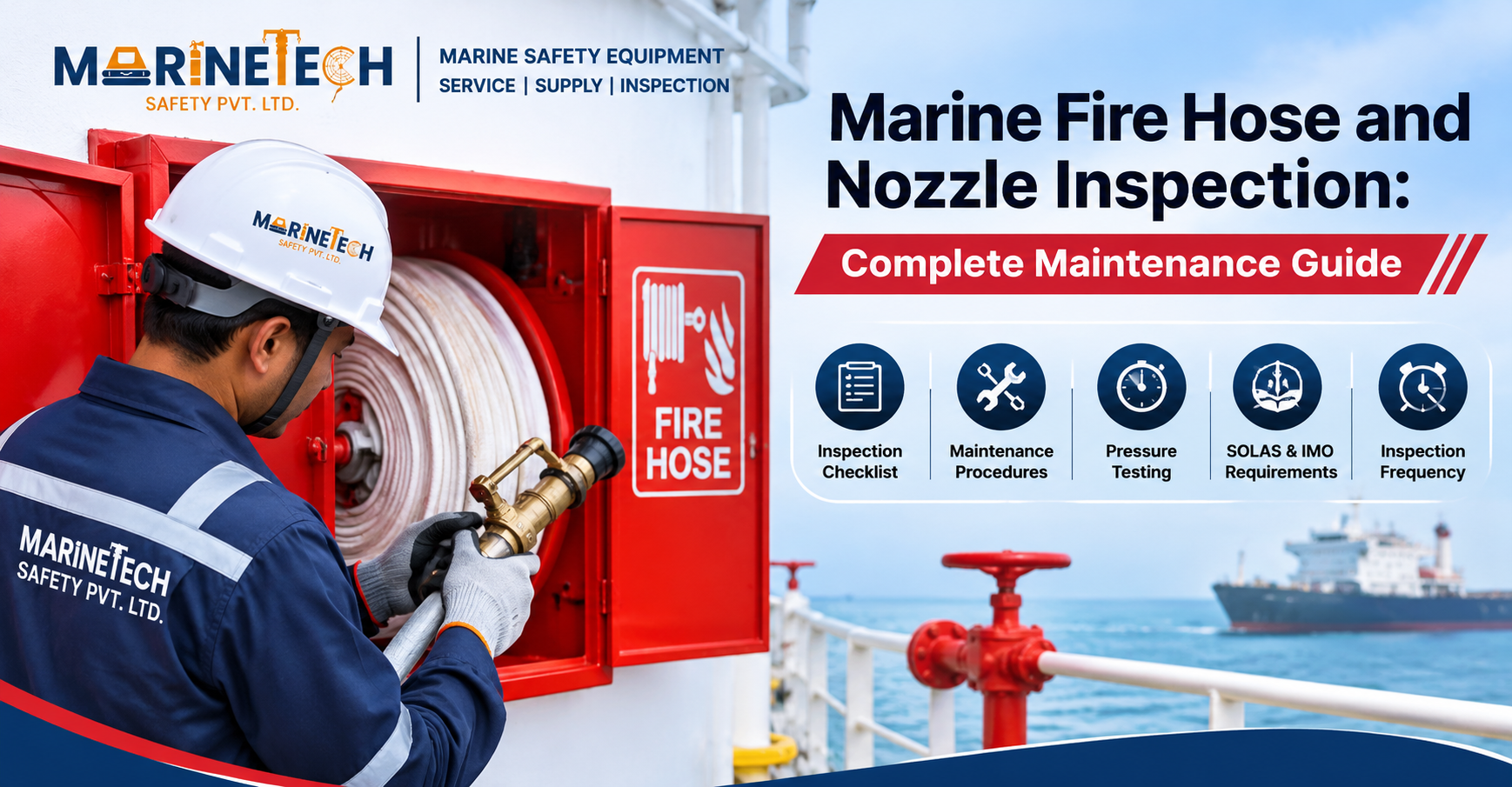
Marine Fire Hose and Nozzle Inspection: Complete Maintenance Guide for Ships
Fire safety is one of the most important aspects of safe
vessel operations. Onboard ships, fire hoses and nozzles are essential
firefighting appliances that allow crew members to deliver water quickly and
effectively to control and extinguish fires. However, their effectiveness
depends on proper installation, regular inspection, pressure testing and
maintenance.
A damaged fire hose, leaking coupling, blocked nozzle or
defective jet-and-spray mechanism can significantly reduce firefighting
performance during an emergency. Therefore, regular marine fire hose
inspection and fire nozzle maintenance are essential parts of a vessel's
fire safety and planned maintenance programme.
For shipowners, ship managers, technical superintendents and
chief engineers, understanding marine fire hose and nozzle inspection
requirements is important for maintaining operational readiness and preparing
vessels for statutory surveys, classification inspections and Port State
Control (PSC) inspections.
Marinetech Safety Pvt. Ltd. is an India-based marine safety
equipment servicing and supply company providing inspection, maintenance and
servicing solutions for shipboard firefighting appliances. Through its Fire Fighting
Appliances Service, Marinetech supports vessel operators with fire hose and
nozzle inspection, pressure testing and other firefighting equipment
maintenance services.
This guide explains marine fire hose and nozzle inspection
procedures, SOLAS requirements, maintenance intervals, common defects and the
importance of professional firefighting appliance servicing.
1. What Are Marine Fire Hoses and Nozzles?
Marine fire hoses are flexible water-delivery equipment
connected to the vessel's fire hydrant system. They allow firefighting teams to
direct water towards a fire in accommodation spaces, machinery spaces, cargo
areas, open decks and other designated locations.
A marine fire hose assembly generally consists of:
- Fire
hose: A flexible, pressure-resistant hose designed for firefighting
applications.
- Hose
couplings: Connections that attach the hose to hydrants and other hose
sections.
- Gaskets
and washers: Components that help prevent water leakage at connections.
- Fire
nozzle: A device fitted at the hose outlet to control the water discharge.
- Nozzle
operating mechanism: Allows the operator to control the discharge pattern
where applicable.
- Hose
rack or storage arrangement: Keeps the hose properly stored and
accessible.
Marine fire nozzles are generally designed to provide
different discharge patterns, depending on the approved nozzle configuration.
Common Types of Marine Fire Nozzles
1. Jet Nozzle
A jet nozzle produces a concentrated stream of water that
can reach a relatively long distance. It is useful for directing water towards
a specific fire location.
2. Spray Nozzle
A spray nozzle distributes water over a wider area. It can
help cool surrounding surfaces and provide protection against radiant heat.
3. Combination Jet and Spray Nozzle
Combination nozzles allow the operator to switch between jet
and spray patterns. These are commonly used in shipboard firefighting
arrangements.
4. Shut-Off Nozzle
A shut-off mechanism allows the operator to stop water
discharge without disconnecting the hose from the hydrant. The nozzle design
must be suitable for the vessel's approved firefighting arrangement.
2. SOLAS Requirements for Marine Fire Hoses and Nozzles
Marine fire hoses and nozzles are covered under the
international fire safety requirements applicable to ships.
The main regulatory references include:
- SOLAS
Chapter II-2, Regulation 10 – Fire Fighting.
- SOLAS
Chapter II-2, Regulation 14 – Operational Readiness and Maintenance.
- International
Code for Fire Safety Systems (FSS Code).
- IMO
MSC.1/Circ.1432 – Revised Guidelines for the Maintenance and Inspection of
Fire Protection Systems and Appliances.
SOLAS Chapter II-2, Regulation 10
SOLAS Regulation II-2/10 establishes requirements for
shipboard firefighting arrangements, including fire pumps, fire mains,
hydrants, fire hoses and associated equipment.
Under the applicable requirements, fire hoses must:
- Be
manufactured from non-perishable material approved by the Administration.
- Have
sufficient length to reach the spaces where they may be required.
- Be
provided with suitable nozzles and necessary couplings.
- Be
kept ready for immediate use.
- Be
stored in conspicuous and accessible positions near hydrants or water
connections.
- Have
compatible couplings and nozzles where interchangeability is required.
SOLAS Fire Hose Length Requirements
SOLAS Chapter II-2/10.2.3.1 specifies the following maximum
hose lengths:
|
Location |
Maximum hose length |
|
Machinery spaces |
15 metres |
|
Other spaces and open decks |
20 metres |
|
Open decks on ships with maximum breadth exceeding 30
metres |
25 metres |
The minimum fire hose length is generally 10 metres.
The exact hose arrangement and number required must be verified
against the applicable vessel type, approved fire control arrangements and
statutory requirements.
IMO MSC.1/Circ.1432
IMO MSC.1/Circ.1432 provides guidelines for the maintenance
and inspection of fire protection systems and appliances.
Section 5.1 covers monthly inspections of fire mains, fire
pumps, hydrants, hoses and nozzles. Section 7.1 covers annual inspection and
testing requirements.
These guidelines provide an important reference for
shipboard firefighting equipment maintenance.
3. Marine Fire Hose Inspection: Step-by-Step Procedure
Regular marine fire hose inspection helps identify
deterioration, leakage, mechanical damage and other defects before the
equipment is needed during an emergency.
The following inspection points should be included in a
vessel's maintenance programme.
1. Visual Inspection of Fire Hoses
The external condition of every accessible fire hose should
be checked.
Inspect for:
- Cuts
and abrasions.
- Cracks
and surface deterioration.
- Bulging
or deformation.
- Signs
of ageing.
- Burn
marks or heat damage.
- Chemical
contamination.
- Oil
contamination.
- Exposed
reinforcement.
- Damaged
outer covering.
- Signs
of leakage.
Particular attention should be given to hoses exposed to
direct sunlight, harsh weather, chemicals, oil and mechanical damage.
Any hose showing serious deterioration should be removed
from service and assessed for repair or replacement.
2. Inspection of Hose Couplings
Hose couplings are critical connection points between the
fire hose and hydrant.
Check:
- Coupling
threads and locking arrangements.
- Cracks
and physical damage.
- Corrosion.
- Loose
connections.
- Worn
coupling surfaces.
- Correct
fitment.
- Compatibility
with vessel hydrants.
- Condition
of coupling gaskets and washers.
Damaged or incompatible couplings can cause leakage and
reduce firefighting efficiency.
3. Inspection of Hose Gaskets and Washers
Gaskets and washers prevent leakage at hose connections.
Inspect them for:
- Cracks.
- Hardening.
- Wear
and deformation.
- Missing
components.
- Improper
fitment.
- Signs
of water leakage.
Replace defective gaskets and washers with suitable
components compatible with the approved equipment.
4. Fire Hose Pressure Testing
Pressure testing is an important part of marine fire hose
maintenance.
The purpose of pressure testing is to verify that the hose
can withstand the applicable fire main pressure without leakage or failure.
A typical controlled test procedure includes:
- Identify
the hose and record its identification details.
- Conduct
an external visual inspection.
- Examine
couplings and gaskets.
- Connect
the hose to an appropriate test arrangement.
- Fill
the hose with water and remove trapped air.
- Apply
pressure using an approved testing arrangement.
- Maintain
the prescribed test pressure for the required duration.
- Check
for leakage, bulging or abnormal deformation.
- Record
the test results.
- Remove
defective equipment from service.
Important: The applicable pressure and test procedure
must be determined from the hose manufacturer's instructions, approved hose
specifications and the requirements of the relevant Administration or
classification society. Do not apply an arbitrary test pressure.
5. Drying and Proper Storage
After water testing or use, fire hoses should be drained and
dried appropriately in accordance with the manufacturer's instructions.
Improper storage can lead to:
- Internal
moisture retention.
- Mould
and deterioration.
- Corrosion
of couplings.
- Material
degradation.
- Unpleasant
odours and contamination.
Fire hoses should be stored in their designated racks or arrangements,
without sharp bends, twisting or unnecessary mechanical stress.
4. Marine Fire Nozzle Inspection and Maintenance
Fire nozzle inspection is equally important because even a
properly maintained hose cannot deliver effective firefighting performance if
its nozzle is blocked or damaged.
A professional fire nozzle inspection should cover the
following areas.
1. External Body Inspection
Check the nozzle body for:
- Cracks.
- Dents.
- Corrosion.
- Physical
deformation.
- Damaged
threads.
- Loose
components.
- Signs
of impact damage.
2. Nozzle Opening Inspection
Inspect the nozzle outlet for obstructions and
contamination.
Common problems include:
- Rust
particles.
- Dirt
and debris.
- Scale
deposits.
- Foreign
materials.
- Damaged
discharge openings.
The nozzle opening should be cleaned using a method approved
by the manufacturer.
3. Jet and Spray Pattern Testing
Where the nozzle is designed to provide jet and spray
functions, verify that both modes operate correctly.
Check that:
- The
jet pattern is properly formed.
- The
spray pattern is uniform.
- The
adjustment mechanism operates smoothly.
- There
is no unwanted leakage.
- The
nozzle can be operated safely.
4. Shut-Off Mechanism Inspection
For nozzles with shut-off facilities, verify that the
mechanism operates correctly.
Check for:
- Smooth
operation.
- Correct
opening and closing.
- Leakage
in the closed position.
- Damaged
operating handles.
- Loose
or worn components.
5. Nozzle and Coupling Compatibility
Confirm that the nozzle coupling matches the fire hose
connection and approved shipboard arrangement.
Incompatible equipment can delay firefighting operations and
create unnecessary problems during emergency response.
5. Marine Fire Hose and Nozzle Inspection Intervals
Inspection intervals should follow the vessel's approved
onboard maintenance plan, applicable Administration requirements and
manufacturer's recommendations.
IMO MSC.1/Circ.1432 provides the following inspection
guidance for fire mains, fire pumps, hydrants, hoses and nozzles.
|
Inspection interval |
Maintenance and inspection activity |
|
Monthly |
Verify that all fire hydrants, hoses and nozzles are in
place, properly arranged and in serviceable condition. Operate fire pumps to
confirm adequate pressure. |
|
Quarterly |
Verify that international shore connections are in serviceable
condition. |
|
Annually |
Visually inspect accessible components, flow-test fire
pumps, test hydrant valves and verify nozzle size, type, maintenance and
working condition. |
|
Annually |
Pressure-test a sample of fire hoses at maximum fire main
pressure, ensuring that all fire hoses are tested within five years. |
Important: The five-year requirement refers to the
coverage of the full inventory through annual sample pressure testing. It does
not mean that each individual hose must be tested only once every five years
under every possible arrangement. Follow the applicable flag Administration
instructions and manufacturer's requirements.
The vessel's maintenance plan should also specify
responsible personnel, inspection records, corrective actions and replacement
arrangements.
6. Common Defects Found During Marine Fire Hose and
Nozzle Inspection
During routine inspection, servicing and vessel surveys, the
following defects may be identified.
|
Defect |
Possible impact |
Recommended action |
|
Cracked fire hose |
Leakage or hose failure |
Replace or assess as per manufacturer |
|
Damaged coupling |
Improper connection |
Repair or replace |
|
Missing gasket |
Water leakage |
Install correct gasket |
|
Corroded nozzle |
Reduced reliability |
Assess and replace if required |
|
Blocked nozzle |
Restricted water discharge |
Clean and function-test |
|
Defective jet/spray mechanism |
Incorrect discharge pattern |
Repair or replace |
|
Incorrect hose length |
Inadequate coverage |
Verify SOLAS requirements |
|
Incompatible couplings |
Connection difficulties |
Provide compatible approved fittings |
|
Poor storage |
Premature hose deterioration |
Improve storage arrangements |
|
Missing inspection records |
Difficulty demonstrating maintenance |
Update onboard records |
Identifying and rectifying these defects before an emergency
or statutory survey helps maintain firefighting readiness.
7. Importance of Professional Marine Fire Hose and Nozzle
Servicing
Marine fire hoses and nozzles are exposed to challenging
environmental conditions, including saltwater, humidity, temperature
variations, vibration and mechanical handling.
These factors can gradually affect their performance and
reliability.
Professional marine firefighting equipment servicing helps
shipowners and vessel operators to:
- Identify
damaged or deteriorated equipment.
- Verify
hose and coupling condition.
- Conduct
applicable pressure testing.
- Check
nozzle operation and discharge patterns.
- Replace
defective components.
- Maintain
inspection and test records.
- Improve
vessel emergency preparedness.
- Support
statutory and classification survey readiness.
Shipowners should ensure that inspection and testing are
carried out by competent personnel using appropriate procedures and equipment.
8. Marinetech Safety Pvt. Ltd. – Marine Fire Hose and
Nozzle Inspection Services in India
Marinetech Safety Pvt. Ltd. is an India-based marine safety
equipment servicing and supply company providing solutions for shipowners, ship
managers, vessel operators and technical superintendents.
The company offers a comprehensive range of marine
firefighting appliance inspection, maintenance and servicing solutions to
support vessel safety and operational readiness.
Our Fire Fighting Appliances Services Include:
- Marine
fire hose inspection and pressure testing.
- Fire
nozzle inspection and functional testing.
- Fire
extinguisher inspection, refilling and hydrostatic testing.
- Fixed
CO2 fire extinguishing system servicing.
- Foam
system inspection and servicing.
- Wet
chemical system servicing.
- Water
mist system inspection.
- SCBA
sets and cylinders inspection and servicing.
- EEBD
inspection and maintenance.
- Fire
detection and alarm system inspection.
- Breathing
air analysis.
- Foam
analysis.
- Immersion
suits and protective suits inspection.
- Supply
of marine firefighting equipment and accessories.
Why Choose Marinetech Safety Pvt. Ltd.?
Marinetech's published firefighting service capabilities
include:
- 9
classification society approvals for relevant services.
- 40+
qualified engineers.
- 7,000+
sq. ft. service stations.
- 10+
years of experience in marine servicing.
- Manufacturer
approvals and specialised testing infrastructure.
The company's firefighting service page identifies
recognition and approvals associated with classification bodies including ABS,
Bureau Veritas, DNV GL, RINA, ClassNK, IRS, DGS, Lloyd's Register, Korean
Register and CCS.
Marinetech provides marine safety equipment servicing and
supply support across major Indian maritime locations, including Mumbai,
Mundra, Surat, Jamnagar, Vizag and Chennai.
For complete details of our inspection, maintenance and
certification services, visit:
Marine
Fire Fighting Appliances Inspection and Servicing – Marinetech Safety Pvt. Ltd.
Shipowners and vessel managers can contact our team for fire
hose and nozzle inspection, pressure testing, firefighting equipment servicing
and supply requirements.
9. Marine Fire Hose and Nozzle Inspection Checklist for Shipowners
The following checklist can help chief engineers, safety
officers and technical superintendents monitor the condition of firefighting
equipment onboard.
Fire Hose Inspection Checklist
- Fire
hoses are available at designated hydrants.
- Hose
material is in satisfactory condition.
- No
visible cracks, cuts or abrasions.
- No
leakage or bulging.
- Couplings
are free from damage and corrosion.
- Gaskets
and washers are fitted correctly.
- Hose
length meets applicable requirements.
- Connections
are compatible with hydrants.
- Pressure
testing is completed when due.
- Inspection
records are maintained.
- Hoses
are properly drained and stored.
Fire Nozzle Inspection Checklist
- Nozzle
is available with the designated hose.
- Nozzle
body is free from damage.
- Outlet
is free from obstruction.
- Coupling
is compatible.
- Jet
function works correctly, where applicable.
- Spray
function works correctly, where applicable.
- Shut-off
mechanism works correctly, where fitted.
- No
abnormal leakage.
- Correct
nozzle type and size are provided.
- Nozzle
is maintained in a ready-for-use condition.
This checklist is a practical aid and should be used
alongside the vessel's approved maintenance plan, equipment manuals and
applicable regulatory requirements.
10. Conclusion
Marine fire hoses and nozzles are essential components of a
ship's firefighting arrangements. Their performance during an emergency depends
on proper installation, regular inspection, pressure testing, functional checks
and correct storage.
Following SOLAS Chapter II-2 and IMO MSC.1/Circ.1432
guidance helps shipowners and vessel operators maintain firefighting equipment
in a serviceable condition and ensure that required inspections are properly
documented.
Marinetech Safety Pvt. Ltd. supports the marine industry
with professional firefighting appliance inspection, servicing, maintenance and
equipment supply solutions across India.
If you are looking for reliable marine fire hose
inspection, fire nozzle inspection, fire hose pressure testing or complete
marine firefighting equipment servicing, connect with our technical team.
Explore our services: Fire Fighting
Appliances Service – Marinetech Safety Pvt. Ltd.
Contact Marinetech Safety Pvt. Ltd.
Website: https://marinetechss.com/
Email: info@marinetechss.com
Phone: +91 72270 38216 | +91 79 7743 0002
NAVIGATING SAFETY, SUPPLYING CONFIDENCE
Frequently Asked Questions (FAQs)
1. How often should marine fire hoses be inspected?
As per IMO MSC.1/Circ.1432, fire hydrants, hoses and nozzles
should be checked monthly to verify their presence, arrangement and serviceable
condition. Annual inspections include visual examination of accessible
components and sample pressure testing of fire hoses, ensuring that all hoses
are tested within five years.
2. Is pressure testing required for marine fire hoses?
Yes. IMO MSC.1/Circ.1432 includes annual pressure testing of
a sample of fire hoses at maximum fire main pressure, with the objective of
testing all fire hoses within five years. Applicable flag Administration and
manufacturer requirements should also be followed.
3. What is the purpose of a marine fire nozzle?
A marine fire nozzle controls the water discharge from a
fire hose. Depending on its design, it may provide a concentrated jet, a spray
pattern or both, helping the crew direct water towards a fire.
4. What are the common defects found in marine fire
hoses?
Common defects include cracks, cuts, abrasions, bulging,
leakage, damaged couplings, missing gaskets, corrosion and deterioration caused
by marine environmental conditions.
5. What are the SOLAS requirements for marine fire hoses?
SOLAS Chapter II-2, Regulation 10 specifies requirements for
fire hoses, including approved non-perishable material, sufficient length,
compatible couplings and nozzles, and proper storage near hydrants or
connections. The minimum and maximum hose lengths depend on the location
onboard.
6. What is IMO MSC.1/Circ.1432?
IMO MSC.1/Circ.1432 is the Revised Guidelines for the
Maintenance and Inspection of Fire Protection Systems and Appliances. It
provides guidance on periodic inspection and maintenance of shipboard
firefighting equipment, including fire mains, pumps, hydrants, hoses and
nozzles.
7. Does Marinetech Safety Pvt. Ltd. provide marine fire
hose and nozzle inspection in India?
Marinetech Safety Pvt. Ltd. lists fire hose and nozzle
inspection, pressure testing and replacement services within its firefighting
appliance service scope. The company also provides inspection and servicing of
other marine firefighting equipment across major Indian maritime locations.
8. Where can shipowners arrange marine firefighting
equipment servicing in India?
Shipowners and vessel managers can contact Marinetech Safety
Pvt. Ltd. for marine firefighting equipment inspection, servicing, maintenance
and supply requirements. Visit https://marinetechss.com/services/fire-fighting-appliances
or email info@marinetechss.com to
discuss vessel requirements.