Blog Post
Liferaft Service in Chennai: SOLAS Requirements, Inspection & Certification
Posted By: Harsh Bamnolia
Posted On : 31-Aug-2026
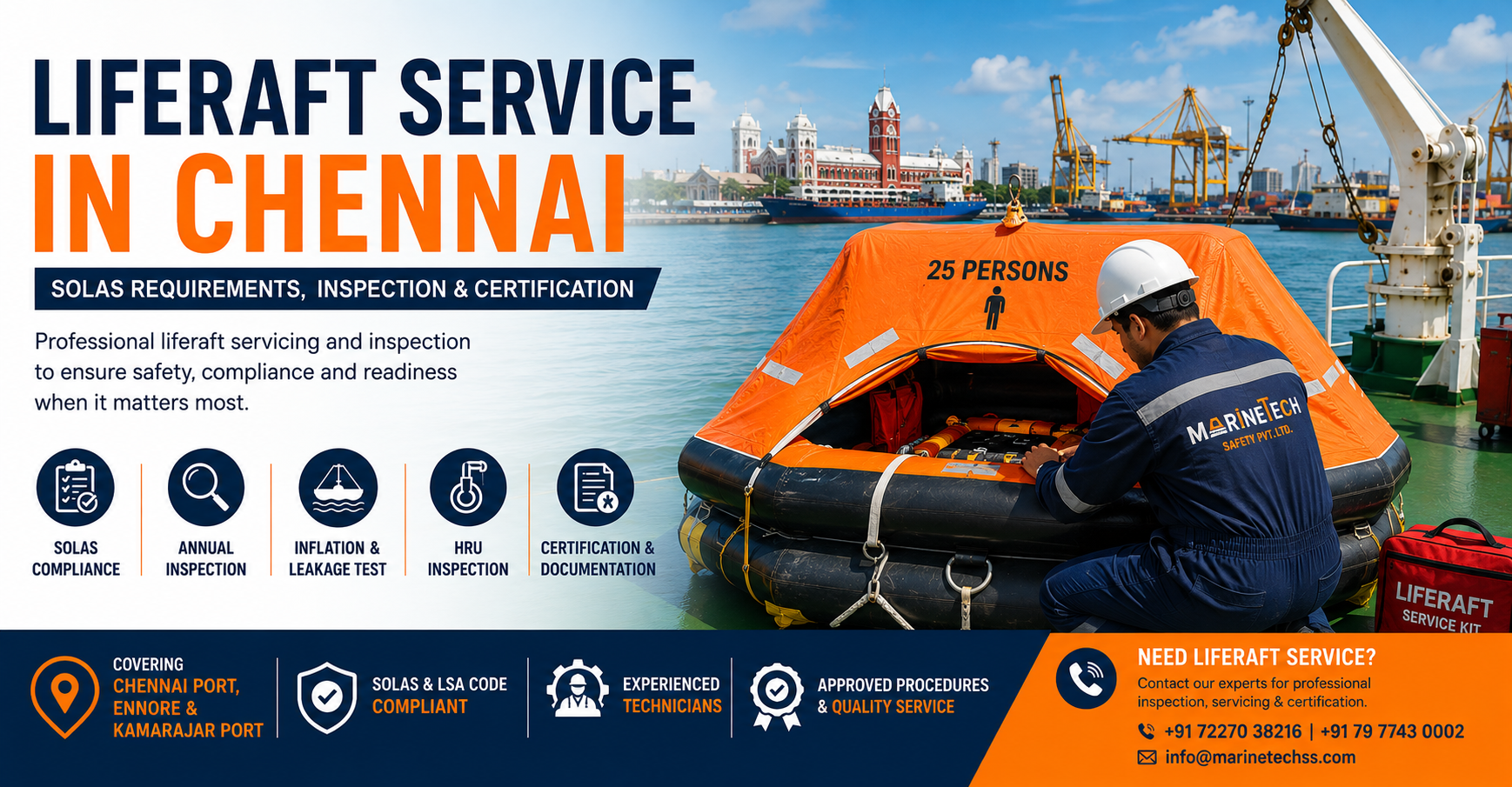
Liferaft Service in Chennai: SOLAS Requirements, Inspection & Certification
For commercial vessels, an
inflatable liferaft is a critical Life-Saving Appliance (LSA) that must
remain ready for immediate deployment during an emergency. Fire, collision,
flooding or any other situation requiring abandonment of the vessel can place
the crew's survival directly dependent on the condition and readiness of the
vessel's lifesaving equipment.
Regular liferaft servicing,
inspection, testing, repacking and certification are therefore essential
parts of vessel safety management.
For shipowners, ship managers,
technical superintendents and masters operating vessels through Chennai
Port, Ennore/Kamarajar Port and the wider Tamil Nadu maritime region,
arranging liferaft service on time is particularly important for maintaining
statutory compliance and avoiding equipment-related deficiencies during surveys
and inspections.
In this guide, we explain the
important SOLAS liferaft servicing requirements, inspection procedures,
certification, HRU checks and servicing considerations for vessels in Chennai.
What Is Liferaft Servicing?
Liferaft servicing is a systematic
process of inspecting, testing, maintaining and repacking an inflatable
liferaft to verify that it remains suitable for its intended emergency
function.
A professional liferaft service can
include examination of:
- Liferaft container or valise
- Inflatable chambers
- Liferaft fabric and seams
- Inflation valves
- Gas inflation system
- CO2 cylinder and associated components
- Pressure and leakage condition
- Canopy
- Boarding arrangements
- Liferaft floor
- Painter system
- Sea anchor
- Emergency equipment
- Survival equipment
- Food and water provisions, where applicable
- Pyrotechnics and expiry dates
- First-aid equipment
- Hydrostatic Release Unit (HRU)
- Identification markings
- Previous service documentation
The exact service scope should
follow the applicable manufacturer's servicing procedures, approval
requirements, flag-state requirements and relevant IMO/SOLAS provisions.
Why Is Liferaft Servicing Important for Ships in Chennai?
Chennai is an important maritime
hub on India's east coast, while the wider Chennai region also supports vessel
operations at Ennore/Kamarajar Port and other nearby maritime
facilities.
Vessels calling at these locations
may include:
- Bulk carriers
- Container vessels
- Tankers
- General cargo vessels
- Offshore-related vessels
- Other commercial ships
A liferaft may remain packed for
months or years without being deployed. During this period, environmental
conditions such as humidity, saltwater, heat, UV exposure and ageing can
affect the condition of inflatable materials and associated equipment.
Regular servicing helps identify
problems before the equipment is needed in an actual emergency.
SOLAS Requirements for Liferaft Servicing
Liferafts fall under SOLAS
Chapter III – Life-Saving Appliances and Arrangements, together with the
applicable requirements of the International Life-Saving Appliance (LSA) Code.
For Indian-flag vessels, the
Directorate General of Maritime Administration states that inflatable
liferafts must be serviced at intervals of not more than 12 months at a
DGS-approved LSA service station, or at an overseas station approved by the
relevant flag-state administration. DGS also specifies annual servicing for
hydrostatic release units. (Directorate General of Shipping)
The current DGS framework further
states that only approved LSA service stations are authorised to undertake
periodic servicing of inflatable lifesaving appliances, including inflatable
liferafts, for Indian-flag vessels and foreign vessels while in Indian waters.
(Directorate General of Shipping)
Therefore, shipowners should verify
the current approval status, servicing scope, OEM authorisation and
competent-person requirements before selecting a service provider.
How Often Should a Liferaft Be Serviced?
For Indian-flag vessels, DGS
currently specifies a servicing interval of not more than 12 months for
inflatable liferafts at an approved LSA service station. (Directorate General of Shipping)
Ship managers should maintain a
liferaft servicing schedule containing:
- Liferaft serial number
- Manufacturer
- Model
- Capacity
- Container number
- Previous service date
- Next service due date
- HRU information
- Service certificate
- Service station details
- Applicable approval information
Planning the service before the due
date is preferable to waiting until the vessel is already alongside.
What Is Checked During Liferaft
Inspection in Chennai?
A professional liferaft inspection
involves more than checking the expiry date printed on the container.
1. Liferaft Container Inspection
Technicians inspect the container
or valise for:
- Cracks
- Physical damage
- Corrosion
- Deformation
- Water ingress
- Damaged securing arrangements
- Missing identification markings
The container is important because
it protects the packed liferaft from the marine environment.
2. Inflation and Leakage Testing
The liferaft is inflated according
to the applicable servicing procedure.
Technicians inspect the inflated
chambers and associated components for:
- Leakage
- Pressure loss
- Damage
- Abnormal deformation
- Valve problems
- Deterioration
Inflation and leakage checks are
particularly important because defects may not be visible while the raft is
packed.
Marinetech's liferaft service
information includes inspection and maintenance, leak and damage checks,
repacking and other liferaft servicing activities. (Marinetech)
3. Fabric and Seam Inspection
The inflatable fabric and seams are
examined for deterioration, abrasion, cuts, delamination and other damage.
Areas exposed to repeated handling,
moisture and environmental conditions require particular attention.
4. Inflation System Inspection
The inflation valves, gas system
and associated components are examined according to the manufacturer's
servicing procedure.
Where applicable, the condition of
the CO2 cylinder and associated fittings is also checked.
5. Emergency Equipment Inspection
The liferaft's emergency equipment
is checked against the applicable equipment requirements.
Depending on the liferaft type and
pack, this may include:
- Paddles
- Sea anchor
- Rescue equipment
- First-aid equipment
- Signalling equipment
- Pyrotechnics
- Torches
- Food and water
- Repair equipment
- Survival equipment
Expired, damaged or missing
equipment should be addressed according to the applicable requirements.
6. Hydrostatic Release Unit (HRU) Inspection
The Hydrostatic Release Unit
(HRU) is an important part of the liferaft launching arrangement when
fitted.
Its function is to release the
liferaft automatically when the vessel sinks below the specified water depth.
DGS identifies HRUs as equipment
requiring annual servicing. (Directorate General of Shipping)
Ship managers should therefore
verify the HRU's:
- Installation
- Identification
- Validity
- Condition
- Replacement/service date
- Compatibility with the liferaft arrangement
7. Repacking of Liferaft
After the applicable inspection and
servicing process has been completed, the liferaft is correctly repacked into
its container or valise.
Correct repacking is important
because the liferaft must be capable of being deployed effectively when
required.
Liferaft Certification After Servicing
Liferaft servicing should be
supported by appropriate documentation.
The servicing records should
provide traceability between the vessel, liferaft and service operation.
Shipowners and managers should
verify details such as:
- Vessel name
- IMO number
- Liferaft manufacturer
- Liferaft serial number
- Capacity
- Service date
- Next service due date
- Service station details
- Approval information
- Competent-person details where applicable
- HRU information
- Replaced components
- Inspection/service results
DGS states that servicing records
containing service-station information, approval details, competent-person
information and identification details should be retained onboard and made
available for inspection. (Directorate General of Shipping)
Liferaft Service in Chennai and Ennore Port
For vessels calling at Chennai
Port and Ennore/Kamarajar Port, liferaft servicing can be coordinated
around vessel schedules, port calls, annual surveys and other planned
maintenance activities.
Marinetech has published dedicated
information covering lifeboat and liferaft servicing at Chennai and Ennore
Port, including annual liferaft servicing, inflation and leak testing,
equipment inspection, gas-system servicing, HRU checks, repacking and
certificate issuance. (Marinetech)
For vessels operating through
Chennai, arranging the required service before the equipment becomes overdue
can help reduce operational disruption and provide adequate time to address
defects or replacement requirements.
Choosing a Liferaft Service Company in Chennai
Shipowners should not select a
liferaft service provider only on the basis of price or location.
Before booking a service, verify:
1. DGS Approval
Check whether the service station
has the required approval for the relevant inflatable lifesaving appliance.
DGS maintains an approved
service-station framework and publishes an updated list of approved life-raft
service stations. (Directorate General of Shipping)
2. OEM Approval
The current DGS framework places importance
on OEM-established or appropriately manufacturer-approved service stations and
qualified service personnel for servicing different makes and models. (Directorate
General of Shipping)
3. Competent Personnel
Confirm that servicing is performed
under appropriately qualified and authorised personnel.
4. Service Documentation
Make sure the service provider can
provide proper servicing documentation and traceability.
5. Manufacturer-Specific
Requirements
Different liferaft manufacturers
can have different servicing procedures and approved components. The service
provider should be able to work according to the applicable OEM requirements.
Marinetech Safety Pvt. Ltd. –
Liferaft Servicing & Inspection
Marinetech Safety Pvt. Ltd.
is an India-based marine safety equipment servicing and supply company
providing solutions for commercial vessels and maritime operators.
The company provides Life Raft
Servicing and Inspection, including inspection, maintenance, repacking and
applicable testing and certification-related services. (Marinetech)
View
Marinetech's Life Raft Servicing & Inspection Service
Marinetech's marine safety service
capabilities extend beyond liferafts and include lifesaving and firefighting
equipment servicing, GMDSS, navigation and communication services, calibration
and other marine technical services. (Marinetech)
Marinetech Liferaft Service Capabilities
Depending on the applicable
equipment, manufacturer and approval scope, services can include:
- Annual liferaft servicing
- Liferaft inspection
- Liferaft inflation checks
- Leakage testing
- Liferaft maintenance
- Liferaft repacking
- Equipment-pack inspection
- HRU inspection
- HRU replacement where required
- Liferaft testing
- Documentation and certification
- Support for commercial vessels
- Marine safety equipment supply
For shipowners and managers, using
one experienced marine safety service provider for multiple safety-equipment
requirements can also simplify vessel maintenance coordination.
Liferaft Servicing for Commercial Vessels
Professional liferaft servicing can
be relevant for:
- Bulk carriers
- Container ships
- Tankers
- General cargo vessels
- Offshore vessels
- Coastal vessels
- Commercial vessels
- Indian-flag vessels
- Foreign vessels operating in Indian waters
The exact servicing requirements
should always be confirmed against the vessel's flag, class, liferaft
manufacturer, approval requirements and applicable statutory regulations.
Liferaft Servicing and Port State Control
Liferafts can be examined during
Flag State, Class and Port State Control inspections.
Potential concerns can include:
- Expired liferaft servicing
- Invalid HRU
- Damaged container
- Missing equipment
- Expired emergency supplies
- Incorrect identification
- Incomplete documentation
- Unapproved servicing
- Equipment condition inconsistent with required standards
DGS specifically states that
service records must be retained onboard and available for inspection. (Directorate General of Shipping)
Maintaining accurate servicing
records therefore forms an important part of the vessel's safety-management
process.
8 Frequently Asked Questions About Liferaft Service in Chennai
1. How often should a liferaft be serviced in India?
For Indian-flag vessels, inflatable
liferafts are currently required to be serviced at intervals of not more
than 12 months at a DGS-approved LSA service station, subject to the
applicable requirements. (Directorate General of Shipping)
2. Where can I arrange liferaft service in Chennai?
Shipowners and ship managers can
arrange liferaft servicing through an appropriately approved service station
covering the Chennai maritime region. The current approval status and scope
should be verified before booking.
3. What is checked during liferaft servicing?
The service can include inspection
of the container, inflatable chambers, fabric, seams, valves, inflation system,
equipment pack, HRU and other applicable components.
4. Is liferaft certification required after servicing?
Proper servicing documentation is
important for demonstrating that the equipment has undergone the required
servicing process. Service records should be retained onboard and available for
inspection when required. (Directorate General of Shipping)
5. What is an HRU on a liferaft?
A Hydrostatic Release Unit is
designed to release a secured liferaft automatically when a sinking vessel
reaches the specified depth. Its validity and condition should be checked as
part of the applicable servicing requirements.
6. Can liferafts be serviced before their due date?
Yes. Shipowners and technical
managers can schedule servicing in advance, particularly when a vessel has an
upcoming port call, survey, dry docking or planned maintenance period.
7. Does the liferaft manufacturer matter when selecting a service station?
Yes. Liferaft servicing can involve
manufacturer-specific procedures, components and approval requirements. The
service provider should have the appropriate approval and capability for the
particular make and model.
8. Does Marinetech Safety Pvt. Ltd. provide liferaft servicing?
Yes. Marinetech Safety Pvt. Ltd.
provides Life Raft Servicing and Inspection as part of its marine safety
equipment service capabilities. Its published service scope includes
inspection, maintenance, repacking and related liferaft servicing activities. (Marinetech)
Related Blogs from Marinetech Safety Pvt. Ltd.
1. Lifeboat & Liferaft Servicing at Chennai & Ennore Port
A Chennai-specific guide covering
lifeboat and liferaft servicing for ship operators, including annual servicing
and inspection considerations at Chennai and Ennore. (Marinetech)
Read:
Lifeboat & Liferaft Servicing at Chennai & Ennore Port
2. Liferaft Servicing in India 2026: Complete Guide for Ship Owners
A broader guide covering liferaft
servicing requirements, service-station considerations and liferaft maintenance
for shipowners operating in India. (Marinetech)
Read:
Liferaft Servicing in India 2026
3. How to Choose a Liferaft Service Station in India
A useful resource for shipowners
and managers comparing liferaft service stations, approvals, OEM requirements
and servicing capabilities. (Marinetech)
Read:
How to Choose a Liferaft Service Station in India
4. Where Can I Service Liferaft in India?
A location-focused guide covering
liferaft servicing requirements and service availability across Indian maritime
locations. (Marinetech)
Read:
Where Can I Service Liferaft in India?
5. SOLAS Life Raft Supplier in India: Brands, Types & How to Order
Useful for shipowners who need to
replace a condemned or unsuitable liferaft and require the correct capacity,
configuration and SOLAS-compliant equipment.
Read:
SOLAS Life Raft Supplier in India
6. Marine Fire Extinguisher Servicing Before Safety Survey
A related marine safety article for
vessel operators preparing firefighting equipment for surveys and inspections.
(Marinetech)
Read:
Marine Fire Extinguisher Servicing Before Safety Survey
Request Liferaft Service in Chennai
Keeping a liferaft within its
required service interval is an important part of maintaining the vessel's
emergency preparedness.
If your vessel is calling at Chennai,
Ennore/Kamarajar Port or another Indian port, plan liferaft inspection and
servicing before the equipment becomes overdue.
For professional Life Raft
Servicing and Inspection, contact:
Marinetech Safety Pvt. Ltd.
Phone: +91 72270 38216 | +91 79 7743 0002
Email: info@marinetechss.com
Request
Life Raft Servicing & Inspection