Blog Post
Liferaft Equipment List: Essential Safety Equipment Inside a Liferaft
Posted By: Harsh Bamnolia
Posted On : 28-Sep-2026
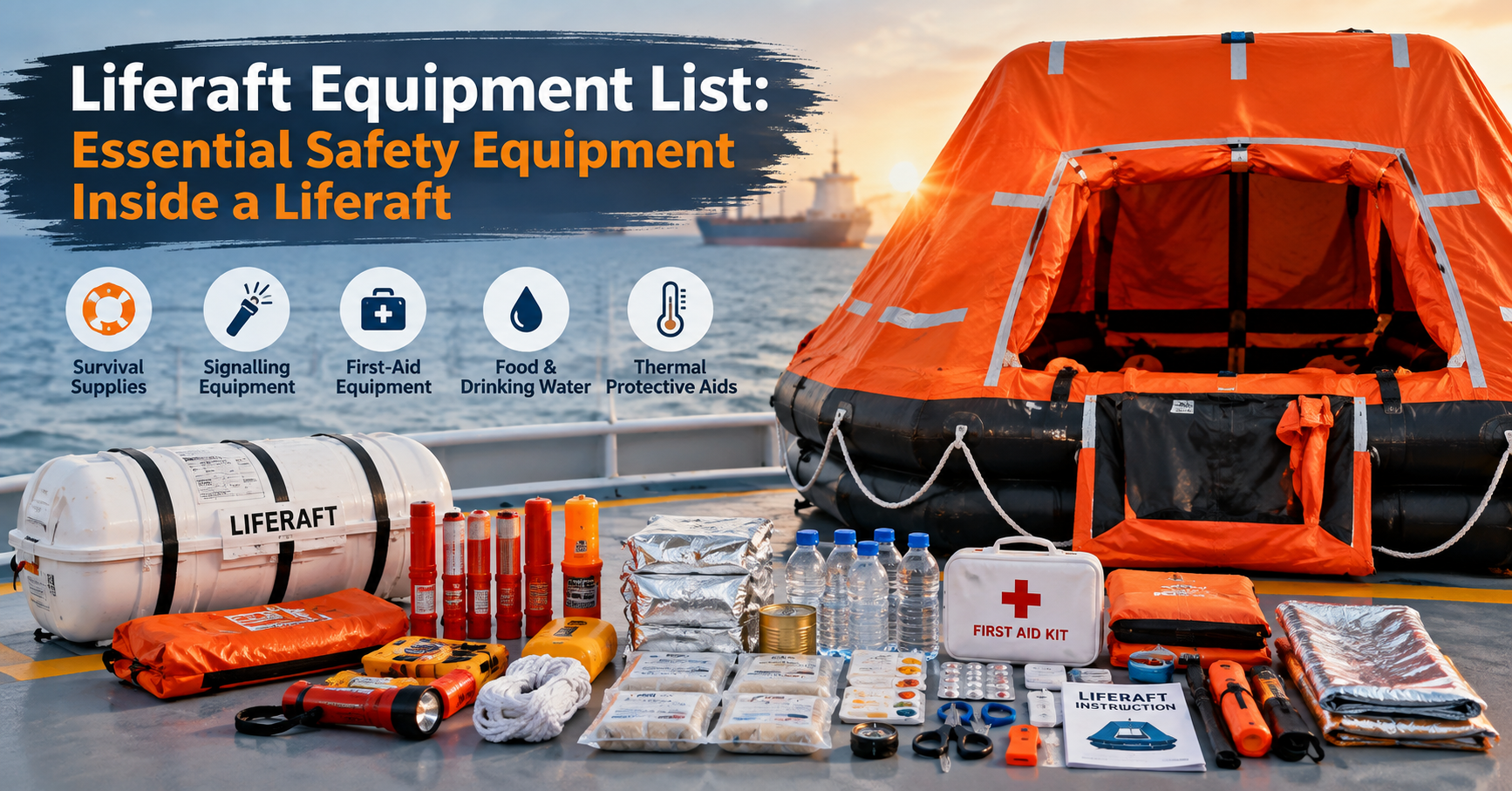
Liferaft Equipment List: Essential Safety Equipment Inside a Liferaft
A liferaft is one of the most
important life-saving appliances (LSA) carried onboard a commercial
vessel. In an emergency such as vessel abandonment, fire, collision, flooding
or sinking, the liferaft provides temporary survival space for crew and
passengers until rescue assistance arrives.
However, the liferaft itself is
only one part of the survival system. The equipment packed inside the liferaft
plays an equally important role. Drinking water, emergency food, first-aid
supplies, signalling equipment, sea anchors, paddles, thermal protective aids
and other equipment are intended to support survival and help rescuers locate
the occupants.
For shipowners, ship managers,
technical superintendents and vessel operators, knowing the liferaft
equipment list is important for ensuring that the raft remains properly
equipped, serviced and ready for deployment.
This guide explains the essential
equipment normally associated with a SOLAS liferaft, why each item is
important, and how professional liferaft servicing and inspection helps
maintain the readiness of these life-saving appliances.
Liferaft Equipment List
A typical SOLAS liferaft contains a
range of equipment covering survival, signalling, communication, first aid and
emergency operations.
Below is a practical overview of
the major categories.
1. Buoyant Rescue Quoit and Buoyant Line
A buoyant rescue quoit with buoyant
line is intended to assist in rescuing a person who has fallen into the water.
It can be thrown toward a person in
the water while the line provides a means of assisting the person back toward
the liferaft.
The LSA Code specifies requirements
for the rescue quoit and associated buoyant line.
2. Liferaft Safety Knife
A safety knife is provided for
emergency use inside or around the liferaft.
It can be required for tasks such
as:
- Cutting rope or lines
- Releasing equipment
- Emergency operations
- Cutting material when necessary
The approved liferaft equipment
configuration determines the type and number of knives provided.
3. Buoyant Bailer
A buoyant bailer is used to remove
water from inside the liferaft.
Even a small amount of water
entering the raft can create discomfort and affect the occupants' ability to
remain dry. A bailer allows survivors to remove accumulated water manually.
The number of bailers can depend on
the permitted capacity of the liferaft.
4. Sponges
Sponges are simple but useful
survival equipment.
They can be used to absorb and
remove smaller amounts of water from inside the liferaft and assist occupants
in keeping the raft's interior as dry as possible.
5. Sea Anchors
Sea anchors are important for
maintaining the liferaft's position and orientation in the water.
They help:
- Reduce drifting
- Improve stability
- Keep the liferaft oriented relative to the sea
- Reduce the effects of wind and waves
The normal LSA Code equipment
arrangement includes two sea anchors, subject to the applicable liferaft
arrangement and requirements.
6. Buoyant Paddles
Paddles provide occupants with a
basic means of manoeuvring the liferaft.
They can be used to:
- Move away from immediate danger
- Assist with positioning
- Manoeuvre near a vessel or rescue craft
- Help occupants control the raft when conditions
permit
Paddles are particularly useful
when the liferaft needs to be moved manually.
7. Tin Openers and Scissors
Food rations supplied in a liferaft
may require opening equipment.
Tin openers and scissors are
therefore included in the survival equipment pack according to the applicable
requirements.
These simple items can become
extremely important when survivors need to access emergency food or other
packaged supplies.
8. First-Aid Kit
A waterproof first-aid outfit is
carried for treating minor injuries and providing basic medical assistance.
Possible emergency situations
include:
- Cuts
- Minor wounds
- Bruises
- Small injuries sustained during evacuation
- Minor medical emergencies
The first-aid equipment should
remain properly sealed, protected and within its applicable validity or
inspection requirements.
9. Whistle or Sound Signalling Device
A whistle or equivalent sound
signalling device provides survivors with a simple way to attract attention.
Sound signalling can be useful
when:
- A rescue vessel is nearby
- Visibility is poor
- Survivors need to attract attention
- Visual signalling is difficult
10. Rocket Parachute Flares
Rocket parachute flares are visual
distress signalling equipment designed to help rescuers locate survivors from a
distance.
They can provide a high-visibility
signal that may be seen by:
- Ships
- Rescue vessels
- Aircraft
- Search and rescue teams
Pyrotechnic equipment has a limited
validity period, so expiry dates and condition should be checked during
liferaft servicing.
11. Hand Flares
Hand flares provide another method
of visual distress signalling.
They are intended for use when a
rescue vessel, aircraft or other potential rescuer is within visual range.
During inspection and servicing,
pyrotechnics should be checked for:
- Expiry date
- Physical damage
- Corrosion
- Packaging condition
- Correct quantity
Expired or damaged pyrotechnics
should be handled and replaced in accordance with applicable requirements and
approved procedures.
12. Buoyant Smoke Signals
Buoyant smoke signals can help
identify a survivor's location, particularly during daylight.
Smoke signals can create a visible
marker on the sea and may assist search and rescue teams in locating the
liferaft.
13. Waterproof Electric Torch
A waterproof electric torch is used
for illumination and can also support signalling.
A liferaft torch may be suitable
for Morse signalling, with spare batteries and a spare bulb or equivalent
arrangement as required by the applicable equipment configuration.
This equipment should be checked
during servicing to ensure that it remains operational.
14. Radar Reflector
A radar reflector can increase the
radar visibility of the liferaft to nearby vessels.
This can be particularly important
when:
- Visibility is poor
- The sea state is rough
- The liferaft is difficult to see visually
- Rescue vessels are searching using radar
Depending on the approved
arrangement, a radar reflector may be provided unless an alternative approved
search-and-rescue locating device arrangement applies.
15. Signalling Mirror
A daylight signalling mirror is
used to attract the attention of ships and aircraft.
When sunlight is available, a
signalling mirror can produce a visible flash that may be detected from a
considerable distance.
Instructions for using the mirror
are also provided as part of the survival equipment arrangement.
16. Lifesaving Signals
A copy of the applicable lifesaving
signals is provided on a waterproof card or in another suitable protected
format.
This helps survivors understand
recognised signals used for communicating with search and rescue personnel.
17. Fishing Tackle
Fishing tackle is included in the
normal liferaft equipment specified by the LSA Code.
It is intended as an additional
survival resource when rescue is delayed.
While fishing equipment may not be
the first item considered during an emergency, it forms part of the wider
survival provisions carried in the liferaft.
18. Emergency Food Rations
Emergency food rations provide an
energy source for survivors while they are awaiting rescue.
The rations are designed for:
- Long shelf life
- Emergency storage
- Easy distribution
- Protection against water and contamination
During servicing, food ration
packaging and validity should be checked and expired supplies replaced.
19. Emergency Drinking Water
Fresh drinking water is one of the
most important items in a survival situation.
The liferaft's approved equipment
pack includes emergency drinking water in the required quantity or an approved
desalination arrangement where applicable.
Water supplies should be checked
for:
- Expiry or recommended replacement date
- Packaging condition
- Leakage
- Correct quantity
- Proper storage
20. Graduated Drinking Vessel
A graduated drinking vessel allows
drinking water to be distributed in controlled quantities.
This is important when survivors
have limited fresh water and need to manage their supplies until rescue.
21. Anti-Seasickness Medicine
Seasickness can significantly
affect survivors' ability to remain comfortable and functional in a liferaft.
Anti-seasickness medicine is
therefore included in the applicable survival equipment pack.
The medicine should be checked for:
- Expiry date
- Packaging condition
- Required quantity
- Instructions for use
22. Seasickness Bags
Seasickness bags provide a hygienic
way for occupants to manage seasickness inside the liferaft.
They are a small item but can make
the survival environment more manageable for occupants during prolonged periods
at sea.
23. Survival Instructions
Survival instructions provide
guidance to occupants on how to manage the liferaft and improve their chances
of survival.
These instructions can cover
matters such as:
- Organising occupants
- Managing water and food
- Using signalling equipment
- Maintaining the liferaft
- Protecting occupants from exposure
- Attracting rescuers
The instructions should be
protected from water and remain legible.
24. Instructions for Immediate Action
Emergency instructions help
occupants understand what actions should be taken immediately after entering
the liferaft.
During an emergency, clear
instructions are especially important because occupants may be dealing with
stress, injuries, rough seas or poor visibility.
25. Thermal Protective Aids
Thermal protective aids help reduce
heat loss and protect survivors from cold environmental conditions.
They are particularly important
when:
- Water temperature is low
- Survivors are exposed to wind
- Rescue is delayed
- Occupants are wet after evacuation
The quantity and arrangement of
thermal protective aids must comply with the applicable requirements for the
liferaft.
Liferaft Equipment Checklist
For practical inspection purposes,
a liferaft equipment checklist can include the following categories:
|
Equipment |
Main Purpose |
|
Rescue quoit & buoyant line |
Rescue of persons in water |
|
Safety knife |
Emergency cutting |
|
Buoyant bailer |
Removing water |
|
Sponges |
Removing small amounts of water |
|
Sea anchors |
Stability and reducing drift |
|
Paddles |
Manual manoeuvring |
|
Tin openers/scissors |
Opening supplies |
|
First-aid kit |
Basic medical treatment |
|
Whistle |
Sound signalling |
|
Rocket parachute flares |
Long-distance distress signalling |
|
Hand flares |
Visual distress signalling |
|
Buoyant smoke signals |
Daylight location marking |
|
Waterproof torch |
Lighting/signalling |
|
Radar reflector |
Improving radar detection |
|
Signalling mirror |
Daylight signalling |
|
Lifesaving signals |
Recognised emergency signalling |
|
Fishing tackle |
Additional survival resource |
|
Food rations |
Emergency nutrition |
|
Drinking water |
Hydration |
|
Drinking vessel |
Controlled water distribution |
|
Anti-seasickness medicine |
Managing seasickness |
|
Seasickness bags |
Hygiene |
|
Survival instructions |
Survival guidance |
|
Immediate-action instructions |
Emergency response |
|
Thermal protective aids |
Protection from cold |
Important: The exact
equipment and quantities should always be verified against the liferaft's
approved equipment pack, manufacturer's documentation, applicable flag-state
requirements and current regulatory requirements. The LSA Code specifies the
normal equipment of liferafts, while SOLAS establishes the broader framework
for life-saving appliances and their operational readiness.
Why Liferaft Equipment Inspection Is Important
Having a liferaft onboard does not
automatically mean that the survival craft is ready for an emergency.
Equipment can deteriorate due to:
- Age
- Moisture
- Salt exposure
- Temperature
- Packaging damage
- Expiry of consumables
- Corrosion
- Improper storage
- Physical damage
- Lack of servicing
For this reason, regular inspection
and servicing are essential.
SOLAS Chapter III includes
requirements concerning the operational readiness, maintenance and inspection
of life-saving appliances. The IMO also identifies the LSA Code as the source
of detailed technical requirements concerning the manufacture, testing,
maintenance and record keeping of life-saving appliances.
Liferaft Servicing and Equipment Inspection
Professional liferaft servicing
goes beyond simply opening and repacking the raft.
Depending on the liferaft,
manufacturer requirements and applicable servicing procedures, inspection can
include:
Liferaft container inspection
The container, markings and
securing arrangements are checked for condition and suitability.
Inflation and leakage checks
The inflatable chambers and
associated components are inspected and tested according to applicable
servicing procedures.
Emergency equipment inspection
The equipment pack is checked
against the approved configuration.
Expiry-date inspection
Items such as food, water,
medicines and pyrotechnics are checked for applicable expiry or replacement
dates.
CO2 cylinder inspection
The inflation system and cylinder
are checked as required by the applicable servicing procedure.
HRU inspection
Where fitted, the Hydrostatic
Release Unit and float-free arrangement are checked according to applicable
requirements.
Repairs
Damaged components can be repaired
or replaced using approved procedures and suitable materials.
Repacking
After servicing, the liferaft is
correctly repacked so that it remains ready for deployment.
Certification and documentation
Applicable servicing documentation
and certification are completed after the inspection.
Why Choose Marinetech Safety Pvt. Ltd. for Liferaft Servicing?
Marinetech Safety Pvt. Ltd.
is an India-based marine safety equipment service and supply company supporting
shipowners, ship managers and vessel operators with marine safety services and
equipment.
Our website identifies liferaft
servicing capabilities including inspection, maintenance, repacking,
certification and emergency repairs. The company also lists class approvals and
manufacturer approvals associated with its liferaft servicing activities.
Marinetech's liferaft servicing
capabilities include:
- Annual liferaft inspection and servicing
- Five-yearly inspection as applicable
- GI testing
- NAP testing
- Floor seam testing
- Liferaft inspection and maintenance
- Repacking
- Emergency repairs
- Certification-related services
- Liferaft equipment inspection
- Liferaft accessories and equipment supply
Marinetech's service page currently
lists approvals/recognition involving ABS, BV, RINA, DNV GL, ClassNK, IRS,
DGS, Lloyd's Register, Korean Register and CCS, together with manufacturer
approvals for various liferaft brands. Applicable approval scope should always
be confirmed for the specific liferaft make, model and service requirement.
Liferaft Equipment Supply in India
In addition to servicing,
Marinetech Safety Pvt. Ltd. supplies liferaft equipment and accessories for
marine applications.
The company's listed liferaft and
accessory range includes items such as:
- Emergency drinking water
- Emergency food rations
- Paddles
- FRP repair kits
- First-aid kits
- Anti-seasickness tablets
- Seasickness bags
- Hatchets
- Liferafts
- Liferaft accessories
This makes it possible for
shipowners and vessel operators to source both liferaft servicing and marine
safety equipment from an India-based marine service and supply company.
Liferaft Servicing in India
For shipowners and managers,
choosing a service provider with appropriate technical capability and approval
coverage is important.
Marinetech Safety Pvt. Ltd.
supports marine customers across major Indian maritime locations and provides
marine safety equipment services and supplies.
For detailed information about
inspection procedures, testing, repacking, certification and available service
capabilities, visit our:
Liferaft
Servicing Service Page
If your vessel requires liferaft
inspection, servicing, equipment replacement or related marine safety equipment
supply, Marinetech can assist with the applicable service requirements.
Liferaft Equipment and SOLAS Compliance
A liferaft's equipment should not
be treated as a simple checklist of miscellaneous emergency items.
Every item has a specific survival
purpose.
The combination of:
- Liferaft construction
- Inflation system
- Sea anchors
- Emergency equipment
- Signalling equipment
- Food and water
- Medical supplies
- Thermal protection
- Instructions
- Proper stowage
- Regular inspection
- Correct servicing
helps ensure that the survival
craft remains ready for its intended emergency function.
SOLAS and the International LSA
Code establish the regulatory framework for life-saving appliances, while the
exact equipment configuration must be verified against the approved liferaft,
manufacturer instructions and applicable flag-state requirements.
Frequently Asked Questions About Liferaft Equipment
1. What equipment is inside a SOLAS liferaft?
A SOLAS liferaft normally contains
survival and emergency equipment such as a rescue quoit and line, safety knife,
bailer, sponges, sea anchors, paddles, first-aid equipment, signalling
equipment, food, drinking water, seasickness medication, survival instructions
and thermal protective aids. The exact equipment and quantities depend on the
applicable approved configuration.
2. What is the most important equipment inside a liferaft?
No single item should be considered
the only essential item. Different equipment serves different survival
functions. Drinking water and food support survival, signalling equipment helps
rescuers locate survivors, first-aid equipment supports injured occupants,
while sea anchors and paddles assist with liferaft control.
3. What is SOLAS A Pack in a liferaft?
SOLAS A Pack refers to the
equipment configuration specified for liferafts under the applicable LSA Code
requirements. Liferaft equipment configurations can differ according to the
applicable requirements and approved arrangement, so the marking and manufacturer's
documentation should be checked.
4. How often should a liferaft be serviced?
Inflatable liferafts are generally
subject to periodic servicing at an approved or appropriately authorized
service station in accordance with applicable IMO, flag-state and manufacturer
requirements. The servicing interval should always be verified for the specific
liferaft.
5. What is checked during liferaft servicing?
Depending on the applicable
servicing procedure, inspection can include the liferaft container, inflation
system, fabric and seams, leakage, emergency equipment, pyrotechnics, food and
water, first-aid supplies, CO2 cylinder, HRU where fitted, repairs, repacking
and documentation.
6. Why do liferaft food and water need inspection?
Food, water and other consumable
items have shelf-life or replacement requirements. Damaged, expired or
deteriorated supplies may not be suitable for an emergency, so they should be
checked and replaced according to applicable servicing requirements.
7. Can Marinetech Safety Pvt. Ltd. supply liferaft equipment?
Yes. Marinetech Safety Pvt. Ltd.
provides liferaft equipment and accessories in addition to marine safety
equipment servicing. Its listed range includes emergency water and rations,
paddles, first-aid kits, anti-seasickness supplies and other liferaft accessories.
8. Where can I get liferaft servicing in India?
Marinetech Safety Pvt. Ltd.
provides liferaft servicing and inspection support in India. For information
about its service capabilities, approvals, inspection procedures and locations,
visit the Liferaft Servicing service page on the Marinetech website.
Related Marine Safety Blogs
Continue learning about liferafts
and marine safety:
- SOLAS Chapter III: Liferaft Requirements for
Merchant Ships
Learn about liferaft capacity, stowage, equipment, HRUs, inspection and servicing requirements. - Liferaft Service in Mumbai: SOLAS Requirements,
Inspection & Certification
Understand liferaft inspection, servicing, certification and maintenance requirements for vessels calling Mumbai and JNPT. - Liferaft Service in Chennai: SOLAS Requirements,
Inspection & Certification
A guide to liferaft servicing requirements for vessels operating around Chennai and Ennore. - Liferaft Servicing Procedures: Essential
Inspection and Maintenance Checklist
Understand the major stages involved in professional liferaft inspection and servicing. - Liferaft Davit Launching Procedure as per SOLAS
Requirements
Learn about key considerations for liferaft launching arrangements and emergency deployment. - Marine Fire Extinguisher Servicing in Chennai:
Ship Inspection, Refilling & Hydro Testing
Explore marine firefighting equipment servicing for vessels calling Chennai and Ennore.
Conclusion
A liferaft is designed to provide a
critical survival platform during a vessel emergency, but its effectiveness
depends heavily on the condition and availability of its equipment.
From drinking water, food
rations and first-aid equipment to flares, smoke signals, sea anchors,
signalling devices and thermal protective aids, every component has a
specific role in supporting survivors.
Regular inspection and professional
liferaft servicing help ensure that equipment remains available,
correctly packed and suitable for emergency use.
For shipowners, ship managers and
vessel operators looking for liferaft servicing, liferaft inspection,
liferaft equipment supply and marine safety equipment services in India,
Marinetech Safety Pvt. Ltd. provides servicing and supply solutions for marine
applications.
Need liferaft servicing or
equipment supply?
Visit the Liferaft Servicing page to learn more about our inspection,
maintenance, testing, repacking and certification-related services.
Marinetech Safety Pvt. Ltd.
Marine Safety Equipment Service & Supply | India
Navigating Safety, Supplying
Confidence