Blog Post
How to Prepare a Vessel for Panama Flag Survey and Inspection: Complete Shipowner Checklist
Posted By: Harsh Bamnolia
Posted On : 05-Sep-2026
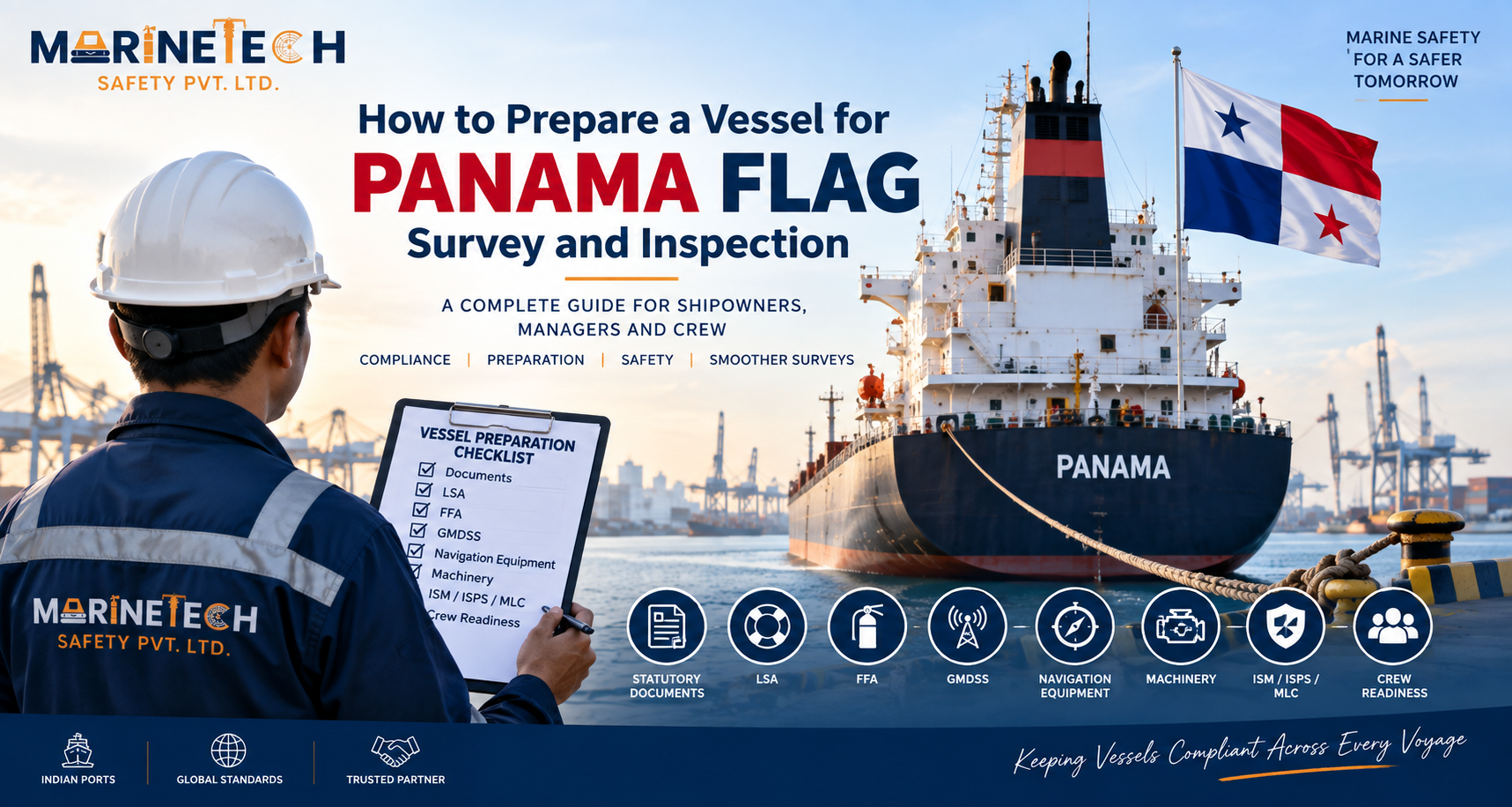
How to Prepare a Vessel for Panama Flag Survey and Inspection
For a Panama-flagged vessel, being
prepared for a Panama Flag Survey and Inspection is essential for
maintaining statutory compliance, operational readiness and smooth vessel
operations.
The Panama Maritime Authority (AMP)
conducts the Annual Safety Inspection (ASI) programme for Panama-flagged
vessels engaged in international trade. The purpose is to verify compliance
with applicable national and international maritime safety requirements.
Panama's legal framework also provides for annual safety inspections and additional
inspections where considered necessary.
A successful inspection should
therefore not be approached as a last-minute exercise. Shipowners and ship
managers should prepare the vessel well before the inspector arrives, review
certificates and records, inspect safety-critical equipment and correct
deficiencies in advance.
For vessels calling at Indian
ports, professional Panama Flag Survey and Inspection support can help
identify potential deficiencies before the official inspection.
What Is a Panama Flag Survey and Inspection?
A Panama Flag Survey or inspection
is an inspection carried out on behalf of the Panama Maritime Authority
to verify that a Panama-flagged vessel complies with applicable Panama
requirements and international maritime conventions.
The Panama Maritime Authority's
Flag State Inspection Section coordinates annual safety inspections of
Panama-flagged vessels and follows up on deficiencies identified during
inspections.
The exact scope of an inspection
can vary depending on the vessel type, statutory requirements, inspection
history, certificates, deficiencies and applicable Panama Maritime Authority
requirements.
Shipowners should therefore prepare
the vessel as a complete operational system rather than concentrating only on
individual safety appliances.
Why Proper Preparation for a Panama Flag Inspection Matters
Poor preparation can result in:
- Deficiencies being recorded during inspection
- Additional corrective actions
- Delays in completing the inspection
- Increased operational costs
- Additional follow-up inspections
- Possible impact on the vessel's compliance status
- Increased risk during subsequent Port State Control
inspections
Panama also monitors inspection
results and follows up on deficiencies identified during flag inspections.
The objective should therefore be
simple:
Identify and correct
deficiencies before the Panama Flag inspector identifies them.
Panama Flag Survey Preparation Checklist
A practical preparation programme
should cover documentation, navigation equipment, radio equipment, lifesaving
appliances, firefighting systems, machinery spaces, deck equipment,
pollution-prevention arrangements, safety management and crew readiness.
1. Review All Statutory Certificates
The first step is to conduct a
complete review of the vessel's statutory documentation.
Depending on vessel type and applicable
requirements, documents may include:
- Cargo Ship Safety Construction Certificate
- Cargo Ship Safety Equipment Certificate
- Cargo Ship Safety Radio Certificate
- International Load Line Certificate
- International Oil Pollution Prevention Certificate
- International Air Pollution Prevention Certificate
- Safety Management Certificate
- Document of Compliance
- International Ship Security Certificate
- Maritime Labour Certificate
- International Energy Efficiency Certificate
- Sewage Pollution Prevention documentation
- Anti-Fouling System documentation
- Ballast Water Management documentation
- Inventory of Hazardous Materials documentation
where applicable
- Certificates of fitness for specialised cargoes
where applicable
- Class certificate
- Relevant statutory endorsements
The Panama Maritime Authority's
certification and application systems specifically reference documents such as
DOC, SMC, ISSC, class certificates and other statutory documentation depending
on the application.
What should the ship manager verify?
Before the inspection:
- Check certificate validity.
- Confirm required endorsements are completed.
- Check that certificates correspond with the
vessel's current particulars.
- Verify that certificates are available onboard.
- Review any conditions of class.
- Check outstanding statutory deficiencies.
- Review previous survey and inspection reports.
- Confirm corrective actions have been properly
closed.
2. Review Previous Panama Flag Inspection Deficiencies
One of the most important
preparation steps is reviewing the vessel's previous inspection history.
The vessel's previous:
- Panama Flag inspection reports
- Port State Control reports
- Class survey reports
- Internal audit reports
- ISM audit reports
- ISPS audit reports
- Deficiency reports
- Corrective action records
should be reviewed before the next
inspection.
Pay particular attention to repeat
deficiencies.
A repeated deficiency can indicate
that the underlying problem was not permanently corrected.
Recommended approach
Create a simple deficiency tracking
table:
|
Deficiency |
Root Cause |
Corrective Action |
Responsible Person |
Due Date |
Status |
|
Fire extinguisher condition |
Maintenance gap |
Service/replace |
Chief Officer |
Before survey |
Closed |
|
Liferaft documentation |
Certificate not onboard |
Obtain certificate |
2/E |
Before survey |
Closed |
|
Emergency lighting |
Defective unit |
Repair/replace |
ETO |
Before survey |
Closed |
This makes the preparation process
measurable and easier for the superintendent and vessel team to manage.
3. Inspect Life-Saving Appliances
Life-saving appliances are an
important part of overall vessel safety readiness.
Before a Panama Flag inspection,
verify the condition and documentation of:
- Lifeboats
- Rescue boats
- Liferafts
- Davits
- Launching appliances
- Release gear
- Lifejackets
- Immersion suits
- Lifebuoys
- Line throwing apparatus
- Emergency position-indicating radio beacons
- Search and rescue transponders
- Pyrotechnics
- Hydrostatic Release Units
- Emergency escape equipment
Check:
- Service dates
- Expiry dates
- Identification markings
- Accessibility
- Physical condition
- Securing arrangements
- Launching arrangements
- Maintenance records
- Service certificates
- Required replacement parts
Panama's published merchant marine
information includes requirements and authorisations relating to maintenance,
thorough examination, operational testing, overhaul and repair of lifeboats,
rescue boats, launching appliances and release gear.
For vessels requiring professional
LSA support before inspection, Marinetech provides marine lifesaving equipment
servicing and related technical support.
4. Check Fire Fighting Equipment
Firefighting equipment should be
inspected systematically rather than only checking whether the equipment is
physically present.
Review:
Portable Fire Extinguishers
Check:
- Correct location
- Accessibility
- Mounting
- Cylinder condition
- Pressure
- Weight where applicable
- Safety pins
- Tamper seals
- Hoses
- Nozzles
- Labels
- Service dates
- Hydrostatic testing status
Fixed Fire Fighting Systems
Depending on the vessel, inspect:
- Fixed CO2 system
- Foam system
- Water mist system
- Fixed fire pumps
- Fire main
- Hydrants
- Fire hoses
- Nozzles
- International shore connection
- Fire detection and alarm system
- Fire dampers
- Remote stops
- Emergency fire pump
Fixed CO2 systems should receive
particular attention because documentation, maintenance and safety procedures
are critical when dealing with stored extinguishing gas.
For additional technical
information, shipowners can refer to Marinetech's guide on IMO
MSC.1/Circ.1318/Rev.1 and fixed CO2 fire-extinguishing system inspection.
5. Prepare the GMDSS and Radio Equipment
Radio communication equipment
should be fully operational and supported by valid documentation.
Depending on vessel configuration
and trading area, review:
- VHF
- VHF DSC
- MF/HF
- DSC
- Inmarsat or applicable satellite communication
equipment
- NAVTEX
- EPIRB
- SART/AIS-SART
- Portable GMDSS VHF radios
- GMDSS reserve batteries
- Antennas
- Emergency power supply
- Radio log
- Test records
Check that:
- Equipment is operational.
- Batteries are within required validity.
- EPIRB and SART tests are current.
- GMDSS certificates are valid.
- Radio log entries are complete.
- Required spare equipment is available.
- Emergency communication procedures are understood
by responsible crew.
Marinetech provides GMDSS Radio
Survey and Inspection support for vessels at major Indian ports.
6. Check Navigation Equipment
Navigation equipment should be
tested before the inspector arrives.
Depending on the vessel's equipment
arrangement, review:
- Radar
- ECDIS
- GPS/GNSS
- AIS
- Gyro compass
- Magnetic compass
- Echo sounder
- Speed log
- BNWAS
- Autopilot
- Navigation lights
- Sound signalling equipment
- Steering gear
- Bridge alarms
- Voyage data recorder
Pay attention to equipment that has
recently been repaired.
Ensure that:
- Repairs are documented.
- Calibration certificates are current where
applicable.
- Navigation equipment is operational.
- Backup arrangements are available.
- Bridge checklists are completed.
- Alarm systems function correctly.
7. Check Lifeboat, Rescue Boat and Davit Arrangements
The condition of lifeboats and
launching appliances can have a significant impact on vessel safety.
Inspect:
- Lifeboat structure
- Engine
- Fuel system
- Starting arrangements
- Battery
- Steering system
- Bilge arrangement
- Release gear
- Falls
- Hooks
- Davit wires
- Winches
- Limit switches
- Brake arrangements
- Remote controls
- Embarkation arrangements
- Boat equipment
- Painter
- Drain plugs
- Emergency lighting
Maintenance, inspection and testing
should be carried out according to the applicable statutory requirements,
manufacturer's instructions and authorised servicing arrangements.
8. Inspect Deck Machinery and Safety Equipment
The deck should be clean, organised
and operationally safe.
Inspect:
- Mooring equipment
- Anchors
- Anchor chains
- Windlass
- Mooring winches
- Fairleads
- Rollers
- Deck machinery
- Gangways
- Pilot ladder
- Accommodation ladder
- Guardrails
- Handrails
- Access arrangements
- Hatch covers
- Emergency escape routes
Check for:
- Corrosion
- Damaged wires
- Oil leakage
- Missing guards
- Poor housekeeping
- Improper securing
- Damaged safety signs
- Unsafe access
A clean and well-maintained deck
makes it easier to demonstrate that the vessel is being actively managed.
9. Review Machinery Space Condition
The engine room should be inspected
before the Flag State inspector boards.
Particular attention should be
given to:
- Oil leakage
- Fuel leakage
- Exhaust insulation
- Hot surfaces
- Bilge condition
- Bilge alarms
- Emergency stops
- Quick-closing valves
- Fuel shut-off arrangements
- Fire pumps
- Emergency fire pump
- Emergency generator
- Emergency lighting
- Ventilation arrangements
- Machinery guards
- Electrical panels
- Alarm systems
Oil contamination around machinery
should be corrected immediately.
Unsafe hot surfaces and leaking
fuel or lubricating oil can create significant fire risks.
10. Verify Emergency Equipment and Drills
The crew should be familiar with
emergency procedures.
Review records for:
- Fire drills
- Abandon-ship drills
- Enclosed-space rescue drills
- Steering gear drills
- Emergency generator tests
- Emergency fire pump tests
- Security drills
- Pollution response exercises
The inspector may also assess
whether crew members understand their emergency duties.
Therefore, simply having a drill
record is not enough.
The crew should be able to explain:
- Their emergency station
- Their assigned duties
- How to raise an alarm
- Where emergency equipment is located
- How to use relevant equipment
- Who is responsible for specific emergency actions
11. Review ISM and Safety Management Documentation
The vessel's Safety Management
System should reflect actual onboard practices.
Review:
- SMS procedures
- Checklists
- Risk assessments
- Permit-to-work records
- Maintenance records
- Non-conformity reports
- Near-miss reports
- Internal audit reports
- Master review
- Safety meeting records
- Training records
- Drill records
- Corrective actions
A common problem is a difference
between what the SMS says and what the vessel actually does.
For example, if the SMS requires a
particular inspection every month, the vessel should have evidence that the
inspection was actually performed.
12. Check ISPS and Security Arrangements
Security arrangements should also
be reviewed before inspection.
Check:
- Ship Security Plan implementation
- Access control
- Gangway security
- Visitor records
- Restricted areas
- Security equipment
- Ship Security Alert System
- Security drills
- Security records
- Identification arrangements
- Lighting
- CCTV where applicable
The Panama Maritime Authority's
certification processes reference ISSC, SMC, ISPS audits and Ship Security Plan
documentation for relevant applications.
13. Review MLC and Crew Welfare Requirements
Crew welfare should not be
overlooked during Flag State preparation.
Review:
- Crew accommodation
- Sanitary facilities
- Galley
- Food storage
- Drinking water
- Medical supplies
- Recreational facilities
- Working and rest hour records
- Seafarer employment agreements
- MLC documentation
- Complaint procedures
- Occupational safety arrangements
Deficiencies in crew welfare can
become a serious compliance issue even when the vessel's technical equipment is
in good condition.
14. Check Pollution Prevention Equipment
Environmental compliance should be
included in the inspection preparation programme.
Depending on vessel type, review:
- Oil Record Book
- Garbage Record Book
- Ballast Water Record Book
- Ballast Water Management Plan
- Sewage arrangements
- Oily water separator
- 15 ppm alarm
- Oil discharge monitoring equipment where applicable
- SOx compliance arrangements
- NOx documentation
- IAPP
- EIAPP
- SEEMP
- Energy efficiency documentation
- Garbage management plan
- Oil spill equipment
The Panama Maritime Authority's
published certification framework includes MARPOL-related certificates such as
IOPP, IAPP, NOx/EIAPP and energy-efficiency documentation.
15. Check Cargo Gear and Lifting Appliances
For vessels fitted with cranes,
derricks or other lifting appliances, review:
- Crane certificates
- SWL markings
- Wire ropes
- Hooks
- Shackles
- Limit switches
- Brakes
- Hydraulic systems
- Safety devices
- Load test certificates
- Thorough examination records
Where testing or examination is
due, arrange it well before the Flag State inspection.
Marinetech also provides Cargo
Gear Load Testing services for applicable marine lifting equipment.
16. Verify Calibration and Testing Certificates
Expired calibration certificates
can create avoidable compliance problems.
Review calibration status for
applicable instruments such as:
- Pressure gauges
- Temperature gauges
- Gas detectors
- Portable measuring instruments
- Navigation instruments
- Electrical testing equipment
- Safety monitoring equipment
Maintain traceable calibration
documentation and ensure that instruments requiring periodic calibration are
not overdue.
17. Conduct a Pre-Panama Flag Inspection
One of the most effective ways to
prepare is to conduct an independent pre-inspection.
A pre-Panama Flag inspection should
simulate the official inspection as closely as practical.
The inspection should cover:
Documentation ? Deck ? Bridge ?
Accommodation ? Engine Room ? LSA ? FFA ? GMDSS ? Navigation ? Security ?
Pollution Prevention ? Crew Familiarisation
The objective is to identify
deficiencies before the official Panama Flag inspector arrives.
Recommended classification of
findings
Critical: Immediate action
required.
Major: Correct before
official inspection.
Minor: Correct and monitor.
Documentation: Update
certificates, records or evidence.
Common Problems Found During Vessel Inspections
Although every vessel is different,
shipowners should pay particular attention to recurring areas such as:
- Expired safety equipment
- Missing certificates
- Incomplete maintenance records
- Damaged fire hoses
- Defective fire extinguishers
- Expired pyrotechnics
- Liferaft service deficiencies
- Lifeboat maintenance problems
- GMDSS battery issues
- Defective navigation equipment
- Oil leakage
- Poor engine-room housekeeping
- Damaged electrical cables
- Emergency lighting problems
- Defective alarms
- Poor access arrangements
- Missing safety signs
- Incomplete drill records
- Inconsistent SMS implementation
The best strategy is to identify
these issues during the vessel's own pre-inspection instead of waiting for the
Flag State inspector.
How Marinetech Safety Pvt. Ltd. Supports Panama Flag Survey Preparation
Marinetech Safety Pvt. Ltd.
is an India-based marine safety equipment servicing and supply company
supporting shipowners, ship managers and vessel operators at major Indian
maritime locations.
Marinetech's current service
portfolio includes:
- Flag Surveys and Audit Inspections
- Lifesaving & Firefighting Appliances Service
- Lifeboat Servicing
- Liferaft Servicing
- GMDSS Radio Survey
- VDR Annual Performance Test
- Calibration
- Cargo Gear Load Testing
- BWMS Sales & Service
- Electronic & Navigation Communication Service
- Electronic Automation Service
- Gas Detection Service
- Gyro Sphere & Magnetic Compass Calibration
The company also supplies marine
safety, lifesaving, firefighting, navigation and communication equipment.
Marinetech's published Flag
Surveys and Audit Inspections service includes Initial, Annual and Renewal
Flag State Inspections, Pre-registration Inspections, Safety Inspections,
ISM/ISPS Audits, MLC Inspections, Condition Surveys and PSC preparation
assistance. The company states that it performs flag surveys on behalf of
Panama and Liberia.
For shipowners and managers looking
for professional Panama Flag Survey and Inspection support in India, the
dedicated [Panama Flag Survey and Inspection service] can be used to discuss
the vessel's flag, port, inspection type, equipment condition and survey
requirements.
Panama Flag Survey Services at Indian Ports
Vessels operating through Indian
ports can require survey and technical support within a limited port-call
window.
Depending on vessel location and
service scope, support can be planned around ports and maritime locations such
as:
- Mumbai
- JNPT / Nhava Sheva
- Mundra
- Kandla
- Hazira
- Surat
- Sikka
- Jamnagar
- Chennai
- Visakhapatnam
- Paradip
The advantage of coordinating
inspection preparation with a marine service company is that equipment
deficiencies can potentially be identified and addressed during the same port
call.
For example, a pre-survey
inspection may identify:
Expired fire extinguishers ?
servicing
Liferaft due for service ?
authorised servicing
GMDSS deficiency ? radio
inspection/repair
Navigation instrument issue ?
testing/calibration
Cargo gear test due ? load
testing
This integrated approach can reduce
the risk of discovering multiple deficiencies immediately before or during the
Flag State inspection.
Frequently Asked Questions About Panama Flag Survey and Inspection
1. What is a Panama Flag Survey?
A Panama Flag Survey or Flag State
Inspection is an inspection of a Panama-flagged vessel to verify compliance
with applicable Panama national requirements and international maritime
conventions. Panama's legal framework provides for annual safety inspections of
registered vessels, subject to applicable exceptions.
2. How often is a Panama Flag Annual Safety Inspection required?
Panama's published information
identifies the Annual Safety Inspection programme for Panama-flagged vessels
engaged in international trade. The exact applicability and inspection
arrangements should be confirmed against the vessel's current Panama Maritime
Authority requirements.
3. What documents should be prepared for a Panama Flag inspection?
Shipowners should review the
vessel's applicable statutory certificates, class documentation, ISM/ISPS
records, safety records, inspection reports, maintenance records and
certificates for safety equipment. The exact documents depend on vessel type
and applicable requirements.
4. What equipment should be checked before a Panama Flag inspection?
The vessel should review lifesaving
appliances, firefighting equipment, GMDSS, navigation equipment, emergency
systems, machinery safety arrangements, pollution-prevention equipment, cargo
gear where applicable and other safety-critical systems.
5. Can a vessel undergo a pre-Panama Flag inspection?
Yes. A pre-inspection can be used
as a preparation exercise to identify deficiencies before the official Flag
State inspection. It should be aligned with the vessel's applicable statutory
and flag-state requirements.
6. Can Marinetech Safety Pvt. Ltd. assist with Panama Flag Survey preparation?
Yes. Marinetech Safety Pvt. Ltd.
provides Flag Surveys and Audit Inspections and states that it performs flag
surveys on behalf of Panama and Liberia. Its broader marine service portfolio
can also support lifesaving, firefighting, GMDSS, calibration, cargo gear and
other vessel safety requirements.
7. Where does Marinetech provide Panama Flag Survey support?
Marinetech supports vessels at
major Indian maritime locations. Service planning can be coordinated around the
vessel's port call and the required inspection or technical scope.
8. What should a ship manager do if deficiencies are found before the inspection?
The deficiency should be
documented, assigned to a responsible person, corrected within the required
timeframe and supported by appropriate testing, service records or certificates
where applicable. Previous deficiencies should also be reviewed to ensure that
recurring problems have been permanently addressed.
Related Blogs
1. Flag State Surveys & ISM / ISPS Audits for Ships in India 2026: Complete Guide
A detailed guide covering Flag
State surveys, ISM audits, ISPS verification and vessel inspection preparation
in India. Flag
State Surveys & ISM / ISPS Audits for Ships in India
2. GMDSS Radio Survey in India 2026: The Complete Guide
Useful for shipowners preparing
GMDSS equipment and radio documentation before statutory surveys and
inspections. GMDSS
Radio Survey in India 2026
3. Marine Fire Extinguisher Servicing Before Safety Survey
Covers inspection, servicing,
refilling and hydrostatic testing of marine fire extinguishers before vessel
safety inspections. Marine
Fire Extinguisher Servicing Before Safety Survey
4. IMO MSC.1/Circ.1318/Rev.1 Explained: Fixed CO2 Fire Extinguishing System Inspection
A useful resource for shipowners
and technical managers responsible for fixed CO2 system inspection and
maintenance. IMO
MSC.1/Circ.1318/Rev.1 Explained
5. Liferaft Service in Mumbai: SOLAS Requirements, Inspection & Certification
Explains liferaft inspection,
servicing, HRU checks, certification and documentation. Liferaft
Service in Mumbai
Contact Marinetech Safety Pvt. Ltd.
Panama Flag Survey & Inspection
| Marine Safety Equipment Service & Supply
Phone: +91 72270 38216 | +91
79 7743 0002
Email: info@marinetechss.com
Visit Marinetech Safety
Pvt. Ltd.
Request a Free Quote for your
vessel's Panama Flag Survey and Inspection requirements.