Blog Post
CO2 vs Dry Powder Fire Extinguisher: Which Is Best for Marine Electrical Fire?
Posted By: Harsh Bamnolia
Posted On : 07-Sep-2026
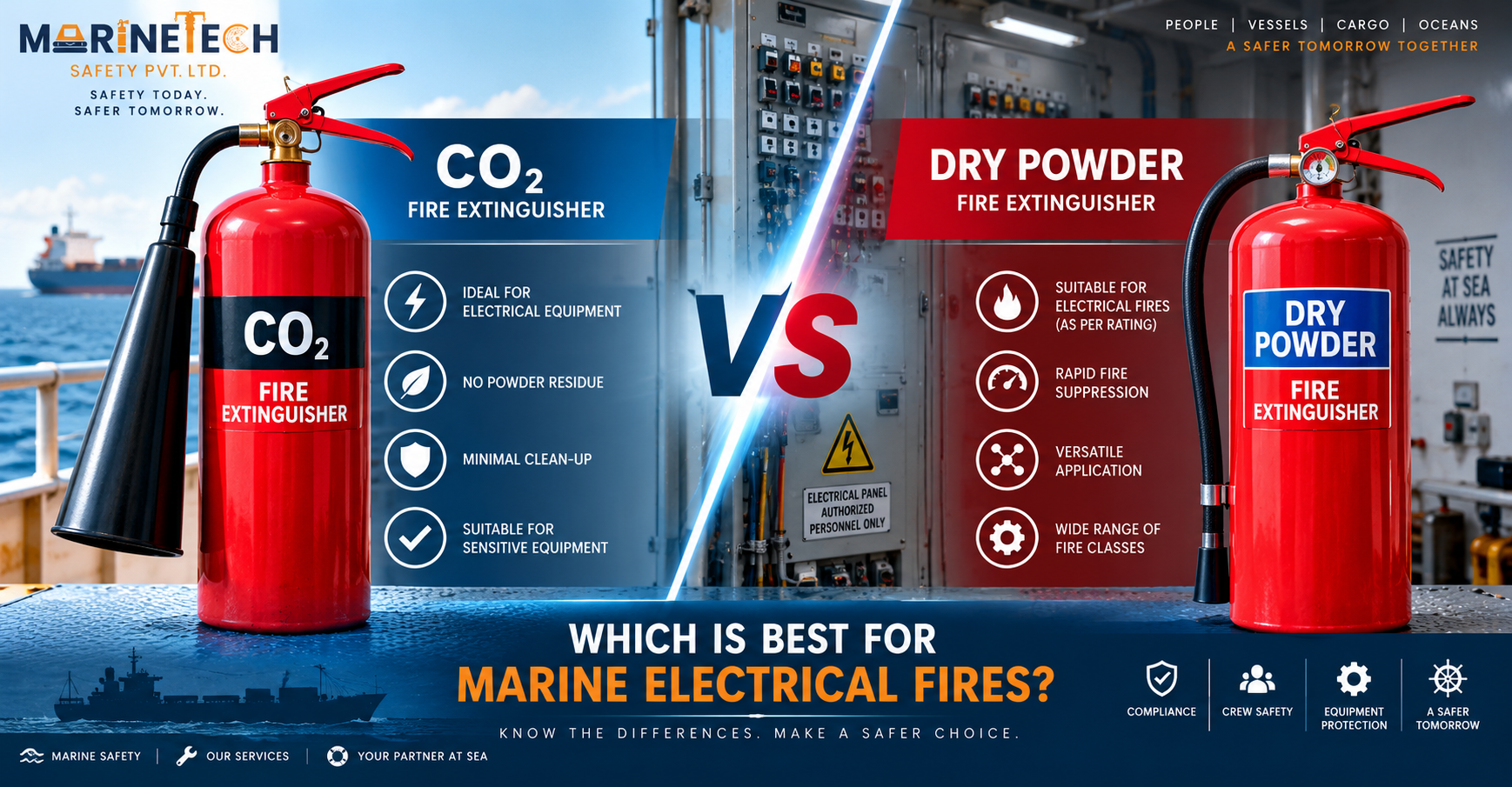
CO2 vs Dry Powder Fire Extinguisher: Which Is Best for Marine Electrical Fire?
Electrical equipment is found
throughout modern ships — from engine-room control panels and switchboards to
navigation equipment, communication systems, electrical motors and distribution
boards. When an electrical fire occurs onboard, selecting the correct fire
extinguisher is critical because the extinguishing agent must control the fire
without creating additional hazards for personnel or sensitive equipment.
Two commonly considered portable
extinguishers for electrical fire risks are CO2 (carbon dioxide) fire
extinguishers and dry powder fire extinguishers.
But which one is better for marine
electrical fires?
The answer depends on the type of
equipment involved, the surrounding fire risk, the possibility of re-ignition,
ventilation, clean-up requirements and the vessel's approved fire-fighting
arrangements.
For many enclosed
electrical-equipment fires, CO2 is often preferred because it leaves no
residue, while dry powder can provide rapid flame knockdown and has a wider
range of fire classifications. However, dry powder may create visibility and
clean-up problems and can contaminate sensitive electrical equipment.
For shipowners and managers,
choosing the right extinguisher is only one part of the equation. Regular
inspection, servicing, refilling, hydrostatic testing and certification of
marine fire extinguishers are equally important.
CO2 vs Dry Powder Fire Extinguisher: Quick Comparison
|
Feature |
CO2 Fire Extinguisher |
Dry Powder Fire Extinguisher |
|
Suitable for electrical fires |
Yes, when appropriately rated and
used |
Yes, depending on extinguisher
rating and application |
|
Residue after discharge |
No significant residue |
Yes |
|
Damage to sensitive electrical
equipment |
Low from residue |
Powder can enter equipment and
require extensive cleaning |
|
Flame knockdown |
Good |
Very rapid |
|
Cooling effect |
Limited |
Limited compared with water-based
agents |
|
Re-ignition risk |
Can occur if the heat source
remains |
Can occur if the heat source
remains |
|
Visibility during discharge |
Can be affected by CO2 discharge |
Powder cloud can significantly
reduce visibility |
|
Clean-up |
Minimal |
Required |
|
Common marine application |
Electrical panels,
machinery/electrical equipment where approved |
General-purpose Class A/B/C risks
depending on agent and rating |
|
Main concern |
Personnel exposure and
re-ignition |
Residue, visibility and equipment
contamination |
Important: The extinguisher
type, capacity, fire rating and installation onboard should always match the
vessel's approved fire-fighting arrangement, equipment manufacturer's
instructions and applicable statutory/class requirements.
What Is a CO2 Fire Extinguisher?
A CO2 fire extinguisher uses carbon
dioxide gas as the extinguishing agent. CO2 works primarily by reducing the
oxygen concentration around the flame and interrupting combustion.
One of the biggest advantages of
CO2 for electrical equipment is that it does not leave a powder or liquid
residue.
This makes CO2 particularly useful where
contamination could damage sensitive equipment.
Typical marine applications can
include:
- Electrical switchboards
- Control panels
- Motor control centres
- Electrical distribution equipment
- Navigation and electronic equipment where an
appropriately rated portable extinguisher is provided
- Machinery-space electrical equipment
However, CO2 extinguishers must be
used carefully. CO2 can create an asphyxiation hazard, particularly in
confined or poorly ventilated spaces. Personnel should never place themselves
at unnecessary risk while attempting to fight a developing fire.
Advantages of CO2 Fire Extinguishers
1. No Powder Residue
One of the main benefits of CO2 is
the absence of powder residue after discharge.
For expensive electrical and
electronic equipment, avoiding contamination can be a significant advantage.
2. Suitable for Many Electrical Fire Risks
CO2 is widely used for appropriate
electrical fire risks because the extinguishing agent is non-conductive.
The actual extinguisher rating and
vessel arrangement must always be checked before use.
3. Minimal Clean-Up
After a small fire is successfully
extinguished, there is generally no powder residue to remove from the
equipment.
4. Useful Around Sensitive Equipment
Where contamination from an
extinguishing agent is undesirable, CO2 can be an attractive option when the
fire size and equipment arrangement make it appropriate.
What Is a Dry Powder Fire Extinguisher?
Dry powder fire extinguishers
contain a specially formulated extinguishing powder designed to interrupt the
chemical chain reaction of combustion.
Depending on the powder
formulation, dry powder extinguishers can be effective against different
classes of fire. ABC dry chemical powder, for example, is designed for a
range of ordinary combustible, flammable liquid and electrical fire risks
within its approved rating.
Dry powder extinguishers are widely
used onboard ships because of their versatility and rapid flame knockdown
capability.
Marine applications can include:
- Machinery spaces
- Workshops
- Engine-room areas
- Fuel-related fire risks
- General fire risks
- Electrical equipment where the extinguisher is
appropriately rated and approved
Advantages of Dry Powder Fire Extinguishers
1. Rapid Flame Knockdown
Dry powder can suppress flames
quickly, making it useful when rapid control of a developing fire is required.
2. Versatile Fire-Fighting Capability
Depending on the type of powder, a
dry powder extinguisher can cover several fire classes.
3. Useful for Mixed Fire Risks
Marine machinery spaces can contain
electrical equipment, lubricating oil, fuel and other combustible materials. A
correctly selected dry powder extinguisher may therefore provide useful
versatility.
CO2 vs Dry Powder: Which Is Better for Electrical Fires?
There is no universal answer that
one extinguisher is always better.
However, for a small, localized
electrical fire involving sensitive electrical equipment, CO2 is often
advantageous because it does not leave powder residue.
For example, if an electrical panel
experiences a localized fire, a suitably rated CO2 extinguisher can suppress
the flames without coating the internal components with dry chemical powder.
Dry powder may also extinguish an
electrical fire effectively, but the powder can enter equipment, contaminate
components and make subsequent cleaning and inspection necessary.
CO2 is often preferred when:
- The fire is localized.
- Sensitive electrical equipment is involved.
- Minimal residue is important.
- The extinguisher is correctly rated and approved
for the application.
- Personnel can use it without entering an unsafe
atmosphere.
Dry powder may be preferred when:
- Multiple fire risks are present.
- Rapid flame knockdown is required.
- The extinguisher is appropriately rated for the
fire class.
- Equipment contamination is an acceptable
consequence.
- The vessel's approved fire-fighting arrangement
specifies dry powder.
The best extinguisher is
ultimately the correctly selected, approved, properly maintained and readily
accessible extinguisher for the specific hazard.
Why Marine Electrical Fires Require Special Attention
Electrical fires onboard ships can
develop in critical areas where failure of equipment may affect propulsion,
navigation, communication or other essential shipboard systems.
Common causes can include:
- Electrical short circuits
- Overloaded circuits
- Damaged cables
- Poor electrical connections
- Insulation failure
- Faulty electrical equipment
- Moisture ingress
- Poor maintenance
- Overheating components
A small electrical fault can
therefore become a serious emergency if it is not detected and controlled
quickly.
Crew training, fire detection
systems, emergency procedures and properly maintained portable extinguishers
all form part of the vessel's overall fire-safety system.
Can You Use a Dry Powder Extinguisher on Electrical Equipment?
Yes, an appropriately rated and
approved dry powder extinguisher can be used for certain electrical fire
situations.
However, suitability should not be
determined solely by the fact that the agent is non-conductive.
The vessel's fire-fighting plan,
extinguisher rating, manufacturer instructions and applicable requirements
should be considered.
Dry powder can also create a
significant powder cloud during discharge. This can reduce visibility and make
post-fire cleaning more difficult.
For sensitive electronic equipment,
this is one reason why CO2 may be preferred where appropriate.
Can CO2 Be Used on Any Marine Electrical Fire?
CO2 is suitable for many electrical
fire applications, but it should not be treated as a universal solution.
A CO2 extinguisher has limited
cooling capability compared with some other extinguishing agents. If the
electrical equipment remains energized or a component continues to generate
heat, re-ignition can occur after the visible flame has disappeared.
Where safe and practicable, the
electrical supply should be isolated according to the vessel's emergency
procedures.
CO2 also presents a serious
personnel hazard in enclosed spaces because high concentrations can displace
oxygen.
The priority should always be personnel
safety first.
CO2 vs Dry Powder: What Should Shipowners Consider?
When selecting or reviewing
portable marine fire extinguishers, shipowners and technical managers should
consider more than the extinguishing agent.
Important factors include:
Fire Classification
The extinguisher must be
appropriate for the expected fire class and carry the required rating.
Equipment Location
The type of equipment and location
influence the most appropriate extinguisher selection.
Vessel Fire Control Plan
Portable extinguishers should be
located according to the vessel's approved arrangements and applicable
requirements.
Manufacturer Requirements
Extinguishers must be serviced,
refilled and tested using the correct procedures and compatible materials.
Certification and Approval
Marine fire-fighting equipment
should have the appropriate approvals and documentation required for the
vessel.
Inspection and Maintenance
Even the best extinguisher is
ineffective if its pressure, hose, nozzle, safety pin, seal, cylinder or
contents are not in satisfactory condition.
Why Regular Marine Fire Extinguisher Service Matters
A fire extinguisher onboard a ship
is emergency equipment. It cannot simply be installed and forgotten.
Regular servicing helps identify problems
such as:
- Loss of pressure
- Corrosion
- Damaged hoses
- Blocked nozzles
- Damaged safety pins or seals
- Incorrect or degraded extinguishing agent
- Cylinder defects
- Missing identification markings
- Expired inspection or testing requirements
- Physical damage
- Incorrect installation or accessibility
Professional marine fire
extinguisher service can include inspection, servicing, refilling and
hydrostatic testing as applicable to the extinguisher and manufacturer's
requirements.
For a broader vessel fire-safety
programme, shipowners can review Marinetech Safety Pvt. Ltd.'s Lifesaving
& Firefighting Appliances Service, which covers fire extinguishers
along with other marine firefighting equipment and systems.
Marine Fire Fighting Appliances Service by Marinetech Safety Pvt. Ltd.
Marinetech Safety Pvt. Ltd.
is an India-based marine safety equipment service and supply company providing
firefighting and lifesaving equipment services for vessels.
Its firefighting service scope
includes fire extinguishers, SCBA sets and cylinders, fixed CO2 systems, foam
systems, wet chemical systems, water mist systems, fire hoses and nozzles, fire
detection and alarm systems, EEBDs and other fire-fighting equipment.
Marinetech states that its
firefighting service operations are supported by approvals/accreditations
associated with classification societies including ABS, BV, RINA, DNV GL,
ClassNK, IRS, DGS, Lloyd's Register, Korean Register and CCS, along with
manufacturer approvals.
The company also provides
fire-fighting equipment and appliances for marine applications, including CO2
and dry powder extinguisher options as part of its broader marine safety
equipment supply range.
For shipowners, ship managers,
fleet managers and technical superintendents looking for marine firefighting
equipment inspection and servicing in India, the dedicated Marinetech Fire
Fighting Appliances Service page provides the full service scope and
technical details.
CO2 or Dry Powder: The Practical Marine Answer
So, CO2 vs dry powder fire
extinguisher — which is best for marine electrical fires?
For a localized electrical fire
involving sensitive equipment, CO2 is often the preferred option because it
leaves no extinguishing-agent residue.
Dry powder, however, offers rapid
flame knockdown and greater versatility for many mixed fire risks, making it
valuable in machinery spaces and other areas where different types of fire
hazards may exist.
The correct choice should therefore
be based on:
Fire risk + extinguisher rating
+ equipment location + vessel requirements + manufacturer instructions + crew
safety.
Most importantly, whichever
extinguisher is carried onboard must be properly inspected, maintained,
serviced and ready for immediate use.
A fire extinguisher that is
incorrectly selected or poorly maintained can fail at the exact moment it is
needed most.
Frequently Asked Questions
1. Is CO2 or dry powder better for electrical fires on ships?
For many localized electrical
equipment fires, CO2 is often preferred because it leaves no powder residue.
Dry powder can also be suitable when the extinguisher is appropriately rated
and approved, particularly where mixed fire risks exist.
2. Can CO2 extinguishers be used on energized electrical equipment?
CO2 is commonly used for
appropriate electrical fire risks because it is non-conductive. However, the
extinguisher must have the correct rating and be used according to the
manufacturer's instructions and vessel procedures.
3. Can dry powder extinguishers be used for marine electrical fires?
Yes, an appropriately rated dry
powder extinguisher can be used for applicable electrical fire risks. However,
powder residue can contaminate electrical and electronic equipment and may
require extensive cleaning afterward.
4. Why is CO2 commonly used near electrical equipment?
CO2 does not leave the powder or
liquid residue associated with many other extinguishing agents. This makes it
useful where protecting sensitive electrical components from contamination is
important.
5. Does dry powder damage electrical equipment?
The powder itself can enter
electrical equipment and contaminate components. Even when the fire is
successfully extinguished, cleaning and inspection may be required before the
equipment is returned to service.
6. How often should marine fire extinguishers be serviced?
Marine fire extinguishers should be
inspected and serviced according to applicable statutory/class requirements,
the vessel's planned maintenance system and the manufacturer's instructions.
Periodic inspection, servicing and testing are essential for reliable
operation.
7. What fire extinguishers are commonly used onboard ships?
Depending on the vessel and fire
risk, ships may carry CO2, dry powder, foam, water or other approved
extinguishing agents. The type, capacity and location depend on the vessel's
fire-control arrangements and applicable requirements.
8. Where can I get marine fire extinguisher servicing in India?
Marinetech Safety Pvt. Ltd.
provides marine firefighting appliances servicing in India, including fire
extinguisher inspection, refilling and hydrostatic testing, along with
servicing of other firefighting systems and equipment. The company's dedicated
service page provides further information about its marine firefighting service
scope.
Related Marine Safety Blogs
For additional information about
marine firefighting and safety equipment, readers can explore:
- Marine Fire Extinguisher Servicing in Mumbai: Ship Inspection, Refilling & Hydro Testing — useful for shipowners and managers looking for fire extinguisher maintenance in Mumbai and JNPT.
-
Read
the Mumbai Marine Fire Extinguisher Service Guide
- Fire Fighting Appliances Service in India 2026: Complete Guide — covers marine FFA inspection, servicing and compliance considerations.
- Read the Fire Fighting Appliances Service Guide
- Marinetech Safety Pvt. Ltd. — Marine Safety Services & Supplies — explore the company's complete range of marine safety equipment services and supplies.
- Visit Marinetech Safety Pvt. Ltd.
Need Marine Fire Fighting
Equipment Service?
For professional marine fire
extinguisher inspection, servicing, refilling, hydrostatic testing and broader
firefighting appliances service, contact Marinetech Safety Pvt. Ltd.
Services: Marine Fire
Fighting Appliances Inspection & Service
Email: info@marinetechss.com
Website: Marinetech
Safety Pvt. Ltd.
For the complete service scope,
visit:
Marine
Fire Fighting Appliances Service – Marinetech Safety Pvt. Ltd.
Request a service quotation for
your vessel and coordinate firefighting equipment inspection and maintenance
around your vessel's port schedule.