Blog Post
Cargo Gear Load Testing Service in Mumbai – Complete Guide for Ship Owners & Managers
Posted By: Harsh Bamnolia
Posted On : 26-Aug-2026
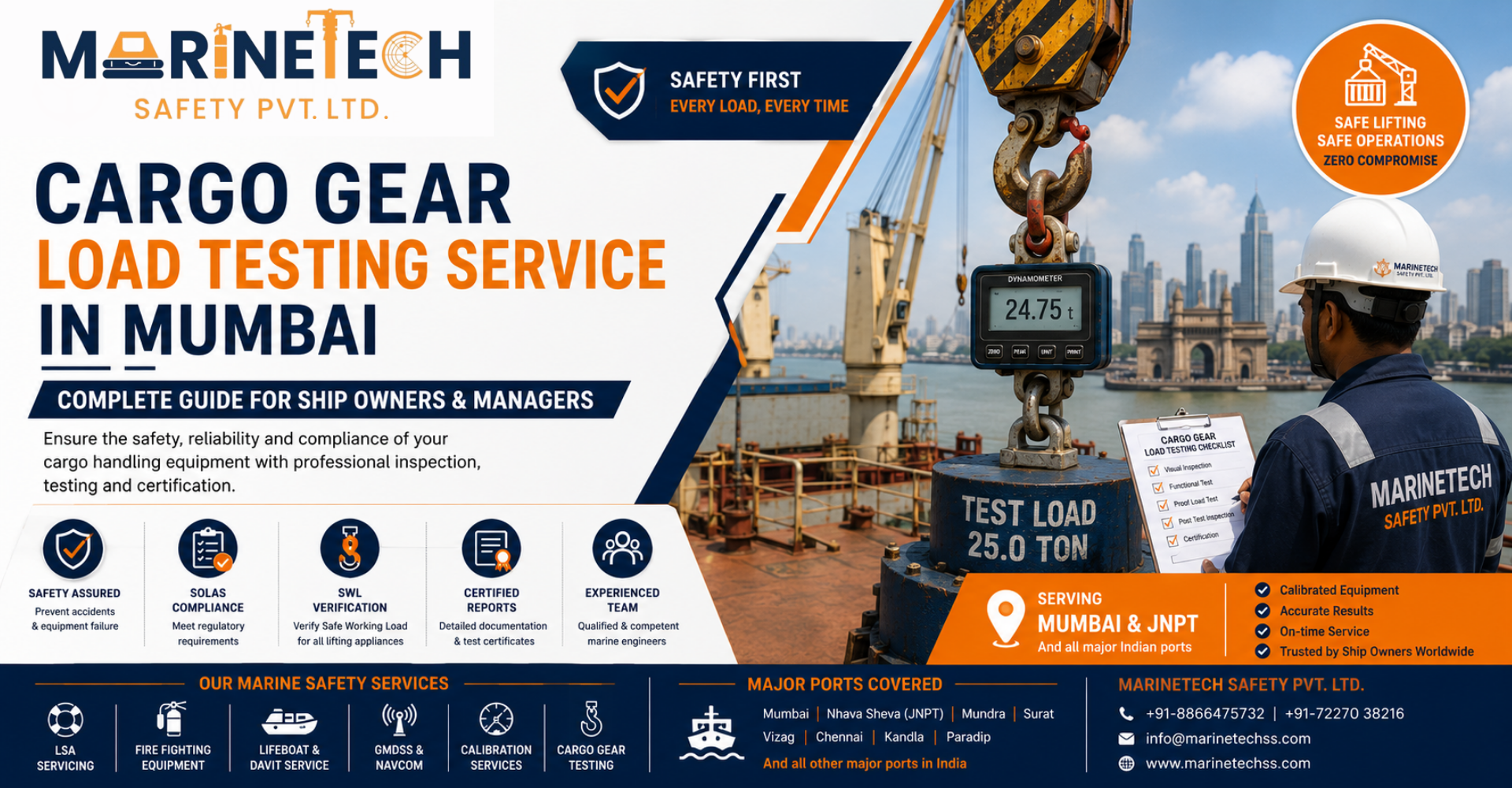
Cargo handling is one of the most important and safety-critical operations performed onboard commercial vessels.
Ship cranes, derricks, hooks,
shackles, wire ropes, slings and other lifting appliances are regularly exposed
to heavy loads, repeated operation and harsh marine conditions. A defect in any
load-bearing component can result in equipment failure, cargo damage, injury,
vessel delays and serious operational consequences.
For this reason, cargo gear load
testing and thorough examination are an important part of maintaining safe
lifting operations onboard ships.
For vessels calling at Mumbai
Port, Jawaharlal Nehru Port (JNPT/Nhava Sheva), and other Mumbai-area terminals,
ship owners and managers need a service provider that can coordinate testing
around vessel schedules and applicable statutory, class and flag requirements.
Marinetech Safety Pvt. Ltd.
provides cargo gear load testing, inspection and related marine safety services
for vessels operating through major Indian ports.
View
Marinetech Safety's Cargo Gear Load Testing Service
This guide explains the cargo gear
testing process, equipment covered, current SOLAS requirements, documentation
and how ship owners and managers can prepare a vessel for cargo gear testing in
Mumbai.
What Is Cargo Gear Load Testing?
Cargo gear load testing is a
controlled testing process used to verify the safe performance of a vessel's lifting
appliances and associated loose gear under the applicable test conditions.
Depending on the vessel and
equipment, the scope can include:
- Ship cranes
- Cargo cranes
- Deck cranes
- Derricks
- Cargo winches
- Hooks
- Shackles
- Wire ropes
- Slings
- Swivels
- Blocks
- Lifting beams
- Spreader beams
- Pad eyes
- Other lifting accessories
The objective is to verify that the
equipment is suitable for its intended operation and that the applicable Safe
Working Load (SWL) and certification requirements are properly addressed.
Cargo Gear Requirements Under SOLAS in 2026
A significant change for ship
owners and managers is the introduction of SOLAS regulation II-1/3-13,
which entered into force on 1 January 2026.
The regulation covers requirements
concerning the application, design, construction, operation, inspection,
testing and maintenance of applicable onboard lifting appliances and
anchor-handling winches. IMO also developed MSC.1/Circ.1663, Guidelines for
Lifting Appliances, to support implementation. (International
Maritime Organization)
Under SOLAS II-1/3-13, applicable
lifting appliances installed on or after 1 January 2026 are subject to load
testing and thorough examination after installation and before first use, and
after repairs, modifications or alterations of a major character. Existing
lifting appliances have transitional requirements linked to the first renewal
survey on or after 1 January 2026. (IMO)
The regulation also requires
applicable lifting appliances and associated loose gear to be operationally
tested, thoroughly examined, inspected, operated and maintained based on the
IMO guidelines. (IMO)
Important Note for Ship Managers
The exact testing interval, test
load and certification arrangements applicable to a particular vessel should be
confirmed against:
- SOLAS
- IMO MSC.1/Circ.1663
- Flag Administration requirements
- Classification Society/Recognized Organization
requirements
- Manufacturer instructions
- Applicable national requirements
- Vessel-specific documentation
Do not apply a generic test-load
percentage or testing interval without confirming the requirement applicable to
the specific lifting appliance.
Cargo Gear Load Testing Process in Mumbai
A professional cargo gear testing
program should be properly planned before the technician boards the vessel.
Step 1 – Pre-Service Documentation Review
The service provider reviews
available information such as:
- Vessel name
- IMO number
- Cargo Gear Register/equipment records
- Previous certificates
- Previous examination reports
- Equipment SWL
- Manufacturer information
- Maintenance records
- Class requirements
- Flag requirements
This helps establish the correct
testing scope.
Step 2 – Equipment Identification
Every item included in the testing
scope should be correctly identified.
Information can include:
- Equipment description
- Manufacturer
- Model
- Serial number
- SWL
- Location
- Equipment identification number
Correct identification is
particularly important for certificates and vessel records.
Step 3 – Visual and Thorough Examination
Before applying a test load, the
equipment should be examined for defects that could affect safe operation.
Checks may include:
- Structural condition
- Corrosion
- Cracks
- Deformation
- Weld condition
- Wire rope condition
- Hook condition
- Sheaves
- Shackles
- Hydraulic systems
- Brakes
- Fasteners
- Safety devices
Where necessary, appropriate NDT
methods may form part of the examination scope.
Step 4 – Functional Testing
Applicable operating functions can
be checked before the load test.
For a ship crane, this may include:
- Hoisting
- Lowering
- Slewing
- Luffing
- Brake operation
- Limit switches
- Emergency stop
- Control systems
- Hydraulic operation
Step 5 – Test Load Preparation
The appropriate testing method
depends on the equipment and applicable requirements.
Depending on the job, testing
equipment can include:
- Calibrated load cells
- Dynamometers
- Water bags
- Test weights
- Hydraulic testing equipment
- Suitable rigging arrangements
- Spreader beams where required
The test arrangement should be
selected based on the crane/derrick capacity, available space, vessel
configuration and applicable test procedure.
Step 6 – Load Testing
The lifting appliance is subjected
to the applicable test load under controlled conditions.
During the test, the service team
monitors for:
- Abnormal movement
- Structural deformation
- Brake slippage
- Hydraulic problems
- Unusual noise
- Excessive deflection
- Other unsafe conditions
The test should be carried out according
to the applicable regulatory, class, manufacturer and approved service
requirements.
Step 7 – Post-Test Examination
After the test load is removed, the
equipment is examined again.
The objective is to identify any:
- Permanent deformation
- Cracks
- Structural damage
- Hydraulic leakage
- Wire rope damage
- Brake problems
- Loose components
- Other abnormal conditions
Step 8 – Documentation and Certification
Following satisfactory completion,
the applicable documentation is prepared.
Depending on the scope, records can
include:
- Cargo gear load test certificate
- Thorough examination report
- Loose gear inspection records
- Test results
- SWL information
- Equipment identification
- Date of testing
- Next due date where applicable
The vessel's records/registers
should then be updated according to its management and regulatory requirements.
What Is SWL?
SWL stands for Safe Working Load.
It represents the maximum permitted
working load for a lifting appliance or item of lifting gear under specified
conditions.
Ship operators should ensure that:
- SWL markings are visible
- Equipment identification is correct
- Certificates match the equipment
- The lifting arrangement is suitable
- The operating load does not exceed the applicable
SWL
Under the new SOLAS framework,
applicable lifting appliances installed on or after 1 January 2026 are required
to have permanent SWL marking and documentary evidence for the SWL. (IMO)
How Often Should Cargo Gear Be Load Tested?
There is no single interval that
should automatically be applied to every vessel and every item of lifting gear.
Under the new SOLAS II-1/3-13
framework, applicable lifting appliances are subject to testing and thorough
examination requirements, including requirements associated with installation,
first use, major repairs/modifications and existing-appliance transition
arrangements. (IMO)
Other requirements may arise from:
- Flag Administration
- Classification Society
- ILO/national requirements
- Manufacturer instructions
- Vessel-specific procedures
- Cargo Gear Register requirements
Therefore, ship owners and managers
should establish the applicable testing schedule for each vessel rather than
relying on a generic internet checklist.
Cargo Gear Load Testing Checklist for Ship Owners & Managers
Before arranging cargo gear testing
in Mumbai, prepare:
- Vessel name
- IMO number
- ETA/ETD
- Port/terminal/berth
- Equipment list
- Crane/derrick SWL
- Previous certificates
- Previous examination reports
- Cargo Gear Register/equipment records
- Maintenance history
- Manufacturer details
- Class requirements
- Flag requirements
- Loose gear list
- Equipment identification numbers
- Required certificate format
- Required testing scope
Providing this information in
advance helps the service provider arrange suitable personnel, testing
equipment and documentation.
Why Mumbai Is an Important Location for Cargo Gear Testing
Mumbai is one of India's major
maritime and commercial centres, with extensive vessel, ship-management, repair
and marine-service activity.
Cargo gear testing may be required
during:
- Port calls
- Cargo operations
- Repairs
- Planned maintenance
- Survey preparation
- Class-related work
- Pre-inspection checks
- Dry-docking support
For ship managers, the main
challenge is often completing technical work within a vessel's limited port
stay.
This makes advance planning and
local technical support particularly valuable.
Cargo Gear Load Testing at Mumbai and JNPT
Vessels operating through the
Mumbai region may call at different terminals and port facilities.
Depending on vessel schedule and
access arrangements, cargo gear service requirements can arise around:
Mumbai | Nhava Sheva/JNPT | Navi Mumbai | Other Maharashtra maritime locations
Service availability, port access
and attendance arrangements should be confirmed based on the vessel's actual
location and schedule.
Why Choose Marinetech Safety Pvt. Ltd.?
Marinetech Safety Pvt. Ltd.
is an India-based marine safety company providing marine safety equipment service,
inspection, testing and supply for vessels and marine operators.
Our service portfolio includes
marine safety and technical support across areas such as:
- Cargo Gear Load Testing
- LSA servicing
- FFA servicing
- Liferaft servicing
- Fire extinguisher servicing
- GMDSS and NAVCOM services
- Marine calibration
- Lifeboat/rescue boat services
- Marine safety equipment supply
For cargo gear, our published
service scope includes load testing of cranes and derricks, lifting gear
inspection, proof load testing, dynamic load testing, certification, visual
inspection and NDT capabilities, subject to the specific equipment and
applicable requirements. (marinetechss.com)
Technical Approach
Our cargo gear testing process can
include:
Document Review ? Inspection ?
Functional Test ? Load Test ? Post-Test Examination ? Certification
The actual scope is determined
according to the vessel's requirements and applicable regulatory/class/flag
provisions.
Marinetech Cargo Gear Load Testing Service
For ship owners and managers
looking specifically for a cargo gear testing provider in Mumbai, our dedicated
service page provides the detailed service scope, equipment coverage and
enquiry route:
Cargo
Gear Load Testing Service in India – Marinetech Safety Pvt. Ltd.
Recommended internal-link anchor
texts for this article:
- Cargo Gear Load Testing Service in Mumbai
- Cargo Gear Load Testing Service in India
- Ship Crane Load Testing Service
- Cargo Gear Inspection and Certification
- Marine Lifting Equipment Testing
- Proof Load Testing Service
Use these naturally throughout the
article rather than repeatedly using the exact same anchor text. This creates a
stronger and more natural internal-link structure.
What Happens If Cargo Gear Fails
Testing?
If a crane, derrick or lifting
component does not meet the applicable acceptance criteria:
- Testing should be stopped or controlled as
appropriate.
- The defective component should be identified.
- The equipment should be prevented from unsafe use.
- The defect should be investigated.
- Repair or replacement should be carried out where
required.
- The equipment should be re-examined.
- Retesting should be performed where required.
- Documentation should be updated.
The objective is not simply to
obtain a certificate—it is to ensure that the equipment is suitable for safe
operation.
Frequently Asked Questions
1. What is cargo gear load testing?
Cargo gear load testing is a
controlled test of shipboard lifting appliances and/or loose gear to verify
their safe performance under the applicable test conditions.
2. Is cargo gear load testing required under SOLAS?
SOLAS II-1/3-13, effective from 1
January 2026, establishes requirements for applicable onboard lifting
appliances covering design, construction, operation, inspection, testing and
maintenance. (International
Maritime Organization)
3. What cargo gear can be tested in Mumbai?
Depending on the service scope,
testing and inspection can cover ship cranes, derricks, hooks, shackles, wire
ropes, slings, lifting beams, spreader beams and other applicable lifting
equipment.
4. Can cargo gear testing be performed during a Mumbai port stay?
Yes, testing can be planned during
a vessel's port stay subject to vessel schedule, terminal/port access, cargo
operations, safety arrangements and the applicable testing procedure.
5. What information should I provide when requesting a quotation?
Provide the vessel name, IMO
number, port, ETA/ETD, equipment list, SWL, previous certificates and required
testing/examination scope.
6. Does Marinetech provide cargo gear load testing in Mumbai?
Marinetech Safety Pvt. Ltd.
provides cargo gear load testing and inspection services for vessels calling
major Indian ports, subject to equipment, schedule, port access and applicable
certification requirements. (marinetechss.com)
7. Does cargo gear testing include loose lifting gear?
The scope can include applicable
loose gear such as hooks, shackles, slings, wire ropes and other lifting
accessories, depending on the vessel's equipment register and requested service
scope.
8. What regulations should ship managers consider?
Depending on the vessel and
equipment, relevant requirements can include SOLAS II-1/3-13, IMO
MSC.1/Circ.1663, Flag Administration requirements, Classification Society/RO
requirements, manufacturer instructions and applicable national regulations. (IMO)
Conclusion
Cargo Gear Load Testing in
Mumbai is an important part of maintaining safe and reliable cargo-handling
operations onboard vessels.
For ship owners and managers, the
goal should be more than obtaining a test certificate. A complete service
should consider:
- Equipment identification
- Document review
- Thorough examination
- Functional testing
- Appropriate load testing
- Post-test inspection
- SWL verification
- Proper documentation
- Applicable class and flag requirements
With SOLAS II-1/3-13 now in
force from 1 January 2026, ship managers should review the
lifting-appliance requirements applicable to their vessels and coordinate
testing and examination with their Flag Administration, Classification
Society/RO and competent service provider as appropriate. (International
Maritime Organization)
For vessels calling Mumbai,
JNPT/Nhava Sheva and other Indian ports, advance planning is essential to
complete cargo gear testing efficiently within the vessel's operational
schedule.
Marinetech Safety Pvt. Ltd.
supports ship owners, ship managers and vessel operators with cargo gear load
testing, inspection and marine safety equipment services across major Indian
ports.
Need Cargo Gear Load Testing in Mumbai?
Marinetech Safety Pvt. Ltd.
Phone: +91-8866475732 |
+91-72270 38216
Email: info@marinetechss.com
Request a Free Quote
For detailed service information:
Cargo
Gear Load Testing Service – Marinetech Safety Pvt. Ltd.
Related Blogs
1. Cargo Gear Load Testing Service in Mundra – Complete Guide for Ship Owners & Managers
This guide covers cargo gear
testing, ship cranes, derricks, loose lifting gear, inspection procedures and
testing preparation for vessels calling Mundra.
Read
the Mundra Cargo Gear Load Testing Guide
2. Cargo Gear Load Testing in India: Requirements, Process & How Marinetech Helps
Learn about cargo gear testing
requirements, inspection procedures and cargo gear services across Indian
ports.
Read
the Cargo Gear Load Testing India Guide
3. Why Cargo Gear Load Testing Is Mandatory Under SOLAS and ILO Regulations
Understand the regulatory framework
surrounding cargo gear inspection, load testing and thorough examination.
Read
the SOLAS & ILO Cargo Gear Guide