Blog Post
Annual vs 5-Yearly Lifeboat Inspection: Exactly What Gets Checked at Each Interval
Posted By: Harsh Bamnolia
Posted On : 16-Feb-2026
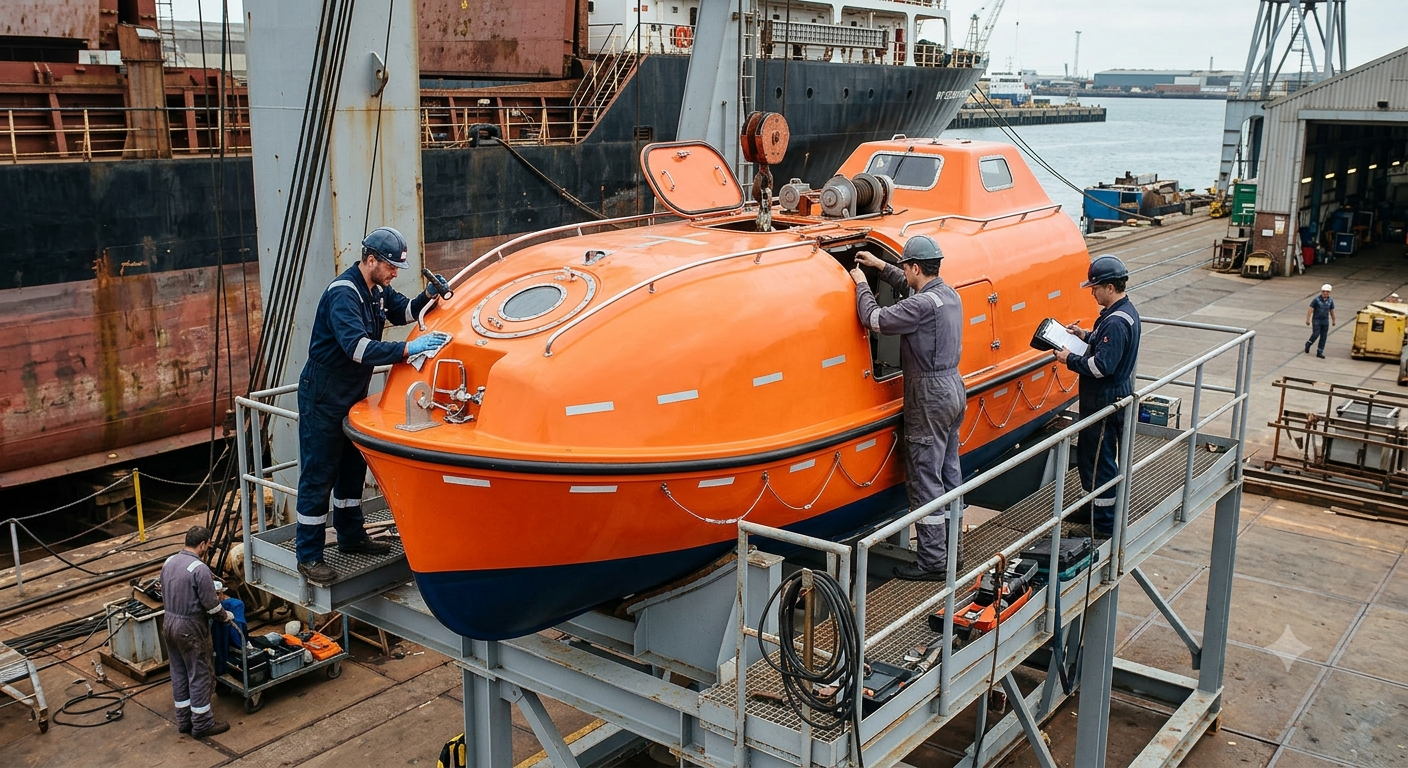
Annual vs 5-Yearly Lifeboat Inspection: Exactly What Gets Checked at Each Interval
One of the most common questions ship managers and superintendents ask before scheduling lifeboat servicing is this: what is the actual difference between the annual inspection and the five-yearly overhaul — and what does each one involve?
It is not a trivial question. Confusing the two, or assuming one covers what the other does, leads to gaps in compliance that PSC officers are specifically trained to find. In 2026, with IMO Resolution MSC.559(108) now fully in force, the requirements at both intervals have become more stringent and more clearly defined than ever before.
This guide breaks down exactly what SOLAS requires at each inspection interval, what gets physically checked, who is authorised to conduct each inspection, and what documentation must be produced when the work is complete.
The Legal Basis: SOLAS Regulation III/20 and MSC.402(96)
Both the annual inspection and the five-yearly overhaul are governed by SOLAS Regulation III/20, which sets out the general requirements for operational readiness, maintenance, and inspections of life-saving appliances. The practical framework for how these inspections must be conducted is detailed in IMO Resolution MSC.402(96), adopted in 2016 and effective from 2020 — with further enhancements introduced by MSC.559(108) in 2024.
The key principle underlying both intervals is straightforward: every lifeboat, launching appliance, and release gear must be maintained in a state of continuous readiness. A lifeboat that looks presentable but has not been properly serviced is not compliant — and a PSC officer reviewing service records will know the difference.
Who Is Authorised to Conduct Lifeboat Inspections?
Before getting into what gets checked at each interval, it is essential to be clear on who is legally permitted to carry out these inspections — because this is where many vessels fall short.
Onboard Maintenance
Weekly and monthly maintenance tasks may be performed by the ship's crew, under the supervision of the officer responsible for the lifeboat. These tasks must be recorded in the ship's maintenance log and reviewed by the master.
Annual Inspection
The annual thorough examination must be conducted by a person who satisfies both of the following conditions:
- Certified and trained by the lifeboat or davit manufacturer, or their officially authorised representative
- Recognised by a classification society or the flag state administration
This means a qualified engineer from a DG Shipping approved, class-certified marine service company — not the ship's crew acting alone, and not an uncertified local technician. IMO MSC.559(108) specifically reinforces this, closing the loophole that previously existed in some regions.
Five-Yearly Overhaul
The five-yearly service requires the same authorisation as the annual inspection, but must additionally be carried out at an approved service station or workshop that has the infrastructure, tooling, and certification to conduct load tests, structural inspections, and full equipment overhauls.
The Annual Lifeboat Inspection: Full Checklist
The annual thorough examination is a comprehensive inspection and operational test of the lifeboat, its launching appliance, and its release gear. Here is exactly what must be covered:
Hull and Structure
- Visual inspection of the entire hull exterior for cracks, osmosis, delamination, corrosion, or impact damage
- Inspection of all internal structural elements — thwarts, bulkheads, floor boards, and frames
- Check of all watertight integrity features including hatches, closing devices, and seals
- Inspection of the buoyancy material to confirm it is intact, dry, and uncontaminated
- Verification that the lifeboat's approval plate is in place, legible, and matches the current configuration
Engine and Fuel System
- Full engine test — the engine must be started and run for a minimum period under load
- Inspection of the fuel system including tank, lines, filters, and fuel level
- Check of the cooling water system and exhaust
- Inspection of the propeller, shaft, and stern tube
- Test of the engine controls from the coxswain's position
- Inspection of the battery and starting system (both primary and emergency starting)
- Verification that the engine air intake system is functioning correctly
On-Load Release Gear
The on-load release gear is one of the most critical — and most frequently deficient — components of any lifeboat system. The annual inspection must include:
- Visual inspection of the hook, operating mechanism, and hydrostatic interlock
- Operational test of the hook opening and resetting sequence
- Verification that the safety device (secondary lock or fall preventer device) is correctly engaged
- Inspection of all connecting lines, shackles, and securing points
- Check of all markings and instructions on the release gear
- Review of the hook's history — is it within its replacement interval? Has it been subject to any modification?
Note: Following a series of fatal lifeboat accidents caused by accidental hook release, IMO has tightened requirements for on-load hook inspection significantly. PSC officers are specifically briefed to inspect hook condition and test records.
Davit and Winch System
- Full visual inspection of the davit structure for cracks, corrosion, distortion, or damage
- Inspection of all sheaves, blocks, and fairleads — bearings must turn freely with no excessive play
- Inspection of the winch brake system — visual check and manual brake test
- Inspection of the winch clutch and operating controls
- Inspection of all wire guides, rollers, and associated fittings
- Check that limit switches and safety devices are functioning correctly
- Inspection of the davit foundation and securing arrangements
Fall Wire and Fall Preventer Device (FPD)
- Visual inspection of the full length of the fall wire for broken wires, kinks, corrosion, or wear
- Verification of the fall wire's age against its installation date — wires must be renewed every 5 years
- Inspection of the thimbles, swages, and end terminations
- Inspection of the Fall Preventer Device (FPD) — condition, correct fitting, and security
- Verification that the FPD renewal date is within its 5-year replacement interval
- Check that the 6-monthly senior officer inspection of the FPD has been completed and recorded
Survival Equipment and Provisions
All equipment listed in SOLAS Regulation III/38 must be physically present, within its service life, and in working condition:
- All pyrotechnics (rocket parachute flares, red hand flares, smoke signals) — check expiry dates
- Portable VHF sets — test operation and battery charge
- SART — verify battery and hydrostatic release where applicable
- First aid kit — check contents against SOLAS Annex list and expiry of perishable items
- Thermal protective aids — check quantity matches the lifeboat's approved capacity
- Fresh water and food rations — check quantity and expiry dates
- Compass, radar reflector, signal mirror — check condition and presence
- All tools and spare parts — verify against the required list
Documentation and Records
- Review of the onboard maintenance log — all weekly and monthly entries must be present and signed
- Review of previous inspection and servicing records
- Confirmation that the vessel's safety management system (SMS) reflects the current lifeboat arrangement
- Issue of a formal inspection report by the authorised service provider, signed and dated
- Update of the lifeboat's individual maintenance record card
The Five-Yearly Lifeboat Overhaul: What Goes Beyond the Annual
The five-yearly service includes everything in the annual inspection — but goes considerably further. Think of the annual as a thorough examination and the five-yearly as a complete rebuild and certification.
Full Structural Overhaul
- Strip-down of all internal fittings and equipment
- Thorough structural inspection by a qualified surveyor — including tapping test of all GRP panels to identify delamination or moisture ingress that is not visible to the eye
- Repair of any structural defects found — using class-approved materials and repair procedures
- Renewal of all corroded, worn, or damaged fittings, bolts, and securing hardware
- Full exterior repaint of the lifeboat in SOLAS-compliant orange paint, using an approved paint system
Dynamic Winch Brake Test
This is the single most important test in the five-yearly overhaul and cannot be performed during an annual inspection. The dynamic winch brake test involves:
- Loading the lifeboat with water bags or approved test weights to 1.1 times the maximum working load of the winch
- Raising the loaded lifeboat and then releasing the winch brake dynamically while the boat descends
- The brake must bring the loaded lifeboat to a controlled stop within the limits specified by the manufacturer
- If the brake fails, the winch must be overhauled or replaced before the lifeboat returns to service
- The test must be witnessed, documented, and certified by the authorised service provider
Launching Appliance Overhaul
- Complete overhaul of the entire davit structure — all pivot points, lubrication points, and wear surfaces
- Overhaul of all sheaves and blocks — replacement of worn sheaves, renewal of bearings
- Inspection and overhaul of the winch — internal inspection, gear inspection, brake lining renewal if required
- Replacement of all hydraulic seals and hoses where hydraulic systems are fitted
- Structural load test of the davit foundation if required by the class surveyor
Fall Wire Renewal
The five-year interval for the five-yearly overhaul aligns with the mandatory renewal interval for fall wires. All fall wires must be renewed at the five-yearly service unless they have been renewed more recently. This includes:
- Full removal and disposal of all existing wire falls
- Supply and fitting of new wire falls of the correct specification, diameter, and grade
- Correct termination of all wire ends — thimbles, swages, or wedge sockets as per the davit manufacturer's specification
- Documentation of wire specification, break load, and installation date
On-Load Release Gear Overhaul
At the five-yearly service, the on-load release gear undergoes a full overhaul rather than just an inspection:
- Complete disassembly and inspection of all components
- Replacement of all seals, springs, and wearing parts
- Repainting or re-coating of all external surfaces
- Full function test after reassembly
- In many cases, replacement of the entire hook unit — depending on manufacturer guidance and the age of the existing hook
Ventilation System Assessment (MSC.559(108))
From 2024 onwards, the five-yearly service must include an assessment of the lifeboat's ventilation system against the new requirements of IMO MSC.559(108):
- Verification that ventilation capacity meets the minimum 5 m³ per hour per person standard
- Test of ventilation controls from inside the lifeboat
- Assessment of watertight integrity of the ventilation system under simulated submerged conditions
- Where the existing system does not meet the standard, a remediation plan must be agreed with the class society
Side-by-Side Comparison: Annual vs Five-Yearly
| Inspection Element | Annual | Five-Yearly |
|---|---|---|
| Hull visual inspection | Visual Inspection | Detailed Inspection |
| Structural tap test (GRP) | If required (suspected damage) | Comprehensive tap test |
| Engine test and fuel check | Functional test | Complete overhaul and servicing |
| On-load release gear test | Operational test | Complete overhaul and load test |
| Davit and winch inspection | Inspection and lubrication | Complete overhaul |
| Dynamic winch brake test | Not required | Mandatory |
| Fall wire inspection | Inspect for wear/corrosion | Renewal required (or as per manufacturer's interval) |
| FPD inspection | Visual and operational inspection | Renewal/major servicing if required |
| Equipment and provisions check | Verify inventory and expiry dates | Complete replacement of expired items and full inventory check |
| Ventilation assessment (MSC.559) | Compliance check | Full assessment and verification |
| Full exterior repaint | Not normally required | If deterioration/corrosion requires refurbishment |
| Launching appliance overhaul | Routine maintenance only | Complete overhaul |
| Formal certification issued | Annual service certificate | Five-yearly service certificate and endorsement |
| Must be done at approved workshop | Not always (can often be onboard by an authorised service provider) | Required, where overhaul is required by OEM/authorised workshop |
What Documentation Must Be Produced After Each Inspection
After both the annual inspection and the five-yearly overhaul, the authorised service provider must produce:
- Formal inspection report — signed and dated by the authorised engineer, confirming the scope of work and the condition of all components inspected
- Statement of fitness — a declaration that the lifeboat arrangement is fit for purpose following the inspection
- Updated maintenance record card — individual records for each lifeboat on the vessel
- Certificate of completion — for the five-yearly service, a certificate should be issued and retained on board
These documents must be kept on board and made available to PSC officers on demand. An incomplete service record — or one that does not clearly identify the authorising engineer and their qualifications — is treated as a deficiency finding.
Frequently Asked Questions
Can the ship's crew conduct the annual lifeboat inspection? No. The annual thorough examination must be conducted by a person certified and trained by the manufacturer, and recognised by a classification society or flag state. The crew's role is to carry out weekly and monthly onboard maintenance and to keep accurate records — not to perform the annual thorough examination.
What happens if the winch brake fails the dynamic test? The lifeboat is taken out of service until the winch is overhauled or replaced and the test is repeated successfully. The vessel cannot sail with a non-compliant lifeboat unless a flag state exemption or a written dispensation from the class society is obtained.
How long does the annual lifeboat inspection typically take? For a standard totally enclosed lifeboat with a conventional gravity davit, an annual thorough examination typically takes 4 to 8 hours. Complex arrangements, free-fall systems, or boats requiring significant repairs will take longer.
Can the annual inspection and five-yearly overhaul be done at the same time? Yes — if a vessel reaches its five-yearly interval, the five-yearly overhaul satisfies the annual inspection requirement for that year. You do not need to do both separately.
How do we know if our service provider is authorised? Ask for their OEM authorisation certificate for the make and model of your lifeboat, and their class society approval certificate. A legitimate DG Shipping and class-approved provider will produce these documents without hesitation.
Do liferafts follow the same inspection schedule as lifeboats? No. Liferafts follow a separate annual servicing schedule governed by SOLAS Regulation III/20.8 and must be serviced at an approved liferaft service station — not the same as lifeboat servicing, though many authorised companies offer both.
Book Your Annual or Five-Yearly Lifeboat Inspection in India
Marinetech Safety Pvt. Ltd. is DG Shipping approved and authorised by the major lifeboat manufacturers. We are recognised by ABS, DNV GL, Bureau Veritas, Lloyd's Register, IRS, NKK, RINA, CCS, and Korean Register. Our engineers conduct annual lifeboat inspections and five-yearly overhauls across all major Indian ports — Mumbai, JNPT, Kandla, Mundra, Hazira, Dahej, Chennai, Vizag, Cochin, Kolkata, and more.